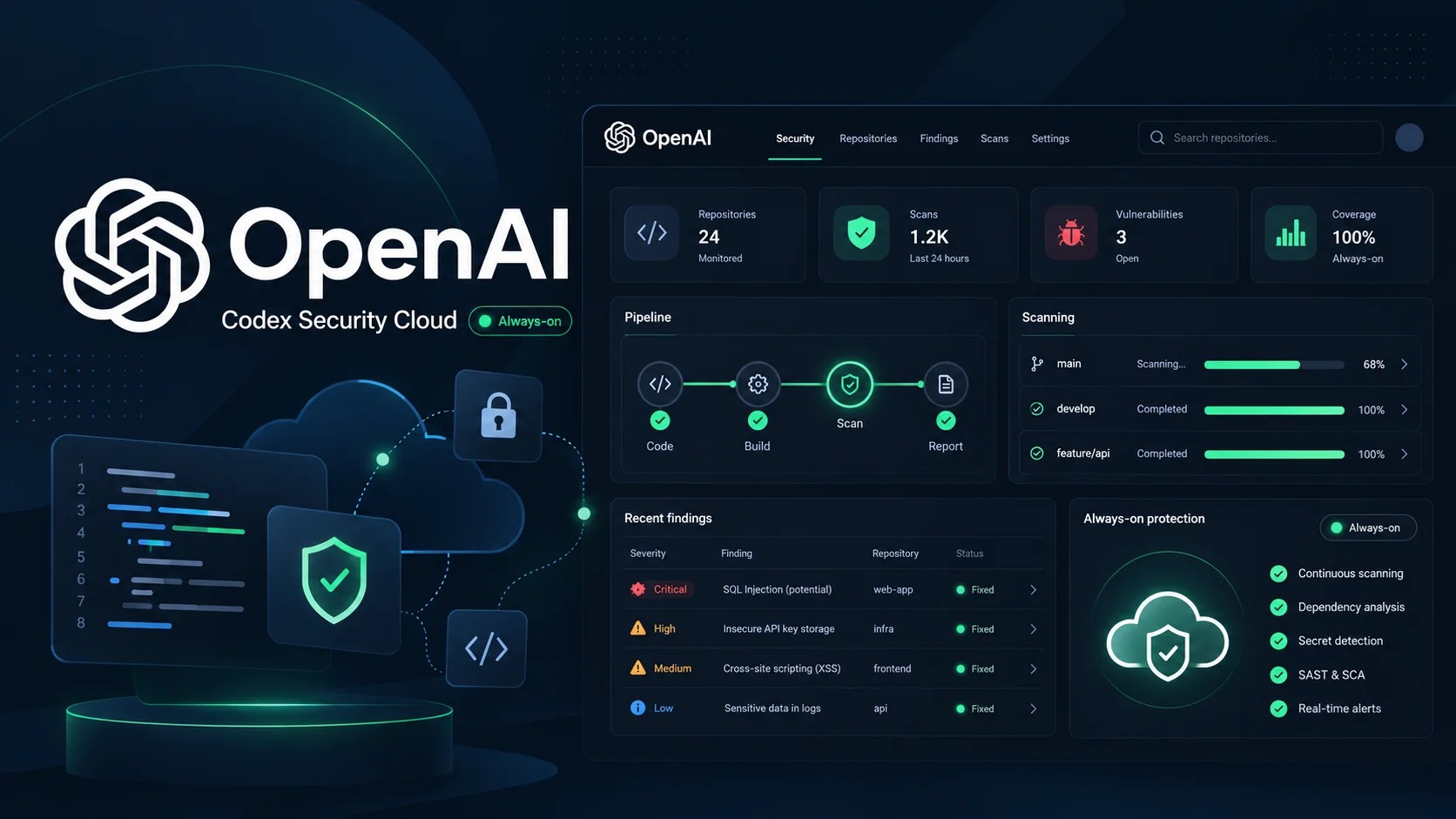
OpenAI has introduced an upgraded version of its Codex platform, now featuring the Codex Security Cloud. This service offers continuous application security by scanning GitHub repositories, monitoring new code commits, and addressing vulnerabilities. Designed to operate seamlessly even when developers are offline, Codex Security Cloud integrates comprehensive vulnerability analysis into everyday workflows.
Advanced Features of Codex Security Cloud
The latest iteration of Codex Security Cloud incorporates cyber-capable models from Daybreak Blue, enhancing its capacity to manage security tasks. By default, it can scan entire GitHub repositories, continuously review commits, and suggest fixes for developer review. This upgrade transforms Codex from a static code scanner into a dynamic security tool, akin to a security researcher, capable of understanding codebases, conducting realistic attack path analyses, and validating potential vulnerabilities in a controlled environment.
Accessible via a plugin on both desktop and web versions of Codex, the Security Cloud is currently available as a research preview to ChatGPT Pro, Business, Enterprise, and Edu users. Teams can connect their GitHub repositories, select suitable cloud environments, and choose between comprehensive scans or continuous monitoring of new commits. Initial scans develop a threat model specific to the project, while subsequent scans focus on newly added code.
Daybreak Blue Integration and Benefits
Daybreak Blue’s integration into Codex Security Cloud brings authorized defensive capabilities, including vulnerability discovery, triage, and secure code review. However, this access is exclusive to the Security Cloud and is not available through other Codex Security products or APIs. By pre-processing findings to eliminate duplicates, Codex Security Cloud aims to reduce alert fatigue, allowing security teams to prioritize significant issues over repeated alerts.
The cloud-based execution facilitates scheduled assessments and individual commit checks independent of local hardware, enhancing efficiency in identifying vulnerabilities. OpenAI stresses the importance of governance, recommending that repository permissions adhere to the principle of least privilege and that generated patches undergo thorough developer review.
Implications for Security Teams
Codex Security Cloud represents a significant evolution in security scanning, offering a persistent defensive resource for development teams. By providing repository-wide insights, continuous monitoring, and validation of findings, OpenAI positions Codex as an essential assistant in defensive engineering. Its success will depend on accurately identifying vulnerabilities without generating excessive noise, and on teams utilizing its automated suggestions as a tool for informed decision-making rather than as a substitute for human oversight.
As OpenAI continues to refine Codex Security Cloud, its potential impact on reducing the time and resources spent on vulnerability management could be substantial. By integrating these advanced features, OpenAI enhances the ability of security teams to respond swiftly and effectively to emerging threats.