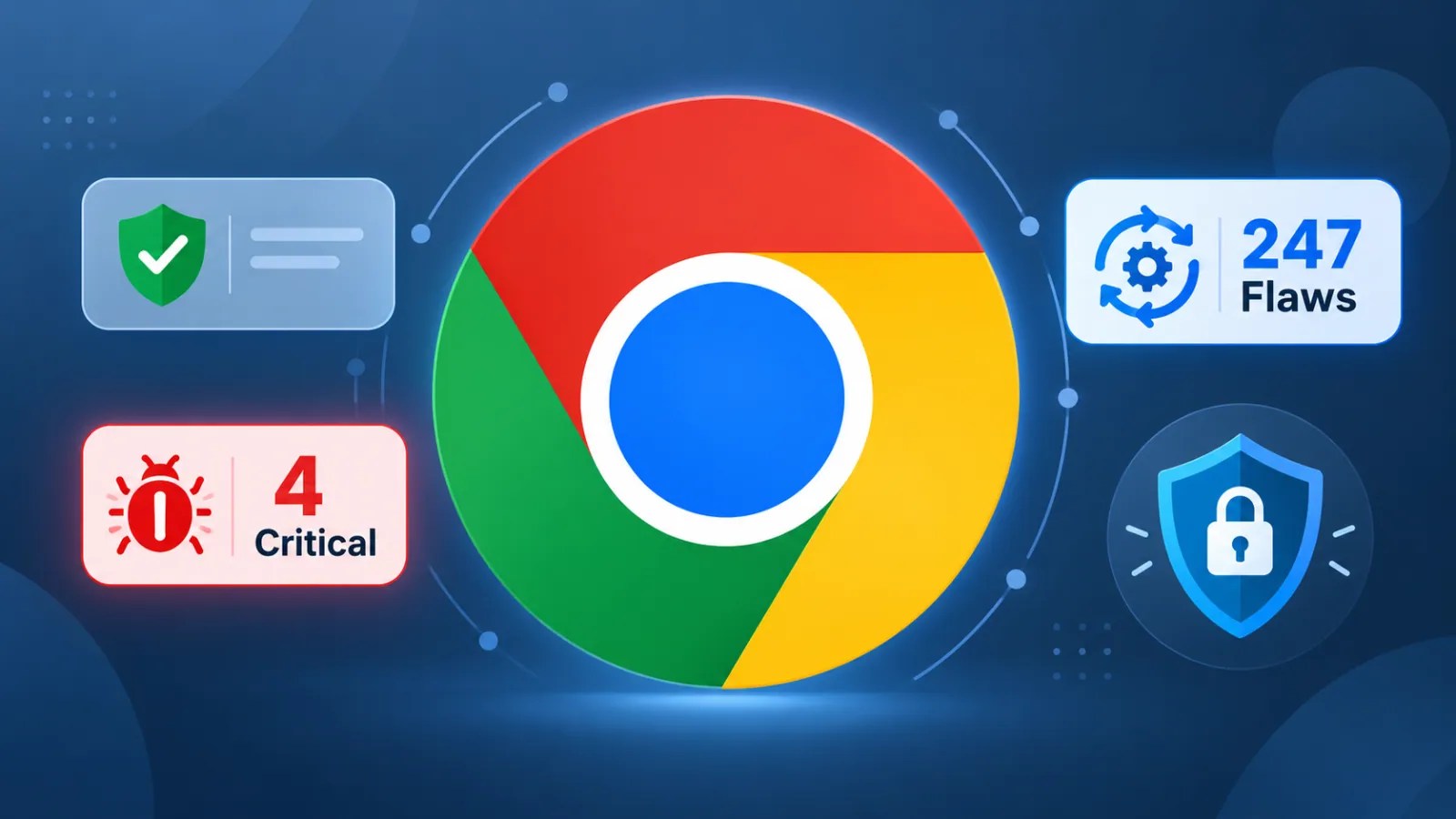
On October 6, 2026, Google launched a significant security update for its Chrome browser, addressing 247 vulnerabilities. This update corrects several memory-safety flaws recognized across Windows, Mac, and Linux platforms. Among these vulnerabilities, four are critical due to their potential to allow unintended code execution.
Details of the Critical Vulnerabilities
The new Chrome versions, 155.0.8059.39/.40 for Windows and Mac, and 155.0.8059.39 for Linux, tackle these security threats. Google has identified these critical issues as use-after-free vulnerabilities, but specifics on exploitation methods or confirmation of arbitrary code execution remain undisclosed.
Key vulnerabilities include CVE-2026-106382, impacting Chromecast, reported on July 15, 2026, and CVE-2026-106197, affecting the Browser component, disclosed by Xinyang Ge on September 11, 2026. Additionally, CVE-2026-106358 impacts Navigation, and CVE-2026-106347 affects Track, both reported in late September 2026.
AI’s Role in Vulnerability Discovery
Google acknowledges the contributions of Xinyang Ge of Anthropic, assisted by AI technology, Claude, in identifying several of these vulnerabilities. This highlights the increasing role of artificial intelligence in enhancing cybersecurity research processes.
The shared weakness among these critical entries is the use-after-free category, which involves software accessing memory that has already been released. However, Google’s advisory does not clarify whether these vulnerabilities could lead to sandbox escapes or require specific user interactions for exploitation.
Broader Security Enhancements
Beyond the critical flaws, the update also mitigates high-severity vulnerabilities across various components, including graphics, media, browser interfaces, and security controls. Notable issues addressed include CVE-2026-102322, related to incorrect authorization in SiteIsolation, and CVE-2026-106239, which involves an integer overflow in WebGL.
Additionally, the V8 engine received patches for race conditions, type confusion, and use-after-free vulnerabilities. Other fixed components are WebRTC, WebAudio, PDF, Storage, Autofill, Fonts, and DevTools. Medium- and low-severity issues addressed include information leaks, missing authorization, misleading interfaces, and improper resource handling.
Security Testing and Future Outlook
Google emphasizes the role of various security tools such as AddressSanitizer, MemorySanitizer, and libFuzzer in detecting these bugs as part of their extensive security testing efforts. Access to detailed information about these vulnerabilities will remain limited until most users have updated their systems to the latest version.
For organizations monitoring remediation, the newly announced version numbers serve as a reference to track deployment progress. The staggered update rollout means availability may vary across systems. Security teams are advised to differentiate between confirmed fixes and unverified exploit claims when communicating risks to users and administrators.