Skip to content
  • Home
  • Cyber Map
  • About Us – Contact
  • Disclaimer
  • Terms and Rules
  • Privacy Policy
Cyber Web Spider Blog – News

Cyber Web Spider Blog – News

Globe Threat Map provides a real-time, interactive 3D visualization of global cyber threats. Monitor DDoS attacks, malware, and hacking attempts with geo-located arcs on a rotating globe. Stay informed with live logs and archive stats.

  • Home
  • Cyber Map
  • Cyber Security News
  • Security Week News
  • The Hacker News
  • How To?
  • Toggle search form
AI Dominates Ad Fraud Schemes as New Threats Emerge

AI Dominates Ad Fraud Schemes as New Threats Emerge

Posted on October 29, 2026 By CWS

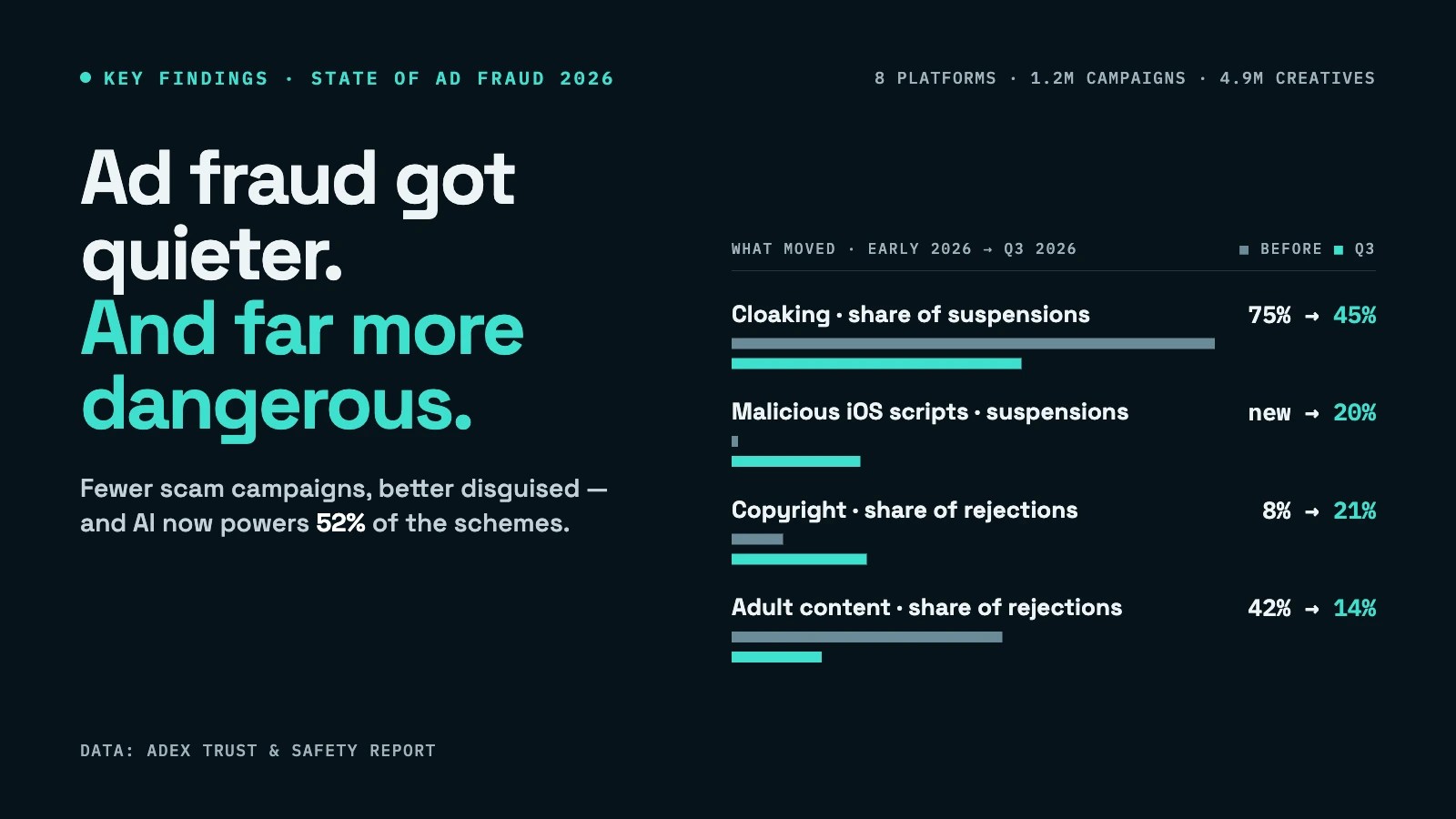
The ad fraud landscape underwent significant changes in 2026, as highlighted by the ADEX Trust & Safety Report. This comprehensive analysis covers moderation and verification data from the first nine months of the year, evaluating 1.2 million ad campaigns across eight platforms.

AI’s Pervasive Role in Fraud

AI has become a major player in ad fraud, with 52% of schemes involving AI-generated or AI-assisted elements. A significant 64% of these schemes utilized bots that mimic human behavior, while 53% employed cloned brands and fake endorsements. The use of deepfakes, although less prevalent, was still evident in 11% of AI-related fraud attempts.

A notable trend is the rise of infected domains as the leading cause of ad rejections from the second quarter onward, accounting for roughly a third of all rejections. Additionally, scareware tactics like fake prize notifications became a distinct category, making up 6% of rejections in the third quarter.

Emerging Threats in Ad Fraud

While cloaking remains a predominant reason for suspensions, the emergence of malicious iOS scripts and messenger-based phishing presents new challenges. These phishing schemes exploit services like WhatsApp and Telegram, leveraging advanced language models to conduct conversations across multiple languages.

The ADEX report notes a decline in the sheer number of rejected campaigns, which fell by about a third after the first quarter, indicating a shift towards fewer but more sophisticated scams. Sergey Martianov, CPO at ADEX, emphasizes the damage potential of well-crafted scams over numerous low-quality attempts.

High-Risk Regions and Industry Insights

Tier-1 markets such as the US, UK, and Germany consistently faced high rejection rates. Other regions, including South Asia and Turkey, also experienced elevated risks during specific periods.

The report aligns its findings with broader industry data, such as the Thales 2026 Bad Bot Report, which revealed that bots constituted over 53% of internet traffic. Additionally, HUMAN reported a 187% increase in AI-driven traffic in 2025.

Looking Ahead: The 2027 Outlook

ADEX forecasts several trends for 2027, including ads tailored for AI agents and increased agent traffic that blurs the lines between bots and genuine users. The report anticipates a rise in fraud operations entirely orchestrated by AI, further exploitation of hacked domains, and a shift of scareware tactics to connected TV and AI assistant platforms.

These insights, along with the full dataset and methodology, are detailed in the complete ADEX report, offering a comprehensive view of the evolving ad fraud landscape.

Cyber Security News Tags:2026 trends, ad fraud, ADEX report, AI, bot traffic, Cybersecurity, Deepfakes, digital advertising, malicious scripts, Phishing

Post navigation

Previous Post: BAE Systems Restores Bankruptcy Courts Without Data Loss

Related Posts

Russian Hacker Targets Global Firms and Ukrainian Sites Russian Hacker Targets Global Firms and Ukrainian Sites Cyber Security News
Phishing Attacks Exploit GitHub and Jira Notifications Phishing Attacks Exploit GitHub and Jira Notifications Cyber Security News
WordPress Plugin Vulnerability Let Attackers Bypass Authentication via Social Login WordPress Plugin Vulnerability Let Attackers Bypass Authentication via Social Login Cyber Security News
ClickFix Attack Uses DNS Hijacking to Deploy Malware ClickFix Attack Uses DNS Hijacking to Deploy Malware Cyber Security News
Critical RCE Vulnerability in Hugging Face’s LeRobot Critical RCE Vulnerability in Hugging Face’s LeRobot Cyber Security News
New Linux Malware Poses Threat to Software Developers New Linux Malware Poses Threat to Software Developers Cyber Security News

Categories

  • Cyber Security News
  • How To?
  • Security Week News
  • The Hacker News

Recent Posts

  • AI Dominates Ad Fraud Schemes as New Threats Emerge
  • BAE Systems Restores Bankruptcy Courts Without Data Loss
  • GitHub Unveils npm Firewall to Prevent Malicious Installs
  • Critical Android ‘SMS of Death’ Flaw Exposed
  • US Election Security: Voting Machines and AI Threats

Pages

  • About Us – Contact
  • Disclaimer
  • Privacy Policy
  • Terms and Rules

Archives

  • October 2026
  • September 2026
  • August 2026
  • July 2026
  • June 2026
  • May 2026
  • April 2026
  • March 2026
  • February 2026
  • January 2026
  • December 2025
  • November 2025
  • October 2025
  • September 2025
  • August 2025
  • July 2025
  • June 2025
  • May 2025

Recent Posts

  • AI Dominates Ad Fraud Schemes as New Threats Emerge
  • BAE Systems Restores Bankruptcy Courts Without Data Loss
  • GitHub Unveils npm Firewall to Prevent Malicious Installs
  • Critical Android ‘SMS of Death’ Flaw Exposed
  • US Election Security: Voting Machines and AI Threats

Pages

  • About Us – Contact
  • Disclaimer
  • Privacy Policy
  • Terms and Rules

Categories

  • Cyber Security News
  • How To?
  • Security Week News
  • The Hacker News

Copyright © 2026 Cyber Web Spider Blog – News.

Powered by PressBook Masonry Dark