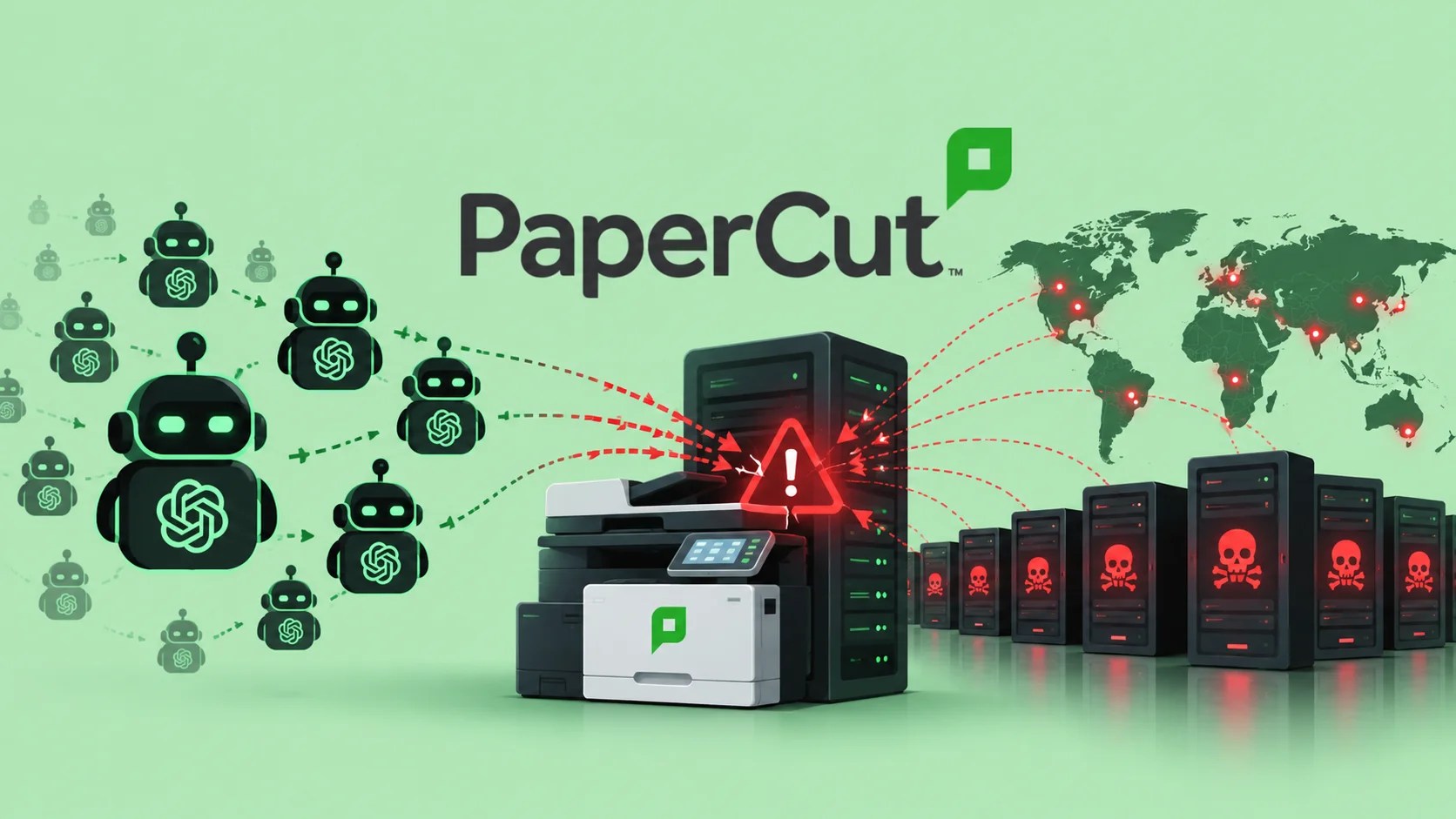
A significant cyberattack orchestrated by a Russian-speaking hacker group has leveraged artificial intelligence on an extensive scale. Utilizing numerous autonomous AI agents, the group targeted critical weaknesses in the PaperCut NG/MF print management software. This resulted in the compromise of 440 servers across 395 organizations situated in 48 countries.
Global Detection and Attack Methods
Security specialists at GreyNoise detected this campaign through their Global Observation Grid, a sophisticated network of sensors that identifies live attack activities on monitored infrastructure. The attackers operated from IP address 45.142.193.132, a source flagged by GreyNoise since early July 2026 for probing internet-exposed systems from several vendors including Palo Alto, Ubiquiti, Citrix, SonicWall, and Proxmox VE.
On August 31, 2026, the focus shifted towards exploiting two specific PaperCut vulnerabilities: CVE-2026-81578 and CVE-2026-82078. These include an authentication bypass and an unsafe reflection remote code execution flaw, respectively.
Exploitation of PaperCut Flaws
PaperCut NG/MF, a commonly used self-hosted print management application, runs with SYSTEM-level privileges on Windows and connects directly to Active Directory, presenting a valuable target for attackers aiming for lateral movement within enterprise networks. The attacker initially created a private lab environment mimicking a vulnerable PaperCut setup to develop and test their exploits before executing them.
The threat actor compiled target lists using Netlas.io through a compromised API key. Once remote code execution and credential harvesting were verified, they deployed hundreds of AI agents powered by OpenAI’s Codex and a DeepSeek model, in conjunction with public offensive tools like Mimikatz, Certipy, Rubeus, and Impacket. The operation was swift, taking under four hours to execute code on a real target, with domain administrator access achieved two hours later.
Impact and Future Implications
The AI-driven campaign rapidly compromised 11 organizations in just 26 seconds and, in one instance, breached a U.S. high school network, achieving full domain admin access in seven minutes. Despite the scale, only 12 out of the 440 compromised instances confirmed domain administrator access, with escalation times varying from five to 144 minutes.
GreyNoise identified three main attack vectors: utilizing LSASS memory and registry secrets for pass-the-hash attacks, exploiting unpatched “noPac” vulnerabilities CVE-2021-42278 and CVE-2021-42287, and adding rogue accounts to Domain Admins when PaperCut was run on a domain controller. In successful cases, DCSync operations were used to exfiltrate the NTDS.DIT credential database.
Interestingly, the attacker’s AI agents were programmed to avoid 28 countries, including Russia, China, and Iran. However, some victims were still found in these regions, indicating possible deviations by the autonomous agents. In one instance, Cloudflare’s Web Application Firewall effectively blocked an exploitation attempt, highlighting the importance of robust security measures.
The United States was most affected, with 98 victim organizations, followed by the UK, France, and Spain. Educational institutions represented a significant portion of affected systems, likely due to PaperCut’s popularity in this sector. The ultimate intent of the attackers remains uncertain, but the potential for selling access to ransomware groups or pursing direct extortion is high. GreyNoise continues to work with incident response teams to alert affected organizations and shares indicators of compromise via their public GitHub repository.