In a significant shift in cybercrime tactics, hackers are now leveraging AI-generated PowerShell scripts to infiltrate Active Directory (AD) environments. This trend marks a departure from traditional hacking tools towards bespoke, AI-driven malware, as reported by security analysts at Huntress. The team recently uncovered and analyzed a script, Untitled1.ps1, used in an attack on June 3, 2026.
Understanding Vibe Coding and Its Implications
Vibe coding involves generating software by iteratively guiding an AI using natural language prompts instead of manually coding. This method has significantly lowered the entry barrier for cybercriminals, allowing even less skilled individuals to create customized attack tools that evade conventional signature-based detection systems.
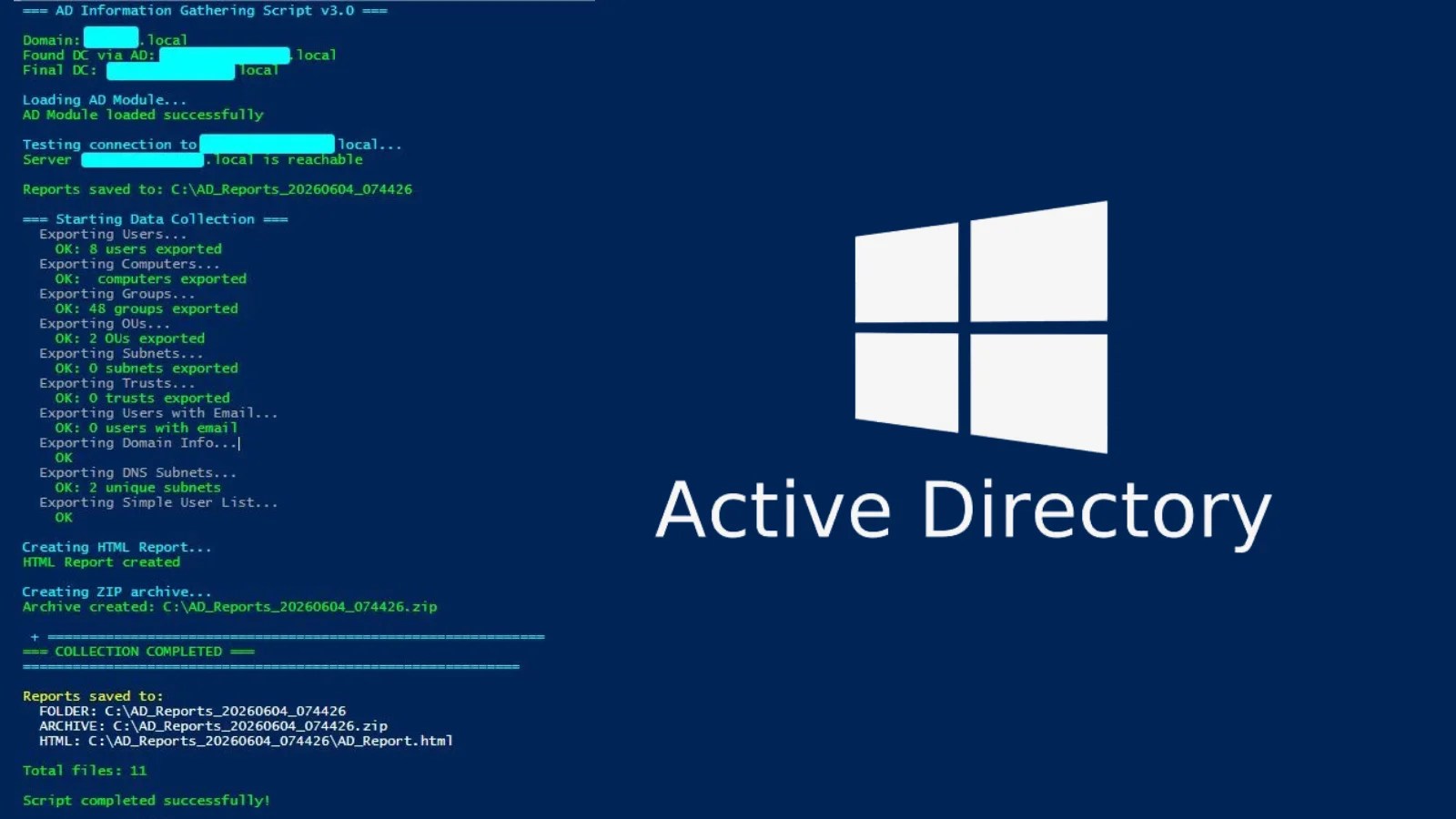
The attack began with the use of previously compromised credentials to establish a Remote Desktop Protocol (RDP) session on a Windows Server linked to a domain. Within minutes, the attacker deployed Untitled1.ps1 to map out domain users, computers, groups, and trusts after staging their tools in the system’s ProgramData directory.
The Mechanics of AI-Generated Attacks
Approximately half an hour later, the attacker executed s5cmd.exe, an Amazon S3 tool often misused for data exfiltration, followed by SharpShares.exe to identify accessible file shares while excluding administrative ones. The script’s reconstruction was possible through Windows Event ID 4104 telemetry, capturing deployed PowerShell script blocks.
The script identified the domain controller using a complex, five-step fallback method involving DNS lookups, nltest, the AD module, environment variables, and a hardcoded backup. It then systematically exported details of AD Users, Computers, Groups, Organizational Units, Subnets, and Trusts to CSV files, culminating in a detailed AD_Report.html and a zipped output of the findings.
Challenges in Detection and Future Outlook
Artifacts such as the script’s title and unedited placeholders indicated its AI origins. The use of redundant discovery methods and excessive console output, typical of AI-generated code, further corroborated this. Such scripts, uniquely generated for each attack, challenge traditional antivirus and EDR tools that rely on static signature detection.
Despite these challenges, SIEM platforms like Huntress’s remain effective due to their reliance on behavioral telemetry rather than file signatures. This incident underscores a growing trend where AI enhances the speed and aggressiveness of cyberattacks rather than introducing new tactics.
As vibe coding becomes more prevalent, security professionals are urged to adopt behavioral analytics over static signature matching to detect these sophisticated threats. The evolving landscape demands a proactive shift in threat detection strategies to counteract the personalization and acceleration brought about by AI in cybercrime.