Skip to content
  • Home
  • Cyber Map
  • About Us – Contact
  • Disclaimer
  • Terms and Rules
  • Privacy Policy
Cyber Web Spider Blog – News

Cyber Web Spider Blog – News

Globe Threat Map provides a real-time, interactive 3D visualization of global cyber threats. Monitor DDoS attacks, malware, and hacking attempts with geo-located arcs on a rotating globe. Stay informed with live logs and archive stats.

  • Home
  • Cyber Map
  • Cyber Security News
  • Security Week News
  • The Hacker News
  • How To?
  • Toggle search form
Android Zero-Click Flaw Allows Remote Access

Android Zero-Click Flaw Allows Remote Access

Posted on May 12, 2026 By CWS

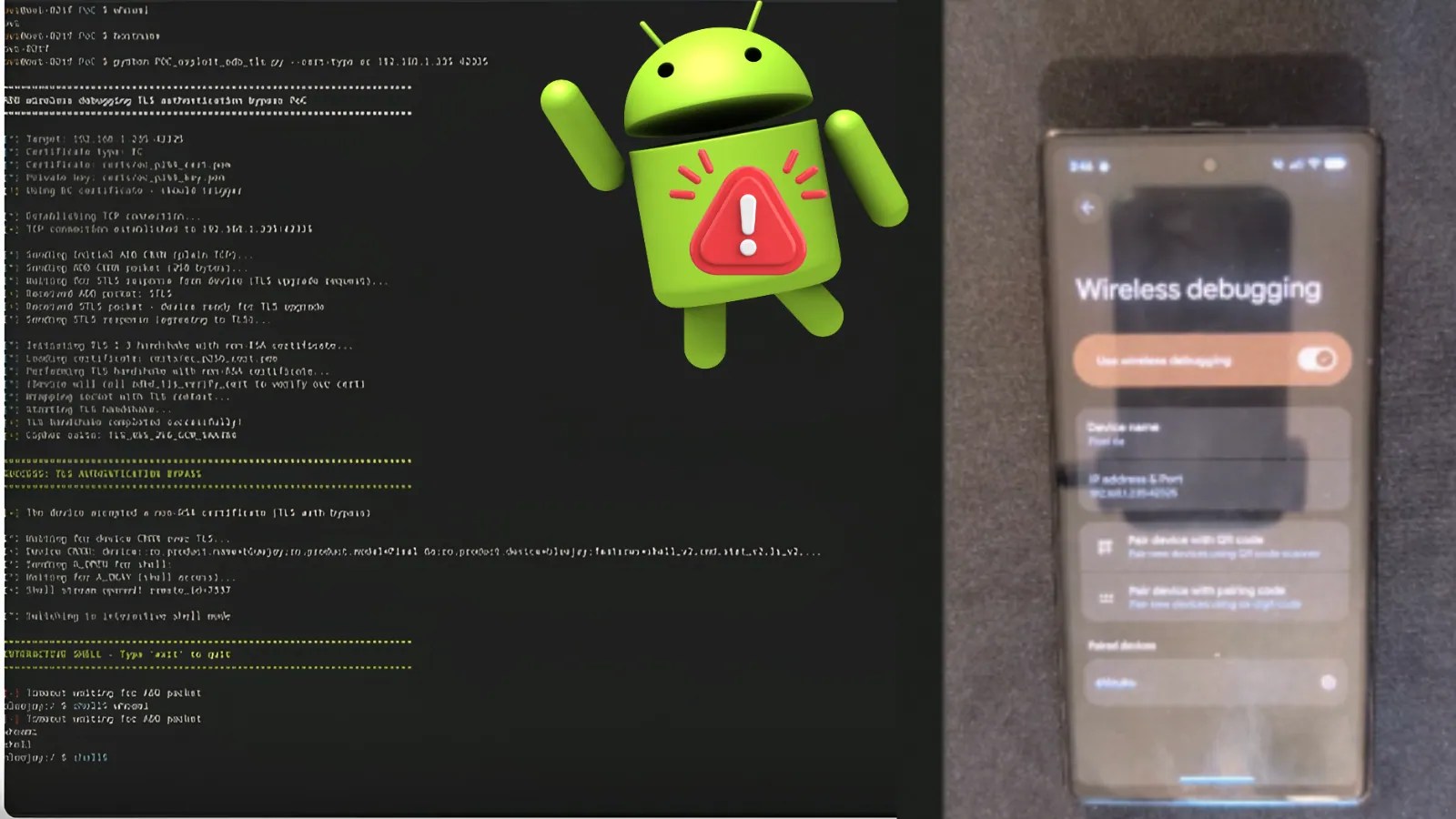
A newly discovered zero-click vulnerability in Android has been revealed in Google’s May 2026 Security Bulletin, posing a significant threat to mobile security. The flaw, identified as CVE-2026-0073, enables attackers to gain full shell access remotely without requiring any interaction from the user.

Details of the Android Zero-Click Vulnerability

Security experts from BARGHEST have brought to light this critical flaw within Android’s adbd daemon. The vulnerability arises from a cryptographic error in the adbd_tls_verify_cert function found in the auth.cpp file. This error compromises the trust model used during debugging, turning a beneficial developer tool into a potential backdoor for cyber threats.

Technical Breakdown of the Vulnerability

The vulnerability hinges on a logic error during the TLS authentication process. During a wireless ADB connection, the system uses the EVP_PKEY_cmp API to validate a client’s certificate against authorized RSA keys. However, if an attacker uses a non-RSA certificate, the comparison returns -1, which is mistakenly interpreted as a successful match due to a C++ implementation flaw.

To exploit this, an attacker must establish a TCP connection, perform a successful STLS protocol upgrade, and present a malicious certificate. Once bypassed, the attacker gains shell user access, allowing them to extract data, install applications silently, and alter system settings, exposing the device to further risk.

Impacted Devices and Mitigation Strategies

The flaw primarily affects devices running Android versions 14 to 16, especially when certain conditions are met. These include enabled developer options, active wireless debugging, a trust store with a paired RSA host key, and network accessibility to ADB TCP port 5555.

To mitigate this risk, users and administrators are urged to apply the May 2026 security patch immediately. Additionally, disabling wireless debugging on untrusted networks and revoking permissions for unfamiliar debugging hosts can help minimize exposure. Turning off developer options when not needed is also highly recommended to prevent potential network attacks.

Stay informed by following us on Google News, LinkedIn, and X for more updates on cybersecurity threats and protective measures.

Cyber Security News Tags:adbd, Android, Cybersecurity, developer options, Encryption, mobile security, Patch, remote access, Security, TLS, Vulnerability, wireless debugging, zero-click

Post navigation

Previous Post: iOS 26.5 Launches Default E2E Encrypted RCS Messaging
Next Post: Instructure Reaches Deal to Prevent Data Leak

Related Posts

New PyStoreRAT Malware Targets IT and OSINT Experts New PyStoreRAT Malware Targets IT and OSINT Experts Cyber Security News
Lessons Learned from Massive npm Supply Chain Attack Using “Shai-Hulud” Self-Replicating Malware Lessons Learned from Massive npm Supply Chain Attack Using “Shai-Hulud” Self-Replicating Malware Cyber Security News
Microsoft Shares BitLocker Keys with FBI to Unlock Encrypted Laptops in Guam Fraud Investigation Microsoft Shares BitLocker Keys with FBI to Unlock Encrypted Laptops in Guam Fraud Investigation Cyber Security News
What tools help reduce fraud or friendly fraud for online businesses?  What tools help reduce fraud or friendly fraud for online businesses?  Cyber Security News
Hackers Breaking Internet with 7.3 Tbps and 4.8 Billion Packets Per Second DDoS Attack Hackers Breaking Internet with 7.3 Tbps and 4.8 Billion Packets Per Second DDoS Attack Cyber Security News
McLaren Health Care Data Breach Exposes 743,000 People Personal Information McLaren Health Care Data Breach Exposes 743,000 People Personal Information Cyber Security News

Categories

  • Cyber Security News
  • How To?
  • Security Week News
  • The Hacker News

Recent Posts

  • TrickMo Android Malware Threatens Financial Apps
  • Instructure Reaches Deal to Prevent Data Leak
  • Android Zero-Click Flaw Allows Remote Access
  • iOS 26.5 Launches Default E2E Encrypted RCS Messaging
  • Critical cPanel Vulnerability Exploited by Hackers

Pages

  • About Us – Contact
  • Disclaimer
  • Privacy Policy
  • Terms and Rules

Archives

  • May 2026
  • April 2026
  • March 2026
  • February 2026
  • January 2026
  • December 2025
  • November 2025
  • October 2025
  • September 2025
  • August 2025
  • July 2025
  • June 2025
  • May 2025

Recent Posts

  • TrickMo Android Malware Threatens Financial Apps
  • Instructure Reaches Deal to Prevent Data Leak
  • Android Zero-Click Flaw Allows Remote Access
  • iOS 26.5 Launches Default E2E Encrypted RCS Messaging
  • Critical cPanel Vulnerability Exploited by Hackers

Pages

  • About Us – Contact
  • Disclaimer
  • Privacy Policy
  • Terms and Rules

Categories

  • Cyber Security News
  • How To?
  • Security Week News
  • The Hacker News

Copyright © 2026 Cyber Web Spider Blog – News.

Powered by PressBook Masonry Dark