Skip to content
  • Home
  • Cyber Map
  • About Us – Contact
  • Disclaimer
  • Terms and Rules
  • Privacy Policy
Cyber Web Spider Blog – News

Cyber Web Spider Blog – News

Globe Threat Map provides a real-time, interactive 3D visualization of global cyber threats. Monitor DDoS attacks, malware, and hacking attempts with geo-located arcs on a rotating globe. Stay informed with live logs and archive stats.

  • Home
  • Cyber Map
  • Cyber Security News
  • Security Week News
  • The Hacker News
  • How To?
  • Toggle search form
AWS Enhances AI Agent Security with New Architecture

AWS Enhances AI Agent Security with New Architecture

Posted on August 20, 2026 By CWS

Amazon Web Services (AWS) is taking significant steps to enhance the security of AI agents with a newly introduced architecture. This development addresses the pressing concern of unauthorized data access in automated systems, a risk inherent in AI agents that interact with various data sources such as databases and document repositories.

Understanding the Security Challenge

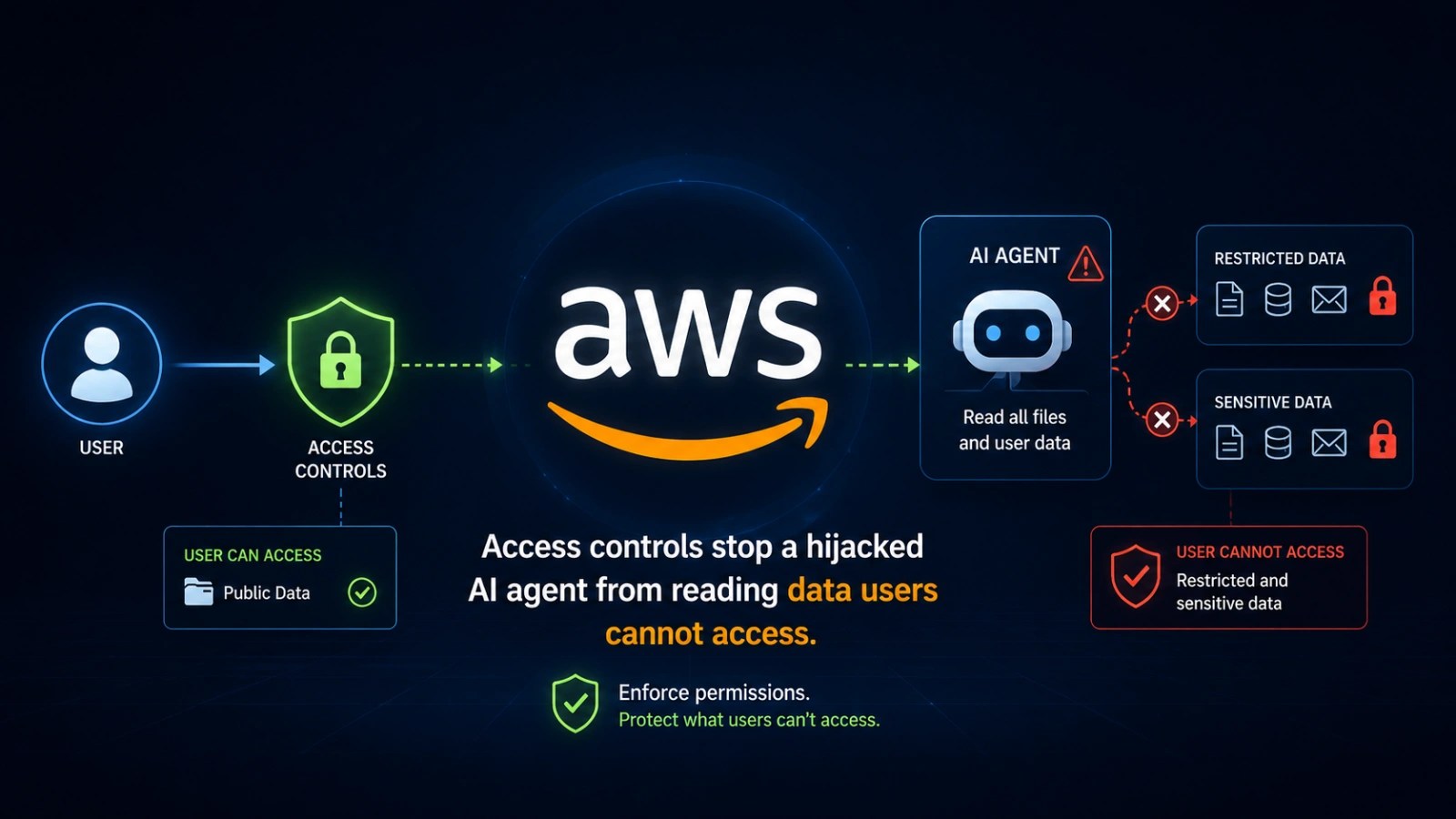
As organizations increasingly deploy AI agents to streamline workflows, a critical security challenge emerges. These agents, often lacking user-specific awareness, can unintentionally expose sensitive information if compromised. An AI agent manipulated through techniques like prompt injection can potentially access data beyond a user’s authorization.

AWS identifies this vulnerability as a structural flaw in traditional setups, where agents are given extensive credentials. The absence of robust security mechanisms leaves systems open to exploitation, necessitating a more secure framework for data access management.

AWS’s Innovative Solution

The solution from AWS revolves around using Amazon Bedrock AgentCore, which shifts authorization decisions from the agent’s code to the underlying infrastructure. This approach aligns with best practices outlined in the AWS Well-Architected Agentic AI Lens, emphasizing the agent’s role as a coordinator rather than a decision-maker.

In this architecture, a CRM chat application serves as a case study, illustrating how AWS handles authorization with Amazon DynamoDB, Bedrock Knowledge Bases, and Salesforce. The system employs Amazon Cognito for user authentication, injecting department claims into JSON Web Tokens (JWTs) to ensure that requests align with user permissions.

Implementing Infrastructure-Level Authorization

AWS’s architecture demonstrates how infrastructure-enforced authorization maintains data security. For Amazon DynamoDB, user tokens are exchanged for temporary credentials, preventing cross-department access at the IAM policy level. Similarly, Bedrock Knowledge Bases use metadata tagging, while Salesforce employs token exchanges that respect native sharing rules.

This method ensures that even if an AI agent is compromised, it cannot exceed the authorized user’s data access rights. The architecture relies on short-lived credentials that are cryptographically secure and resistant to tampering or misuse.

Future Implications for AI Security

The introduction of this architecture by AWS marks a significant advancement in AI security. By enforcing authorization at the infrastructure layer, organizations can protect sensitive data more effectively. This model is adaptable to various access control scenarios, offering a scalable solution for industries handling critical data, such as finance, healthcare, and customer service.

As AI agents become more prevalent, the focus on securing these systems against emerging threats will be crucial. AWS’s approach provides a robust framework for mitigating risks associated with AI agent manipulation, setting a new standard for data protection in cloud environments.


Cyber Security News Tags:AI agents, AI security, Amazon Bedrock, Authorization, AWS, cloud computing, Cognito, data access, data protection, DynamoDB, IAM, identity management, information technology, infrastructure security, Salesforce

Post navigation

Previous Post: Russian Hackers Exploit OAuth and WhatsApp for Cyber Attacks
Next Post: Addressing Shady AI: A Growing Governance Challenge

Related Posts

ClickFix Attacks Evolved With Weaponized Videos That Tricks Users via Self-infection Process ClickFix Attacks Evolved With Weaponized Videos That Tricks Users via Self-infection Process Cyber Security News
Vulnerabilities Exposed in Socomec DIRIS M-70 Device Vulnerabilities Exposed in Socomec DIRIS M-70 Device Cyber Security News
CISA Alerts to Exploited SolarWinds Serv-U Vulnerability CISA Alerts to Exploited SolarWinds Serv-U Vulnerability Cyber Security News
Key Cybersecurity Threats: Notepad++ Hack & Office 0-Day Key Cybersecurity Threats: Notepad++ Hack & Office 0-Day Cyber Security News
Hackers Attacking Fortinet SSL VPN Under Attack From 780 unique IPs Hackers Attacking Fortinet SSL VPN Under Attack From 780 unique IPs Cyber Security News
BlackSuit Ransomware’s Data Leak and Negotiation Portal Seized BlackSuit Ransomware’s Data Leak and Negotiation Portal Seized Cyber Security News

Categories

  • Cyber Security News
  • How To?
  • Security Week News
  • The Hacker News

Recent Posts

  • Addressing Shady AI: A Growing Governance Challenge
  • AWS Enhances AI Agent Security with New Architecture
  • Russian Hackers Exploit OAuth and WhatsApp for Cyber Attacks
  • CRLF Desync Attack Poisons CDN Caches and Delivers XSS
  • Cybersecurity Threats Evolve: Key Developments

Pages

  • About Us – Contact
  • Disclaimer
  • Privacy Policy
  • Terms and Rules

Archives

  • August 2026
  • July 2026
  • June 2026
  • May 2026
  • April 2026
  • March 2026
  • February 2026
  • January 2026
  • December 2025
  • November 2025
  • October 2025
  • September 2025
  • August 2025
  • July 2025
  • June 2025
  • May 2025

Recent Posts

  • Addressing Shady AI: A Growing Governance Challenge
  • AWS Enhances AI Agent Security with New Architecture
  • Russian Hackers Exploit OAuth and WhatsApp for Cyber Attacks
  • CRLF Desync Attack Poisons CDN Caches and Delivers XSS
  • Cybersecurity Threats Evolve: Key Developments

Pages

  • About Us – Contact
  • Disclaimer
  • Privacy Policy
  • Terms and Rules

Categories

  • Cyber Security News
  • How To?
  • Security Week News
  • The Hacker News

Copyright © 2026 Cyber Web Spider Blog – News.

Powered by PressBook Masonry Dark