Skip to content
  • Home
  • Cyber Map
  • About Us – Contact
  • Disclaimer
  • Terms and Rules
  • Privacy Policy
Cyber Web Spider Blog – News

Cyber Web Spider Blog – News

Globe Threat Map provides a real-time, interactive 3D visualization of global cyber threats. Monitor DDoS attacks, malware, and hacking attempts with geo-located arcs on a rotating globe. Stay informed with live logs and archive stats.

  • Home
  • Cyber Map
  • Cyber Security News
  • Security Week News
  • The Hacker News
  • How To?
  • Toggle search form
Banana RAT Enhances Banking Malware with New Variants

Banana RAT Enhances Banking Malware with New Variants

Posted on July 9, 2026 By CWS

In a significant development in cybersecurity, Banana RAT, a notorious remote access trojan linked to Brazilian banking fraud, has advanced its evasion tactics. A recent operation reveals the use of an exposed server to generate polymorphic malware variants, posing a greater challenge for security teams.

Advanced Infrastructure of Banana RAT

The operation utilizes a server that not only hosts malicious files but also actively generates new, disguised payloads. This system was uncovered by researcher Moises Cerqueira, who identified a public index on a single IP address through routine internet scans. The server functions as a dynamic delivery platform, equipped with a payload generator and obfuscation scripts.

According to ANY.RUN, this infrastructure enabled the creation of two distinct Banana RAT versions within a matter of weeks. This adaptability allows the malware to continuously alter its appearance, complicating detection efforts by defenders.

Technical Evolution of the Malware

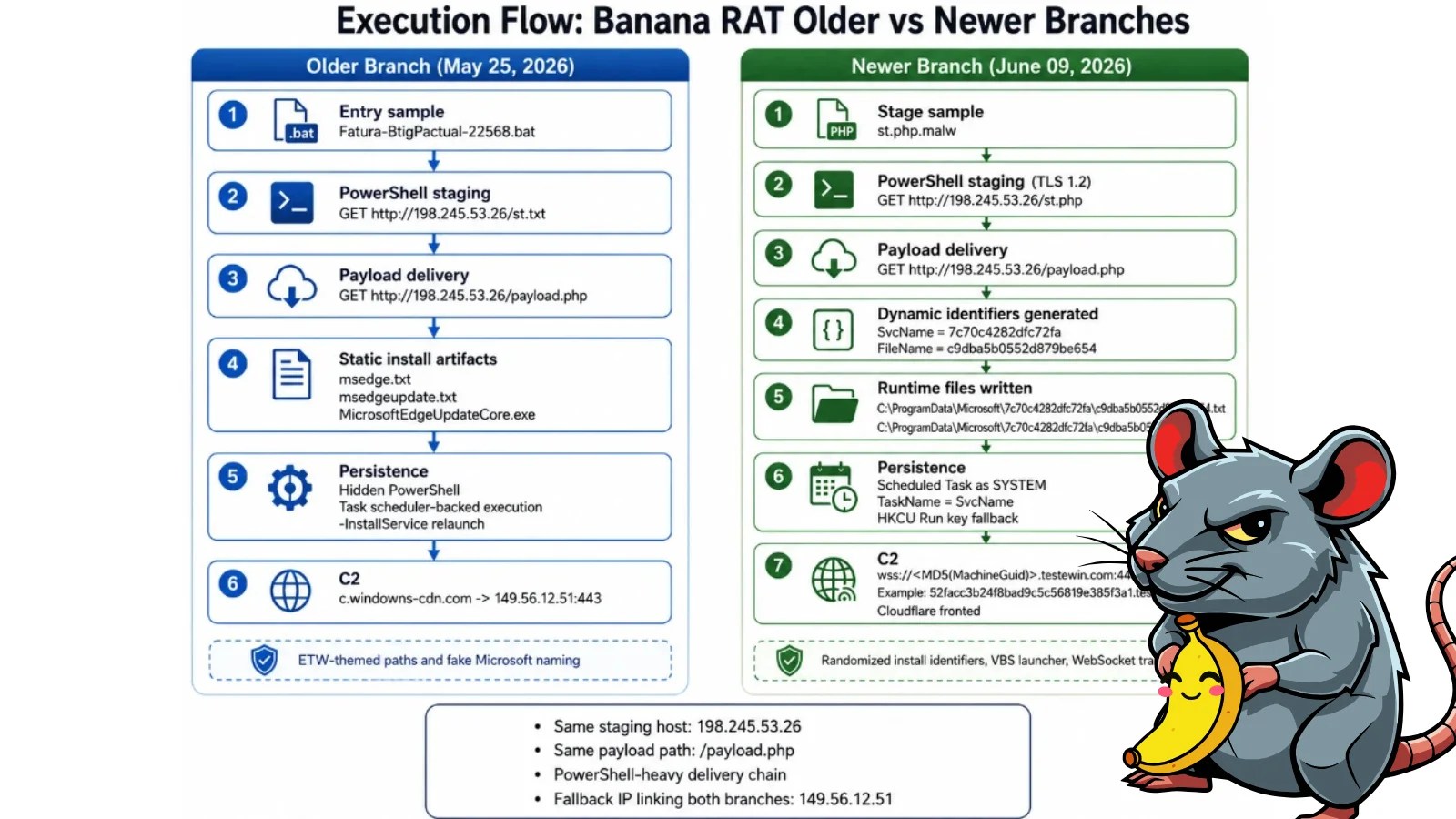
Analysts executed the exposed setup in a sandbox to trace the malware’s evolution between late May and early June 2026. The server powered both versions, providing insights into the operator’s real-time refinement of evasion techniques. This ongoing transformation means that detection rules based on static samples are less effective.

The malware specifically targets financial transactions, aiming to steal banking credentials. Its ability to regenerate in new forms undermines traditional blocklist defenses, highlighting the need for more sophisticated security measures.

Detailed Analysis of Malware Versions

The initial version of Banana RAT used predictable file names and folders resembling legitimate Windows updates, which made it somewhat identifiable. In contrast, the latest version adopts random file names and folders, with persistence mechanisms shifting to a VBS launcher and hidden tasks with system-level privileges.

Communication with attacker servers is conducted over encrypted WebSocket channels, leveraging unique identifiers for each infected machine. Despite these changes, a fallback IP address remains constant, linking all versions to the same infrastructure.

Security teams are advised to monitor traffic from known indicators and investigate any suspicious PowerShell activity.

Conclusion and Future Outlook

This operation underscores the evolving nature of cyber threats and the necessity for continuous adaptation in defense strategies. Tracking the evolution of Banana RAT through its infrastructure provides a clearer picture of its tactics, enabling better preparation against future attacks. Enterprises are encouraged to integrate live threat feeds and collaborate with SOC teams to enhance their proactive defense capabilities.

Cyber Security News Tags:ANY.RUN, Banana RAT, banking malware, Brazilian banking fraud, Cybersecurity, payload generator, polymorphic malware, PowerShell obfuscation, remote access trojan, servidor_completo_pool.py, WebSocket communication

Post navigation

Previous Post: CrowdStrike Reveals New AI Threats with Prompt Injection

Related Posts

Tycoon2FA Infra Used by Dadsec Hacker Group to Steal Office365 Credentials Tycoon2FA Infra Used by Dadsec Hacker Group to Steal Office365 Credentials Cyber Security News
AI Browsers Present New Security Risks with Prompt Injection AI Browsers Present New Security Risks with Prompt Injection Cyber Security News
Bing Search Leads to Akira Ransomware Attack via SEO Poisoning Bing Search Leads to Akira Ransomware Attack via SEO Poisoning Cyber Security News
New AiTM Attack Campaign That Bypasses MFA Targeting Microsoft 365 and Okta Users New AiTM Attack Campaign That Bypasses MFA Targeting Microsoft 365 and Okta Users Cyber Security News
Sophisticated Crypto Clipper Malware Targets USB Drives Sophisticated Crypto Clipper Malware Targets USB Drives Cyber Security News
Hackers Exploit NinjaOne Software for Covert Attacks Hackers Exploit NinjaOne Software for Covert Attacks Cyber Security News

Categories

  • Cyber Security News
  • How To?
  • Security Week News
  • The Hacker News

Recent Posts

  • Banana RAT Enhances Banking Malware with New Variants
  • CrowdStrike Reveals New AI Threats with Prompt Injection
  • APT-C-20 Uses PNG Images for Stealthy C# Backdoor
  • Android Malware PromptSpy Adapts Using AI in Real-Time
  • Fake Google Page Targets Mexican Bank Users with Malware

Pages

  • About Us – Contact
  • Disclaimer
  • Privacy Policy
  • Terms and Rules

Archives

  • July 2026
  • June 2026
  • May 2026
  • April 2026
  • March 2026
  • February 2026
  • January 2026
  • December 2025
  • November 2025
  • October 2025
  • September 2025
  • August 2025
  • July 2025
  • June 2025
  • May 2025

Recent Posts

  • Banana RAT Enhances Banking Malware with New Variants
  • CrowdStrike Reveals New AI Threats with Prompt Injection
  • APT-C-20 Uses PNG Images for Stealthy C# Backdoor
  • Android Malware PromptSpy Adapts Using AI in Real-Time
  • Fake Google Page Targets Mexican Bank Users with Malware

Pages

  • About Us – Contact
  • Disclaimer
  • Privacy Policy
  • Terms and Rules

Categories

  • Cyber Security News
  • How To?
  • Security Week News
  • The Hacker News

Copyright © 2026 Cyber Web Spider Blog – News.

Powered by PressBook Masonry Dark