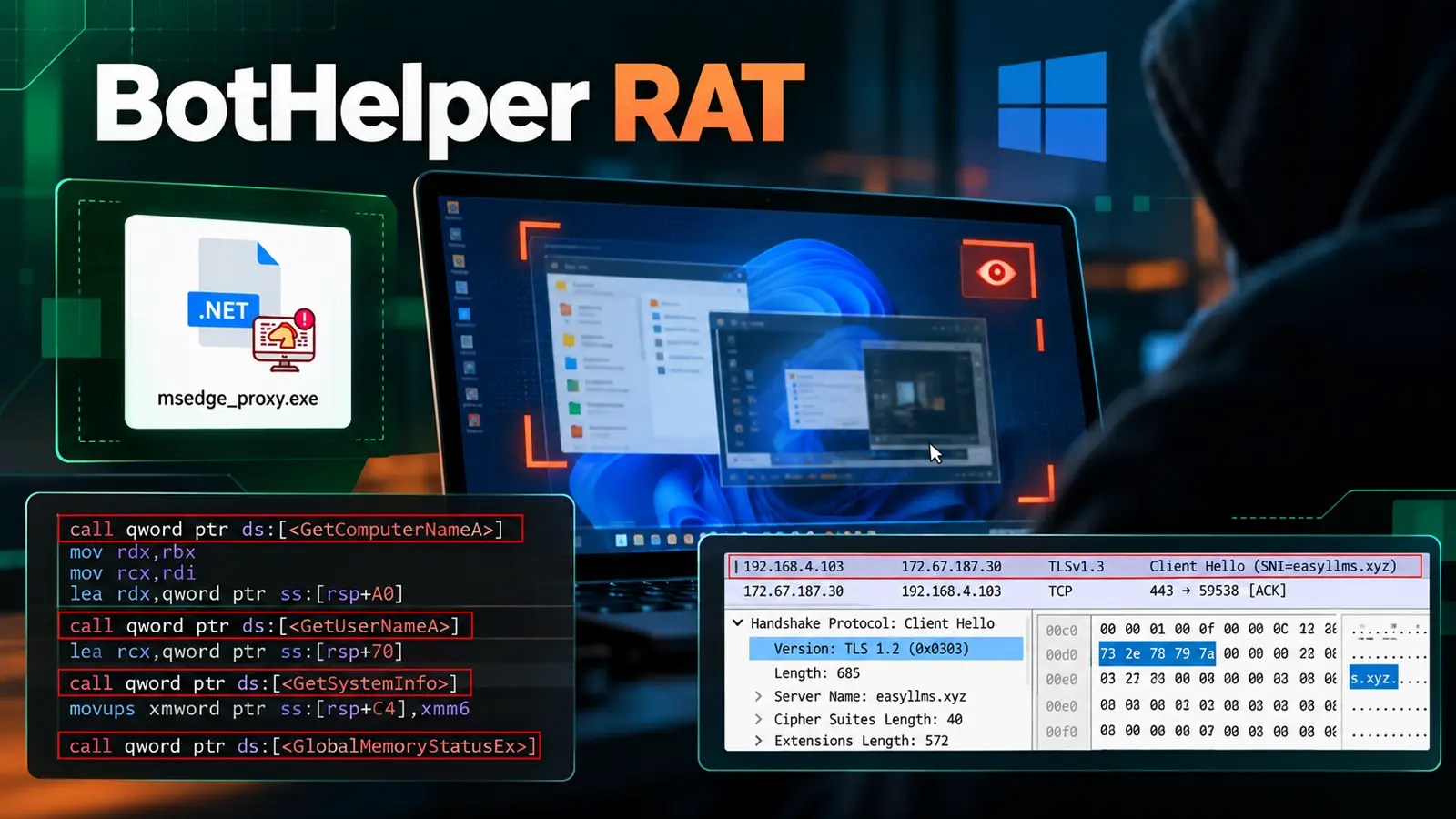
A newly discovered malware, BotHelper RAT, has emerged as a significant threat to Windows users by enabling attackers to secretly view and control infected devices. This remote access trojan (RAT) leverages encrypted payloads and sophisticated techniques to infiltrate systems without detection.
The attack initiates with a small starter program that profiles the target computer’s system information. This initial step involves contacting a remote server via HTTPS, downloading an encrypted file which is decrypted and executed in memory. The initial infection vector remains unclear, but Point Wild analysts traced the malware’s lineage from the first-stage program to its active surveillance capabilities.
Stealthy Operations and Encrypted Payloads
The BotHelper RAT employs encryption to conceal its operations. The initial download consists of 52,744 bytes of data lacking typical Windows executable headers, making it difficult for security tools to identify. A position-dependent XOR decryption routine reveals the executable only during runtime.
Once activated, the RAT uses the infected device’s identifier to communicate with command and control (C&C) servers. These servers issue commands such as Screenshot and ScreenStreamStart, enabling real-time desktop surveillance at three frames per second with a JPEG quality setting of 40. This method allows attackers to monitor user activity without directly exfiltrating files.
Comprehensive Remote Control Features
Beyond screen capture, BotHelper RAT supports a broad range of functionalities. It runs commands via Command Prompt or PowerShell, downloads and executes files, monitors clipboard activity, displays messages, and can shut down or restart the device. These capabilities underscore its potential for extensive system control and data theft.
The RAT further complicates detection by altering the Windows Antimalware Scan Interface (AMSI), a tactic that prevents early discovery. Its persistence is maintained through scheduled tasks that reactivate the malware every 30 minutes, even if temporary files are removed.
Detection and Prevention Measures
Security experts recommend isolating suspected compromised hosts and scrutinizing scheduled tasks, hidden files, and unusual outbound HTTPS connections. Organizations should deploy endpoint controls to detect behaviors like certificate-validation bypasses and in-memory payload decryption.
Additionally, resetting potentially exposed credentials and monitoring active sessions are crucial, given the RAT’s ability to reveal sensitive information through live screen views. The stealthy nature of BotHelper’s operations necessitates vigilant monitoring and a robust defensive posture to mitigate its impact on Windows environments.
BotHelper RAT exemplifies the evolving landscape of cyber threats, combining stealth, persistence, and real-time surveillance to achieve its objectives. Its comprehensive command set and encrypted communication make it a formidable challenge for cybersecurity teams.