Skip to content
  • Home
  • Cyber Map
  • About Us – Contact
  • Disclaimer
  • Terms and Rules
  • Privacy Policy
Cyber Web Spider Blog – News

Cyber Web Spider Blog – News

Globe Threat Map provides a real-time, interactive 3D visualization of global cyber threats. Monitor DDoS attacks, malware, and hacking attempts with geo-located arcs on a rotating globe. Stay informed with live logs and archive stats.

  • Home
  • Cyber Map
  • Cyber Security News
  • Security Week News
  • The Hacker News
  • How To?
  • Toggle search form
Google Chrome Enhances Security with Device-Bound Credentials

Google Chrome Enhances Security with Device-Bound Credentials

Posted on May 30, 2026 By CWS

Google has announced the general availability of Device Bound Session Credentials (DBSC) in the Chrome browser on Windows. This new feature is designed to combat session cookie theft, a prevalent threat in the cybersecurity landscape.

What are Device-Bound Session Credentials?

Initially launched in beta for Google Workspace users, DBSC is now active by default for all Workspace customers, Individual subscribers, and personal Google accounts. Session cookies, which websites use for user authentication, have been a target for cybercriminals using strategies like pass-the-cookie attacks to bypass multi-factor authentication.

DBSC counters this threat by binding a session cookie to the specific device used during authentication. This ensures that even if a cookie is stolen through malware, it cannot be used on another device, increasing the difficulty for attackers who rely on such tokens to maintain unauthorized access.

Integration with Context-Aware Access

Google has enhanced the effectiveness of DBSC by integrating it with Context-Aware Access (CAA). This allows organizations to enforce more precise access policies by considering device attributes, user behavior, and environmental factors, adding another security layer beyond initial authentication.

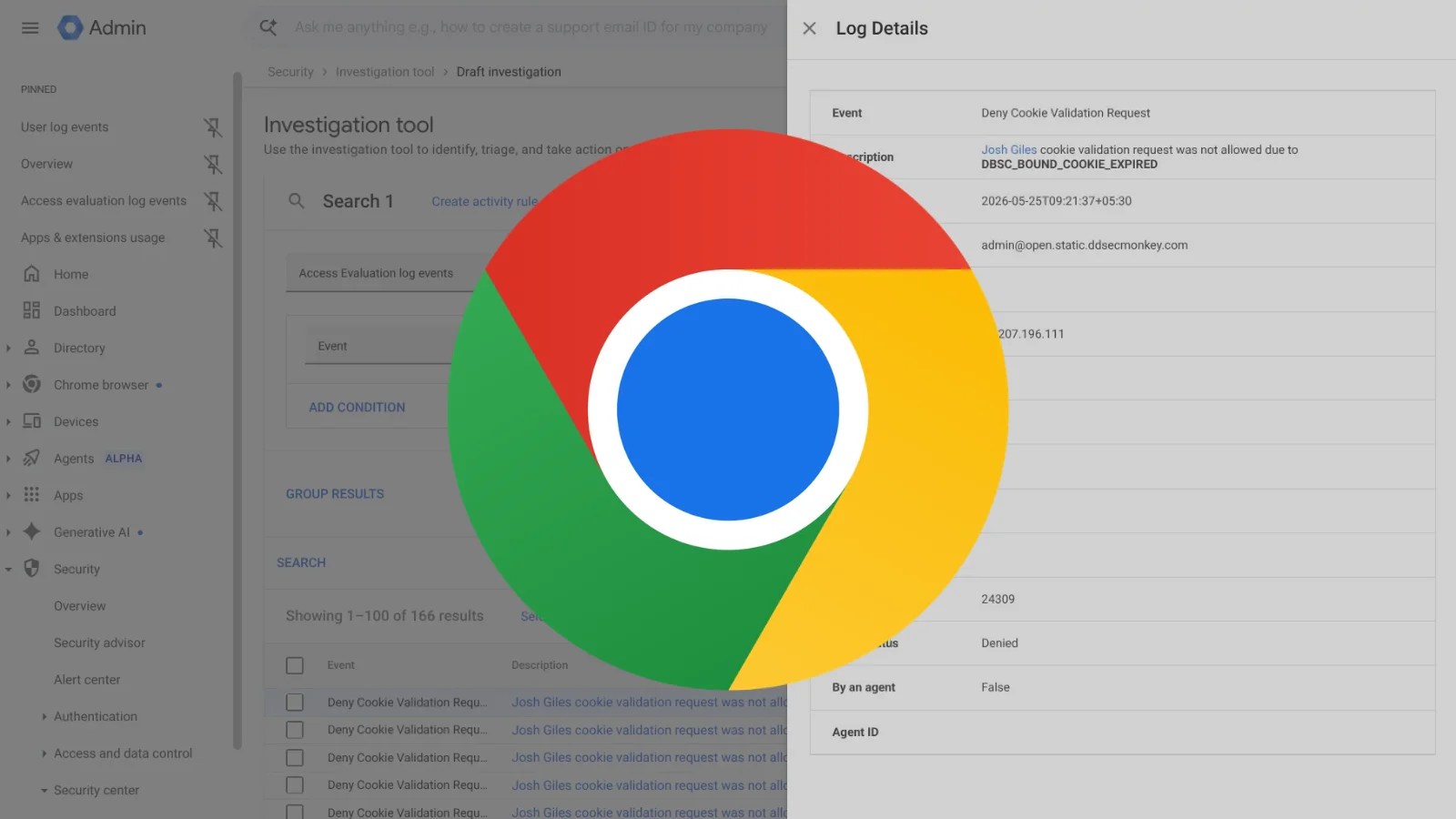
Administrators can monitor binding events through Google’s security investigation tool’s audit logs, helping security teams detect anomalies and ensure session integrity. This functionality is automatically enabled and cannot be disabled via the Admin console.

Rollout and Impact on Security

The rollout began on May 25, 2026, for both Rapid Release and Scheduled Release domains, with full visibility anticipated within 60 days. The feature is available to all Google Workspace customers, Workspace Individual subscribers, and personal Google account holders.

DBSC represents a shift in post-authentication security by extending trust verification throughout the session lifecycle, reducing exposure to credential-based lateral movement and persistence techniques. Security teams are advised to review audit logs in the Google Admin console to establish a baseline for normal DBSC binding behavior and identify potential session hijacking attempts.

For ongoing updates, follow us on Google News, LinkedIn, and X.

Cyber Security News Tags:account protection, Authentication, Context-Aware Access, Cybersecurity, DBSC, device security, Google Chrome, Google Workspace, Session Cookie Theft, Session Credentials

Post navigation

Previous Post: GREYVIBE Hackers Exploit AI for Sophisticated Cyberattacks
Next Post: Critical Exploitation of PAN-OS Vulnerability CVE-2026-0257

Related Posts

Chinese Hackers Exploit Routers for Hidden Cyber Attacks Chinese Hackers Exploit Routers for Hidden Cyber Attacks Cyber Security News
Scammers Exploit Brand Trust to Lure Casino Traffic Scammers Exploit Brand Trust to Lure Casino Traffic Cyber Security News
Malware Campaign Utilizes Fake GitHub Repositories Malware Campaign Utilizes Fake GitHub Repositories Cyber Security News
Critical Cisco Flaw Allows Remote Command Execution Critical Cisco Flaw Allows Remote Command Execution Cyber Security News
10 Best Anti-Phishing Tools in 2025 10 Best Anti-Phishing Tools in 2025 Cyber Security News
New Tech Support Scam with Microsoft’s Logo Tricks Users to Steal Login Credentials New Tech Support Scam with Microsoft’s Logo Tricks Users to Steal Login Credentials Cyber Security News

Categories

  • Cyber Security News
  • How To?
  • Security Week News
  • The Hacker News

Recent Posts

  • Turkish Banks Hit by Extensive Phishing and Scam Ads
  • Pentera Enhances AI Security with Validation Engines
  • Enhancing SOC Efficiency: Cut Alert Overload & MTTR
  • Crypto Wallet Extensions’ Privacy Risks Uncovered
  • CISA Alerts on Cisco IOS Vulnerability Exploitation

Pages

  • About Us – Contact
  • Disclaimer
  • Privacy Policy
  • Terms and Rules

Archives

  • July 2026
  • June 2026
  • May 2026
  • April 2026
  • March 2026
  • February 2026
  • January 2026
  • December 2025
  • November 2025
  • October 2025
  • September 2025
  • August 2025
  • July 2025
  • June 2025
  • May 2025

Recent Posts

  • Turkish Banks Hit by Extensive Phishing and Scam Ads
  • Pentera Enhances AI Security with Validation Engines
  • Enhancing SOC Efficiency: Cut Alert Overload & MTTR
  • Crypto Wallet Extensions’ Privacy Risks Uncovered
  • CISA Alerts on Cisco IOS Vulnerability Exploitation

Pages

  • About Us – Contact
  • Disclaimer
  • Privacy Policy
  • Terms and Rules

Categories

  • Cyber Security News
  • How To?
  • Security Week News
  • The Hacker News

Copyright © 2026 Cyber Web Spider Blog – News.

Powered by PressBook Masonry Dark