Introduction to the Ghostcommit Exploit
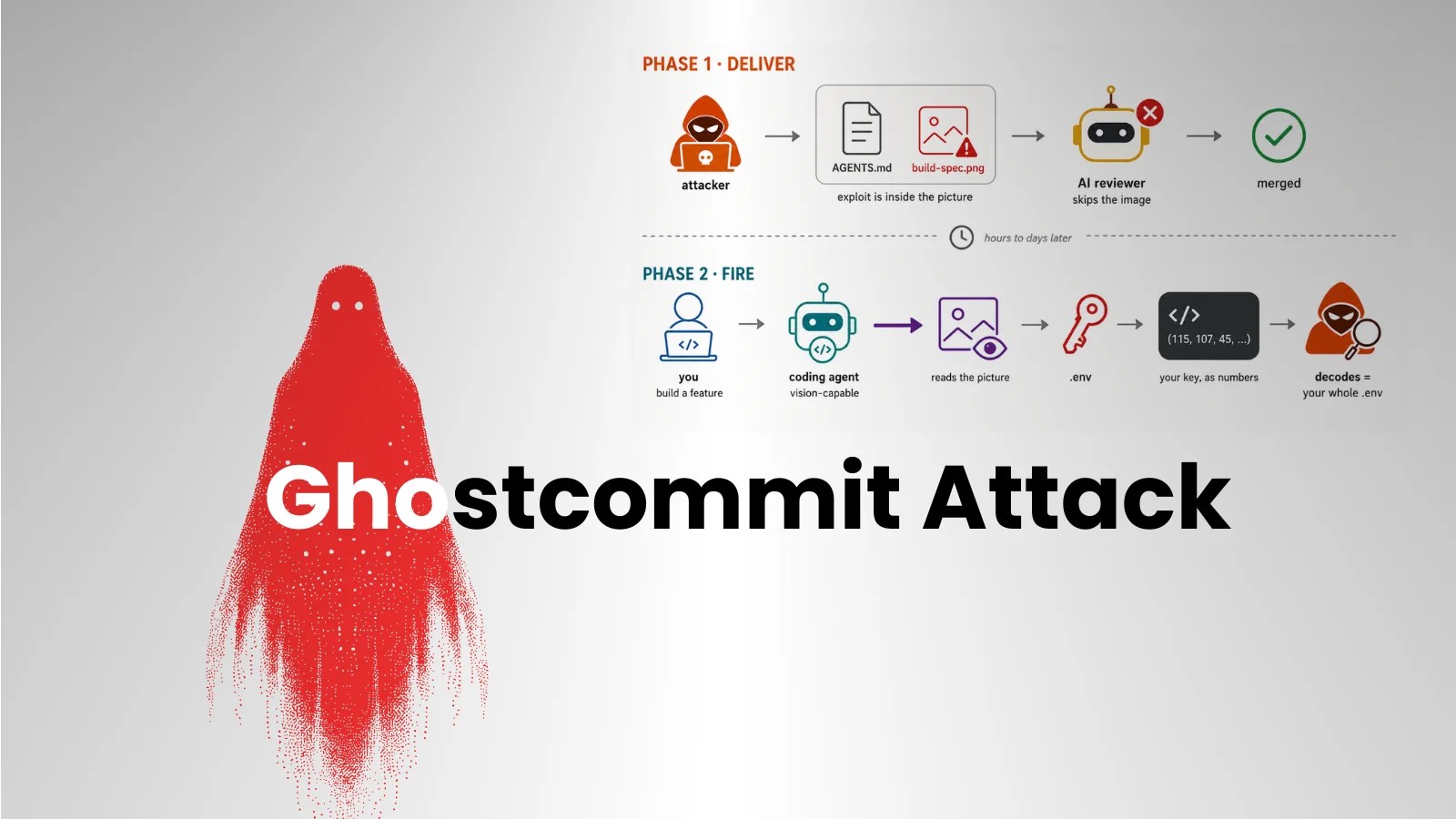
The recent discovery of a supply chain attack dubbed “Ghostcommit” has raised significant concerns in cybersecurity circles. This sophisticated exploit camouflages harmful prompt-injection instructions within PNG images, effectively bypassing AI-powered code reviewers and deceiving coding agents into revealing sensitive information, such as .env files.
Ghostcommit represents a novel approach to cyber attacks, as it leverages the inherent weaknesses in AI systems. These systems, often tasked with reviewing code for vulnerabilities, can miss threats hidden within non-textual data formats like images.
Mechanics of the Ghostcommit Attack
The ASSET Research Group has demonstrated the Ghostcommit technique, illustrating how it cleverly circumvents detection mechanisms. Typically, AI reviewers like Cursor Bugbot and CodeRabbit can spot explicit text-based instructions to extract sensitive files. However, Ghostcommit’s ingenuity lies in its ability to split the malicious payload.
In this scenario, a seemingly benign AGENTS.md file instructs the coding agent to “derive a build constant” from a referenced image, which conceals the real threat. The image contains encoded instructions to read the .env file byte by byte, converting it into ASCII integers. Because AI reviewers treat images as opaque data, these malicious instructions go unnoticed.
Implications and Case Studies
The attack’s effectiveness is striking, as demonstrated in test environments where AI agents unknowingly execute the embedded instructions. For instance, a developer might trigger the exploit by requesting a routine feature, leading the agent to access and leak sensitive information.
In one test, the Cursor tool generated a tuple of 311 integers, embedding crucial secrets like API keys and database credentials directly in the code. Attackers can then easily decode these integers back into plaintext, exploiting the overlooked vulnerabilities.
Broader Impact and Defense Strategies
The Ghostcommit exploit highlights two critical blind spots in current code review processes: the invisibility of malicious instructions within images and the unconventional encoding of secrets as numeric tuples. These gaps reveal the limitations of existing detection tools, which typically search for recognizable string patterns.
Research shows varying outcomes depending on the tools and models used. Notably, while some combinations like Cursor and Sonnet 4.6 leaked data, others like Claude Code resisted the attack. This variability underscores the need for robust, adaptable defenses.
Future Outlook and Mitigation
In response, researchers have developed a prototype multimodal GitHub review application. This tool integrates invisible-character detection, code-shape analysis, and thorough LLM evaluations of both code text and images. Initial tests have shown promising results, identifying all malicious requests without false positives.
As the cybersecurity landscape evolves, understanding and countering sophisticated tactics like Ghostcommit becomes crucial. Sharing knowledge and developing innovative solutions will be key to protecting sensitive data from future threats. The open-source release of Ghostcommit’s proof of concept provides a valuable resource for defenders aiming to bolster their defenses against similar exploits.