Skip to content
  • Home
  • Cyber Map
  • About Us – Contact
  • Disclaimer
  • Terms and Rules
  • Privacy Policy
Cyber Web Spider Blog – News

Cyber Web Spider Blog – News

Globe Threat Map provides a real-time, interactive 3D visualization of global cyber threats. Monitor DDoS attacks, malware, and hacking attempts with geo-located arcs on a rotating globe. Stay informed with live logs and archive stats.

  • Home
  • Cyber Map
  • Cyber Security News
  • Security Week News
  • The Hacker News
  • How To?
  • Toggle search form
LangGraph Vulnerability Allows Malicious Python Code Execution During Deserialization

LangGraph Vulnerability Allows Malicious Python Code Execution During Deserialization

Posted on November 10, 2025November 10, 2025 By CWS

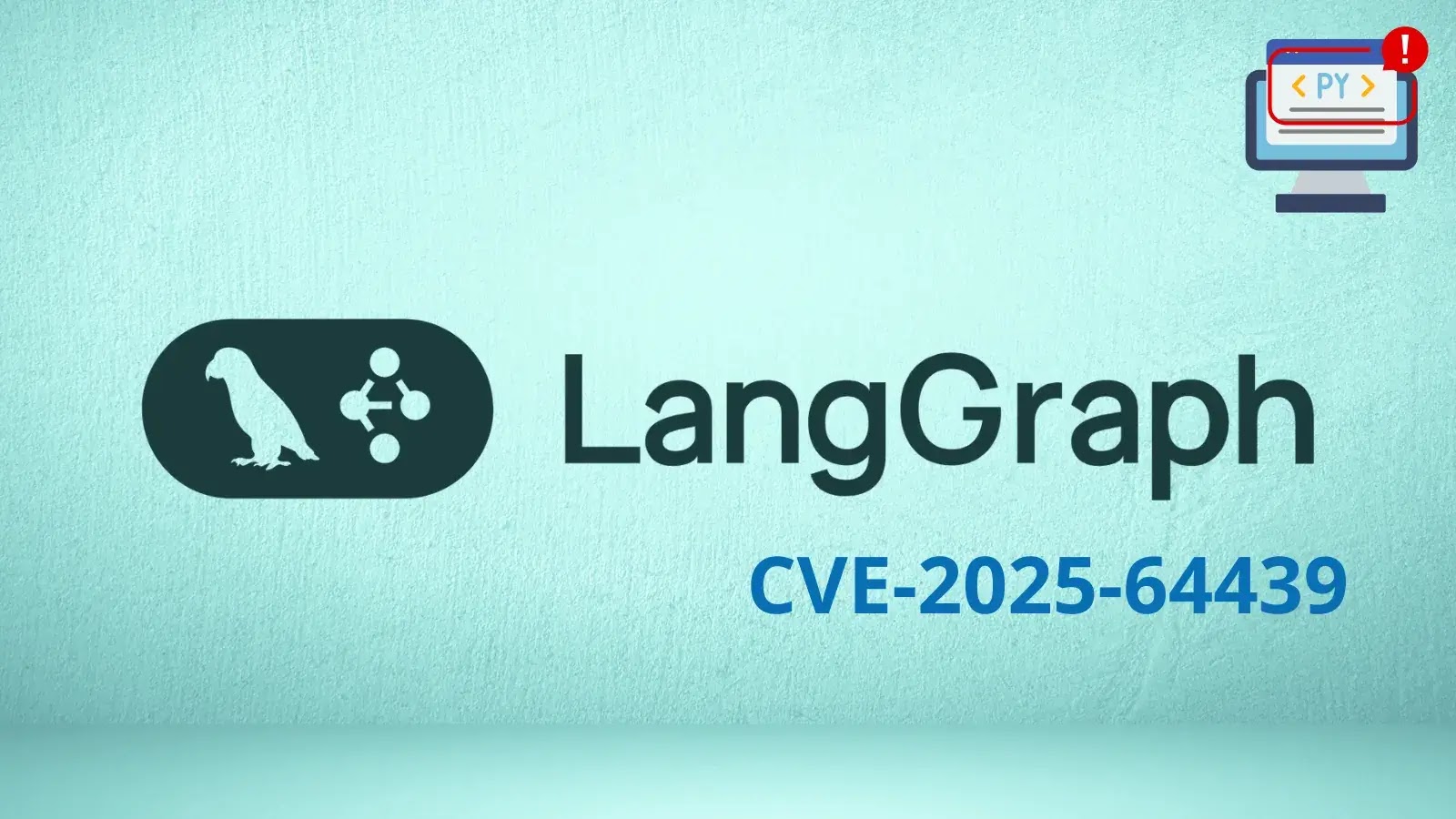
A vital distant code execution vulnerability has been found in LangGraph’s checkpoint serialization system.

The flaw CVE-2025-64439 impacts variations of langgraph-checkpoint earlier than 3.0. It permits attackers to execute arbitrary Python code when untrusted information is deserialized.

The vulnerability resides in LangGraph’s JsonPlusSerializer, the default serialization protocol used for checkpoint persistence.

When the serializer encounters unlawful Unicode surrogate values throughout msgpack serialization, it routinely falls again to JSON mode.

LangGraph Vulnerability

On this fallback state, the deserializer helps a constructor-style format that reconstructs customized objects throughout loading.

The flaw carries a CVSS rating of 8.5, categorised as “Excessive” severity. It falls beneath CWE-502, which covers deserialization of untrusted information vulnerabilities.

An attacker can exploit this mechanism to inject malicious payloads that execute arbitrary features when deserialized.

AttributeDetailsCVE IDCVE-2025-64439Vulnerability TypeRemote Code Execution (RCE)ComponentLangGraph JsonPlusSerializerAffected Versionslanggraph-checkpoint Patched Versionslanggraph-checkpoint >= 3.0SeverityHigh (7.5 CVSS v4)Assault VectorNetwork

The vulnerability primarily impacts functions that meet two circumstances: They permit untrusted or user-supplied information to be endured into checkpoints, they usually use the default JsonPlusSerializer (or explicitly instantiate it).

Purposes processing solely trusted information face considerably decrease sensible threat. LangGraph-API deployments working model 0.5 or later are unaffected.

Attackers can weaponize this vulnerability by way of a rigorously crafted proof-of-concept. That injects a malicious payload structured with particular JSON components: an “lc” worth of two, a “sort” set to “constructor,” and an “id” area pointing to harmful system features like “os.system.”

When the compromised checkpoint is loaded, the deserialization course of routinely executes the embedded command.

LangChain has launched langgraph-checkpoint model 3.0 to deal with this concern.

The repair implements an allow-list for constructor deserialization, limiting permissible paths to explicitly accredited module and sophistication mixtures.

Moreover, saving payloads in JSON format has been deprecated to eradicate this unsafe fallback mechanism. Customers ought to improve instantly to model 3.0 or later.

The replace maintains full compatibility with langgraph 0.3. It requires no code modifications or import adjustments, making the patching course of easy and low-risk for many deployments.

Comply with us on Google Information, LinkedIn, and X for day by day cybersecurity updates. Contact us to characteristic your tales.


Cyber Security News Tags:Code, Deserialization, Execution, LangGraph, Malicious, Python, Vulnerability

Post navigation

Previous Post: Hyper-V Malware, Malicious AI Bots, RDP Exploits, WhatsApp Lockdown and More
Next Post: Critical Vulnerability in Popular NPM Library Exposes AI and NLP Apps to Remote Code Execution

Related Posts

Conducting Risk Assessments That Drive Business Value Conducting Risk Assessments That Drive Business Value Cyber Security News
17,000+ Fake News Websites Caught Promoting Investment Frauds 17,000+ Fake News Websites Caught Promoting Investment Frauds Cyber Security News
Hackers Mimic as OpenAI and Sora Services to Steal Login Credentials Hackers Mimic as OpenAI and Sora Services to Steal Login Credentials Cyber Security News
Blockchain for Cybersecurity Real-World Applications and Limits Blockchain for Cybersecurity Real-World Applications and Limits Cyber Security News
Chrome Use After Free Vulnerability Let Attackers Execute Arbitrary Code Chrome Use After Free Vulnerability Let Attackers Execute Arbitrary Code Cyber Security News
ValleyRAT_S2 Attacking Organizations to Deploy Stealthy Malware and Extract Financial Details ValleyRAT_S2 Attacking Organizations to Deploy Stealthy Malware and Extract Financial Details Cyber Security News

Categories

  • Cyber Security News
  • How To?
  • Security Week News
  • The Hacker News

Recent Posts

  • Critical F5 BIG-IP Vulnerability Now Actively Exploited
  • China-Linked Cyber Threats Target Southeast Asian Government
  • AI-Powered VoidLink Malware Framework Poses New Cyber Threat
  • Top Log Monitoring Tools to Watch in 2026
  • Top Spam Filter Tools for 2026: A Comprehensive Guide

Pages

  • About Us – Contact
  • Disclaimer
  • Privacy Policy
  • Terms and Rules

Archives

  • March 2026
  • February 2026
  • January 2026
  • December 2025
  • November 2025
  • October 2025
  • September 2025
  • August 2025
  • July 2025
  • June 2025
  • May 2025

Recent Posts

  • Critical F5 BIG-IP Vulnerability Now Actively Exploited
  • China-Linked Cyber Threats Target Southeast Asian Government
  • AI-Powered VoidLink Malware Framework Poses New Cyber Threat
  • Top Log Monitoring Tools to Watch in 2026
  • Top Spam Filter Tools for 2026: A Comprehensive Guide

Pages

  • About Us – Contact
  • Disclaimer
  • Privacy Policy
  • Terms and Rules

Categories

  • Cyber Security News
  • How To?
  • Security Week News
  • The Hacker News

Copyright © 2026 Cyber Web Spider Blog – News.

Powered by PressBook Masonry Dark