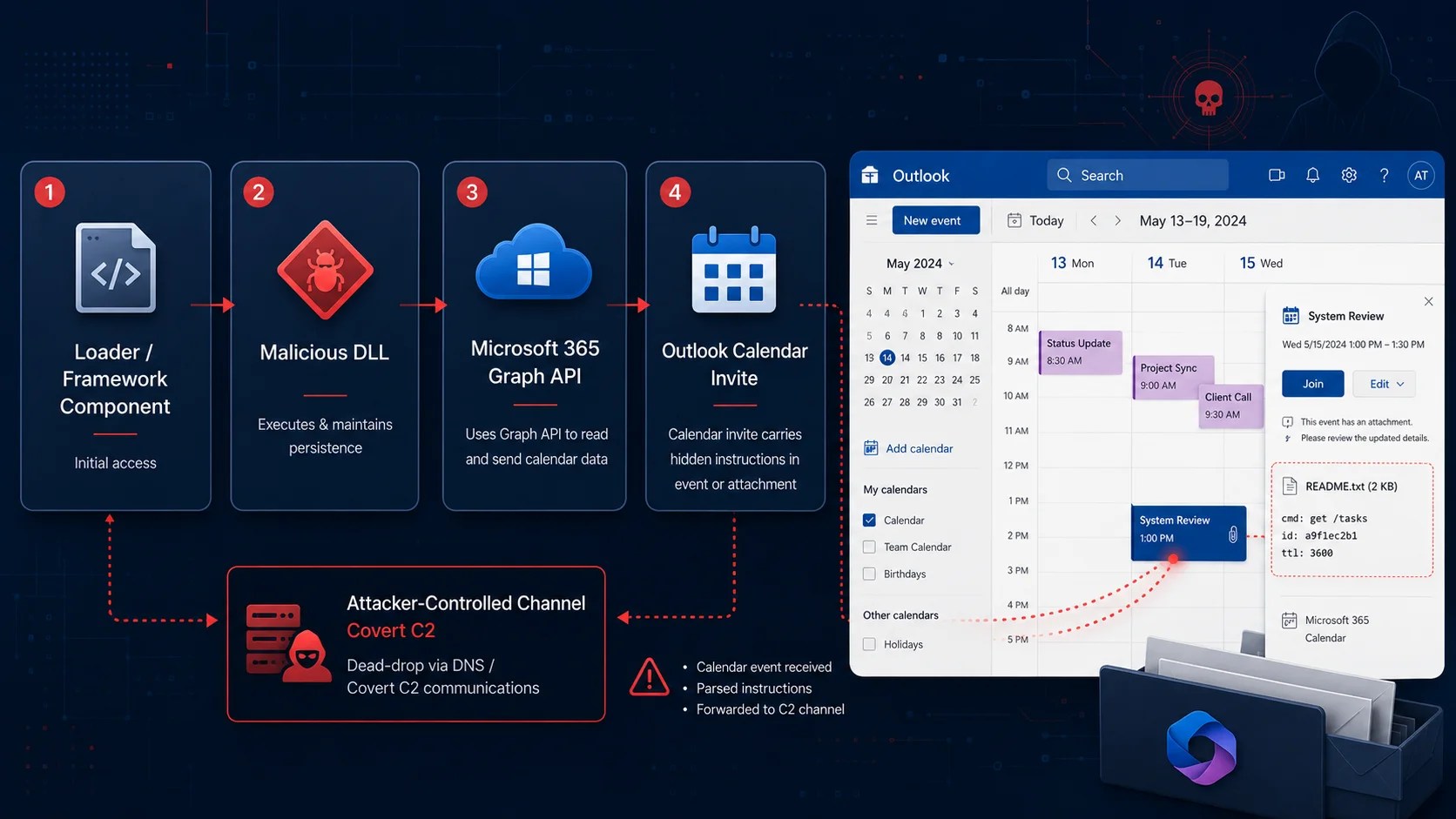
A sophisticated new cyber threat has emerged with the discovery of HOLLOWGRAPH, a malware that covertly communicates with hackers by hijacking Microsoft 365 calendars. By disguising its commands as typical calendar events, this malware remains under the radar while executing its malicious activities.
Malware Exploitation of Microsoft 365 Calendars
HOLLOWGRAPH is a malware component compiled in .NET, leveraging the Microsoft Graph API through compromised Microsoft 365 accounts. It transforms the mailbox calendar into a secret communication channel, or ‘dead drop’, for attackers. This malware operates using two basic commands: ‘get’ and ‘send’. By routing traffic through Microsoft’s cloud infrastructure, it blends seamlessly with regular business operations.
According to a report by Group-IB, attackers embed instructions within calendar events, while the malware extracts stolen files by creating encrypted events, hiding data within file attachments. To ensure these events are unnoticed by users, they are scheduled far into the future, specifically on May 13, 2050.
Additional Stealth Techniques
Beyond calendar manipulation, HOLLOWGRAPH employs DNS tunneling via IPv6 AAAA records to the domain ‘cloudlanecdn[.]com’. This tactic refreshes its Microsoft Entra ID credentials, storing them in a file misleadingly named ‘logAzure.txt’.
The data exchanged through the Graph API is secured with hybrid RSA and AES-256-GCM encryption, using distinct key pairs for incoming and outgoing data, ensuring cryptographic separation.
Attribution and Impact
Group-IB attributes HOLLOWGRAPH with high confidence to the Cavern backdoor framework, a toolkit previously linked to an Iranian actor known as Cavern Manticore. This is based on similar command syntax and shared self-command codes. Some technical similarities to the Lyceum group, associated with Iran’s Ministry of Intelligence and Security, were also noted, although this connection is less certain.
The campaign is not widespread; only 12 systems were identified as infected, with three actively communicating with attackers. The operation appears focused on Israeli organizations, indicating a targeted espionage effort rather than random attacks.
Protection and Detection Measures
Organizations can identify potential infections by searching for calendar events scheduled for 2050-05-13, or events with subjects resembling GUIDs or patterns like ‘Event ID:’ and ‘Boss{..}ID{..}’. Attachments may be named ‘File{n}.txt’.
Security teams should monitor Microsoft Graph activity for unexpected calendar changes, watch for unusual AAAA DNS queries, and flag the domain ‘cloudlanecdn[.]com’ and ‘logAzure.txt’ file. Group-IB advises enhancing cloud visibility, monitoring for misuse of trusted cloud services, and tightening controls on OAuth application permissions and Entra ID credentials to detect similar threats early.
Strengthen your SOC by integrating advanced threat detection tools with your current systems to ensure rapid identification and response to emerging cyber threats.