Skip to content
  • Home
  • Cyber Map
  • About Us – Contact
  • Disclaimer
  • Terms and Rules
  • Privacy Policy
Cyber Web Spider Blog – News

Cyber Web Spider Blog – News

Globe Threat Map provides a real-time, interactive 3D visualization of global cyber threats. Monitor DDoS attacks, malware, and hacking attempts with geo-located arcs on a rotating globe. Stay informed with live logs and archive stats.

  • Home
  • Cyber Map
  • Cyber Security News
  • Security Week News
  • The Hacker News
  • How To?
  • Toggle search form
New ClickFix Attack Tricks Users with ‘Fake OS Update’ to Execute Malicious Commands

New ClickFix Attack Tricks Users with ‘Fake OS Update’ to Execute Malicious Commands

Posted on November 13, 2025November 13, 2025 By CWS

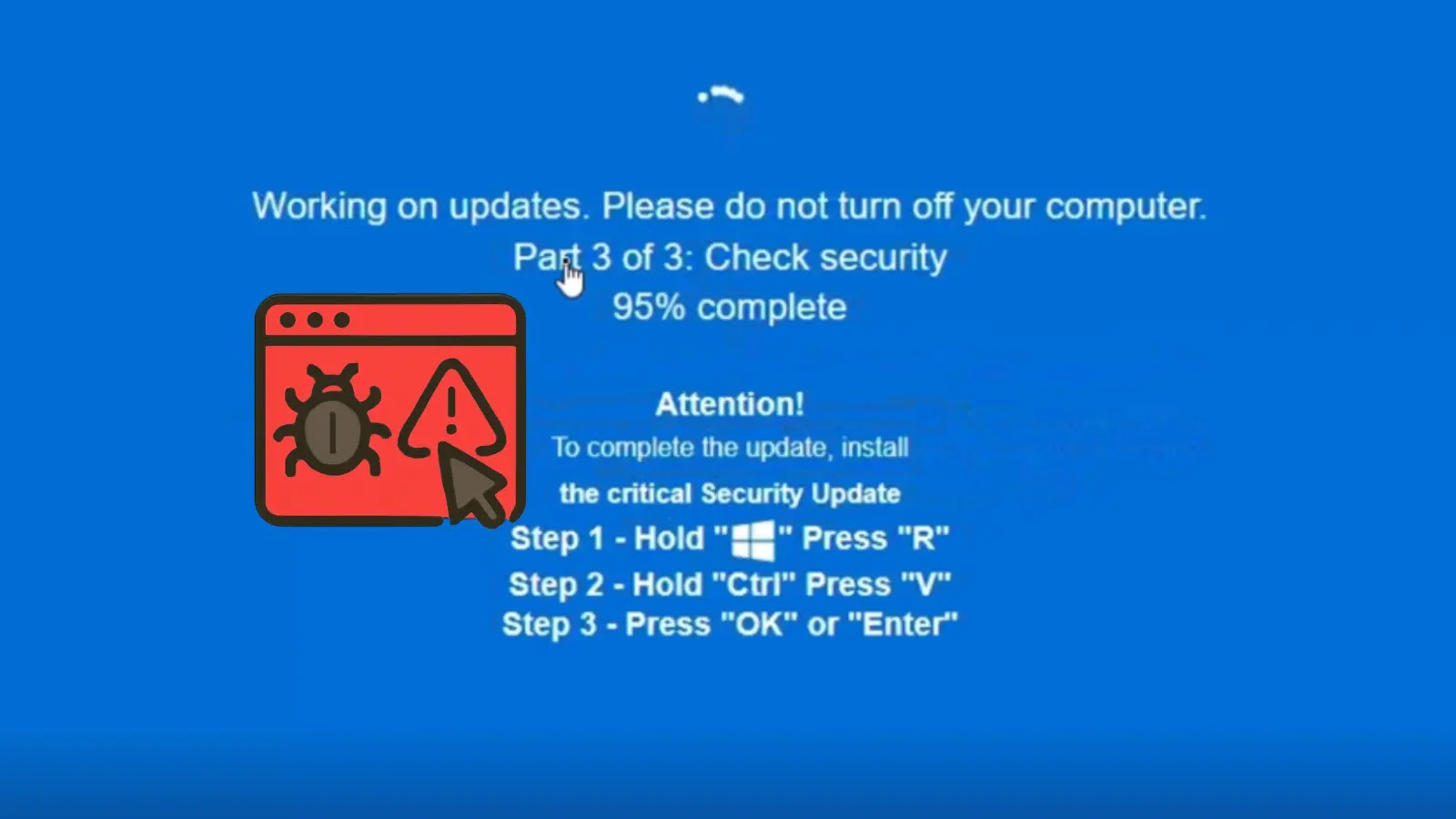
A brand new ClickFix marketing campaign is tricking customers with a faux Home windows replace that runs of their browser. Known as “Faux OS Replace,” this rip-off takes benefit of individuals’s belief within the acquainted blue display of dying (BSOD) from Microsoft.

It delivers malware and reveals how social engineering could be more practical than technical methods.

Cybersecurity researcher Daniel B., who works on the UK’s Nationwide Well being Service, first noticed the assault final month whereas probing malicious on-line threats.

As detailed in his LinkedIn publish, the rip-off operates totally on the area groupewadesecurity[.]com. Merely visiting the positioning typically through malvertising or spam hyperlinks triggers a full-screen overlay mimicking a Home windows OS crash or replace immediate.

The faux BSOD, full with error codes and progress bars, seems on each PCs and smartphones, creating panic and urgency.

What units this other than earlier ClickFix variants is its multi-step deception. After the preliminary display, victims are instructed to carry out three “handbook fixes” utilizing keyboard shortcuts: urgent Ctrl+Alt+Del to “restart companies,” getting into a bogus command in a simulated command immediate, and at last downloading a “restoration device” from a linked malicious web site.

In actuality, these actions grant attackers distant entry or set up infostealers and ransomware loaders. The marketing campaign’s sophistication lies in its cross-device compatibility and avoidance of fast redirects, making it tougher for browser protections to flag.

ClickFix assaults, which trick customers into “fixing” non-existent points through clicks, have plagued browsers since 2020. However as attackers refine their techniques using hyper-realistic graphics, localized languages, and well timed lures tied to actual occasions like Patch Tuesday, this variant proves particularly insidious.

Consultants warn that such campaigns spotlight a essential hole: whereas endpoint detection instruments catch many automated threats, human error stays the weakest hyperlink.

“Person vigilance and common cybersecurity coaching are as very important as firewalls,” notes a spokesperson for the UK’s Nationwide Cyber Safety Centre (NCSC).

Organizations ought to prioritize consciousness packages that simulate these situations, alongside browser extensions equivalent to uBlock Origin to dam suspicious domains.

Comply with us on Google Information, LinkedIn, and X for every day cybersecurity updates. Contact us to characteristic your tales.

Cyber Security News Tags:Attack, ClickFix, Commands, Execute, Fake, Malicious, Tricks, Update, Users

Post navigation

Previous Post: Microsoft SQL Server Vulnerability Let Attackers Escalate Privileges
Next Post: Cisco ISE, CitrixBleed 2 Vulnerabilities Exploited as Zero-Days: Amazon

Related Posts

Hackers Hijacking VNC Connections to Gain Access to OT Control Devices in Critical Infrastructure Hackers Hijacking VNC Connections to Gain Access to OT Control Devices in Critical Infrastructure Cyber Security News
Multiple Schneider Electric Vulnerabilities Let Attackers Inject OS Commands Multiple Schneider Electric Vulnerabilities Let Attackers Inject OS Commands Cyber Security News
India’s New SIM-Binding Rule for WhatsApp, Signal, Telegram, and Other Messaging Platforms India’s New SIM-Binding Rule for WhatsApp, Signal, Telegram, and Other Messaging Platforms Cyber Security News
Thousands of North Korean IT Workers Using VPNs and ‘Laptop Farms’ to Bypass Origin Verification Thousands of North Korean IT Workers Using VPNs and ‘Laptop Farms’ to Bypass Origin Verification Cyber Security News
Jira Software Vulnerability Let Attacker Modify Any Filesystem Path Writable By JVM process Jira Software Vulnerability Let Attacker Modify Any Filesystem Path Writable By JVM process Cyber Security News
Microsoft Copilot Rooted to Gain Unauthorized Root Access to its Backend System Microsoft Copilot Rooted to Gain Unauthorized Root Access to its Backend System Cyber Security News

Categories

  • Cyber Security News
  • How To?
  • Security Week News
  • The Hacker News

Recent Posts

  • VMware Fusion Vulnerability Receives Critical Update
  • Critical Vulnerability in MongoDB Risks Data Exposure
  • Windows Zero-Day Exploits: YellowKey and GreenPlasma Revealed
  • Fragnesia Linux Kernel Vulnerability Allows Root Access
  • NGINX Vulnerability Allows Remote Code Execution

Pages

  • About Us – Contact
  • Disclaimer
  • Privacy Policy
  • Terms and Rules

Archives

  • May 2026
  • April 2026
  • March 2026
  • February 2026
  • January 2026
  • December 2025
  • November 2025
  • October 2025
  • September 2025
  • August 2025
  • July 2025
  • June 2025
  • May 2025

Recent Posts

  • VMware Fusion Vulnerability Receives Critical Update
  • Critical Vulnerability in MongoDB Risks Data Exposure
  • Windows Zero-Day Exploits: YellowKey and GreenPlasma Revealed
  • Fragnesia Linux Kernel Vulnerability Allows Root Access
  • NGINX Vulnerability Allows Remote Code Execution

Pages

  • About Us – Contact
  • Disclaimer
  • Privacy Policy
  • Terms and Rules

Categories

  • Cyber Security News
  • How To?
  • Security Week News
  • The Hacker News

Copyright © 2026 Cyber Web Spider Blog – News.

Powered by PressBook Masonry Dark