Skip to content
  • Home
  • Cyber Map
  • About Us – Contact
  • Disclaimer
  • Terms and Rules
  • Privacy Policy
Cyber Web Spider Blog – News

Cyber Web Spider Blog – News

Globe Threat Map provides a real-time, interactive 3D visualization of global cyber threats. Monitor DDoS attacks, malware, and hacking attempts with geo-located arcs on a rotating globe. Stay informed with live logs and archive stats.

  • Home
  • Cyber Map
  • Cyber Security News
  • Security Week News
  • The Hacker News
  • How To?
  • Toggle search form
PoC Exploit Released for Critical React, Next.js RCE Vulnerability (CVE-2025-55182)

PoC Exploit Released for Critical React, Next.js RCE Vulnerability (CVE-2025-55182)

Posted on December 5, 2025December 5, 2025 By CWS

A proof-of-concept (PoC) exploit for CVE-2025-55182, a maximum-severity distant code execution (RCE) flaw in React Server Elements, surfaced publicly this week, heightening alarms for builders worldwide.

Dubbed “React2Shell” by some researchers, the vulnerability carries a CVSS rating of 10.0 and impacts React variations 19.0.0 via 19.2.0, in addition to Subsequent.js 15.x and 16.x utilizing App Router. Even functions not explicitly implementing server features stay uncovered in the event that they help React Server Elements (RSC).​

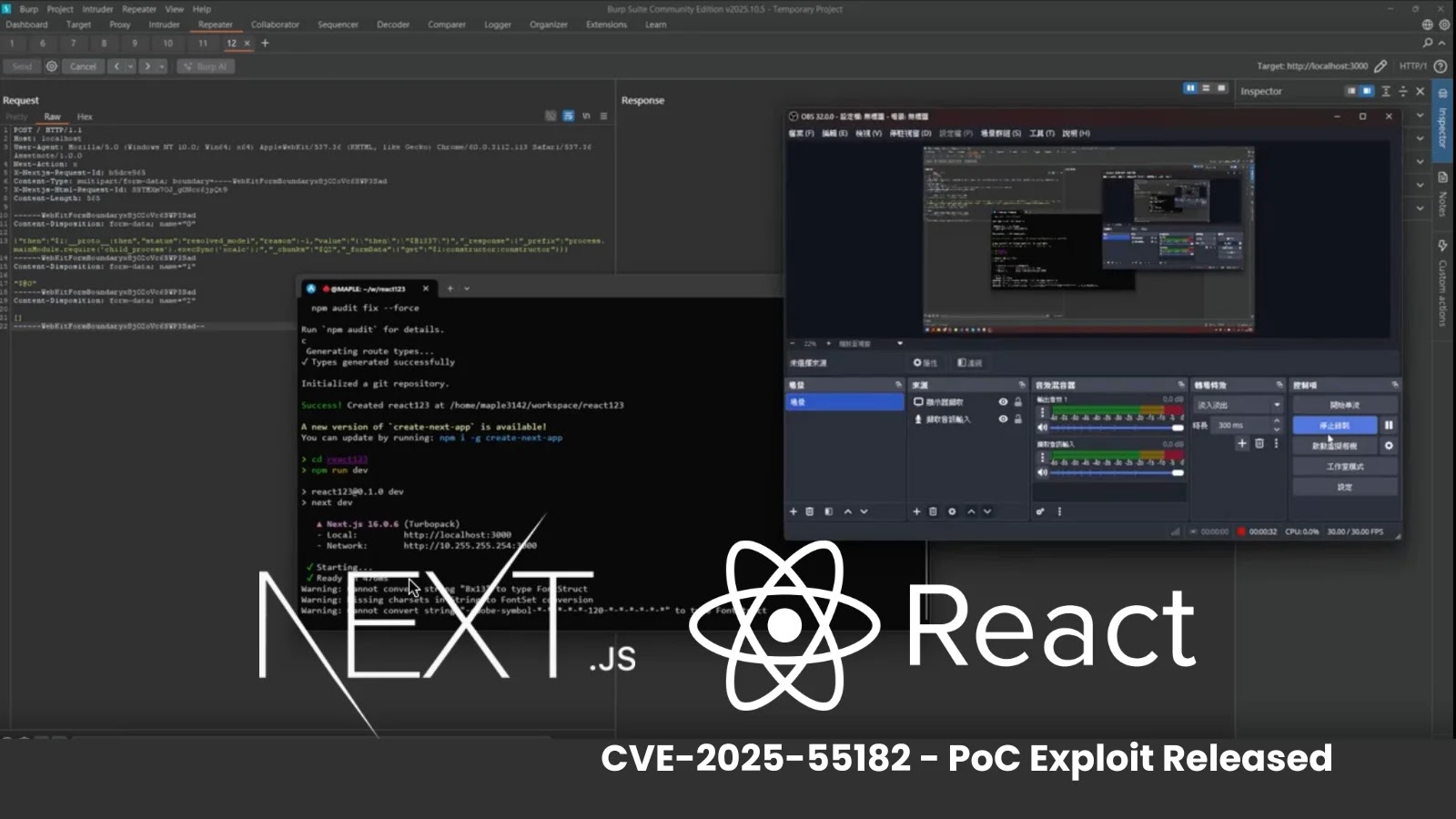
Safety researcher @maple3142 demonstrated the exploit through a Twitter submit, showcasing a easy multipart HTTP request that injects a Node.js payload.

The demo triggers little one course of, popping open a Linux calculator on the goal server with out authentication.

An accompanying video captures a curl-like command exploiting the flaw via React’s Flight protocol, bypassing serialization safeguards with strategies like Blob references labeled “$B1337.” Framed as a CTF-style “JS jail” problem, the shared gist drew reward from the group alongside questions on evasion strategies.​

The basis trigger lies in insecure deserialization throughout the RSC Flight protocol, the place malformed payloads pollute object prototypes and hijack server-side execution.

Found by Lachlan Davidson and responsibly disclosed to Meta and Vercel on November 29, the problem went public on December 3, prompting swift patches.

A brand new scanner device was additionally launched to determine susceptible endpoints on the community for CVE-2025-55182.

Amazon risk intelligence reported exploitation makes an attempt by China-nexus teams like Earth Lamia inside hours of disclosure. Wiz Analysis estimates 39% of cloud environments host susceptible cases, scanning over 968,000 servers.​

Palo Alto Networks Unit 42 and others confirmed the assault requires solely a crafted POST request to RSC endpoints, attaining near-100% reliability in exams. React’s official advisory urges instant upgrades, noting the flaw persists in default configurations of common frameworks.​

Builders ought to audit deployments, apply patches from React 19.2.1+ and Subsequent.js updates, and monitor for anomalies.

Whereas no widespread breaches are confirmed but, the PoC’s simplicity amplifies dangers in manufacturing environments. This incident underscores the perils of server-side rendering in fashionable JavaScript stacks.​

Observe us on Google Information, LinkedIn, and X for day by day cybersecurity updates. Contact us to characteristic your tales.

Cyber Security News Tags:Critical, CVE202555182, Exploit, Next.js, PoC, RCE, React, Released, Vulnerability

Post navigation

Previous Post: India Rolls Back Order to Preinstall Cybersecurity App on Smartphones
Next Post: China-Nexus Hackers Actively Exploiting React2Shell Vulnerability in The Wild

Related Posts

Threat Actors Gaining Access to Victims’ Machines and Monetizing Access to Their Bandwidth Threat Actors Gaining Access to Victims’ Machines and Monetizing Access to Their Bandwidth Cyber Security News
Chinese Front Companies Providing Advanced Steganography Solutions for APT Operations Chinese Front Companies Providing Advanced Steganography Solutions for APT Operations Cyber Security News
Hacktivist Groups Attacks on Critical ICS Systems to Steal Sensitive Data Hacktivist Groups Attacks on Critical ICS Systems to Steal Sensitive Data Cyber Security News
Fake CAPTCHA Attack Leverages Microsoft Application Virtualization (App-V) to Deploy Malware Fake CAPTCHA Attack Leverages Microsoft Application Virtualization (App-V) to Deploy Malware Cyber Security News
Google’s New AI Agent, CodeMender, Automatically Rewrites Vulnerable Code Google’s New AI Agent, CodeMender, Automatically Rewrites Vulnerable Code Cyber Security News
Microsoft Teams to Enforce Messaging Safety Defaults Starting January 2026 Microsoft Teams to Enforce Messaging Safety Defaults Starting January 2026 Cyber Security News

Categories

  • Cyber Security News
  • How To?
  • Security Week News
  • The Hacker News

Recent Posts

  • Rapid SSH Worm Exploits Linux Systems with Credential Stuffing
  • Odido Telecom Hacked: 6.2 Million Accounts Compromised
  • Lazarus Group Targets npm and PyPI with Malicious Packages
  • DragonForce Ransomware Group’s Expanding Cartel Operations
  • North Korean Hackers Exploit AI for Enhanced Cyber Attacks

Pages

  • About Us – Contact
  • Disclaimer
  • Privacy Policy
  • Terms and Rules

Archives

  • February 2026
  • January 2026
  • December 2025
  • November 2025
  • October 2025
  • September 2025
  • August 2025
  • July 2025
  • June 2025
  • May 2025

Recent Posts

  • Rapid SSH Worm Exploits Linux Systems with Credential Stuffing
  • Odido Telecom Hacked: 6.2 Million Accounts Compromised
  • Lazarus Group Targets npm and PyPI with Malicious Packages
  • DragonForce Ransomware Group’s Expanding Cartel Operations
  • North Korean Hackers Exploit AI for Enhanced Cyber Attacks

Pages

  • About Us – Contact
  • Disclaimer
  • Privacy Policy
  • Terms and Rules

Categories

  • Cyber Security News
  • How To?
  • Security Week News
  • The Hacker News