Skip to content
  • Home
  • Cyber Map
  • About Us – Contact
  • Disclaimer
  • Terms and Rules
  • Privacy Policy
Cyber Web Spider Blog – News

Cyber Web Spider Blog – News

Globe Threat Map provides a real-time, interactive 3D visualization of global cyber threats. Monitor DDoS attacks, malware, and hacking attempts with geo-located arcs on a rotating globe. Stay informed with live logs and archive stats.

  • Home
  • Cyber Map
  • Cyber Security News
  • Security Week News
  • The Hacker News
  • How To?
  • Toggle search form
15 TP-Link Omada Flaws Risk Network Security

15 TP-Link Omada Flaws Risk Network Security

Posted on August 5, 2026 By CWS

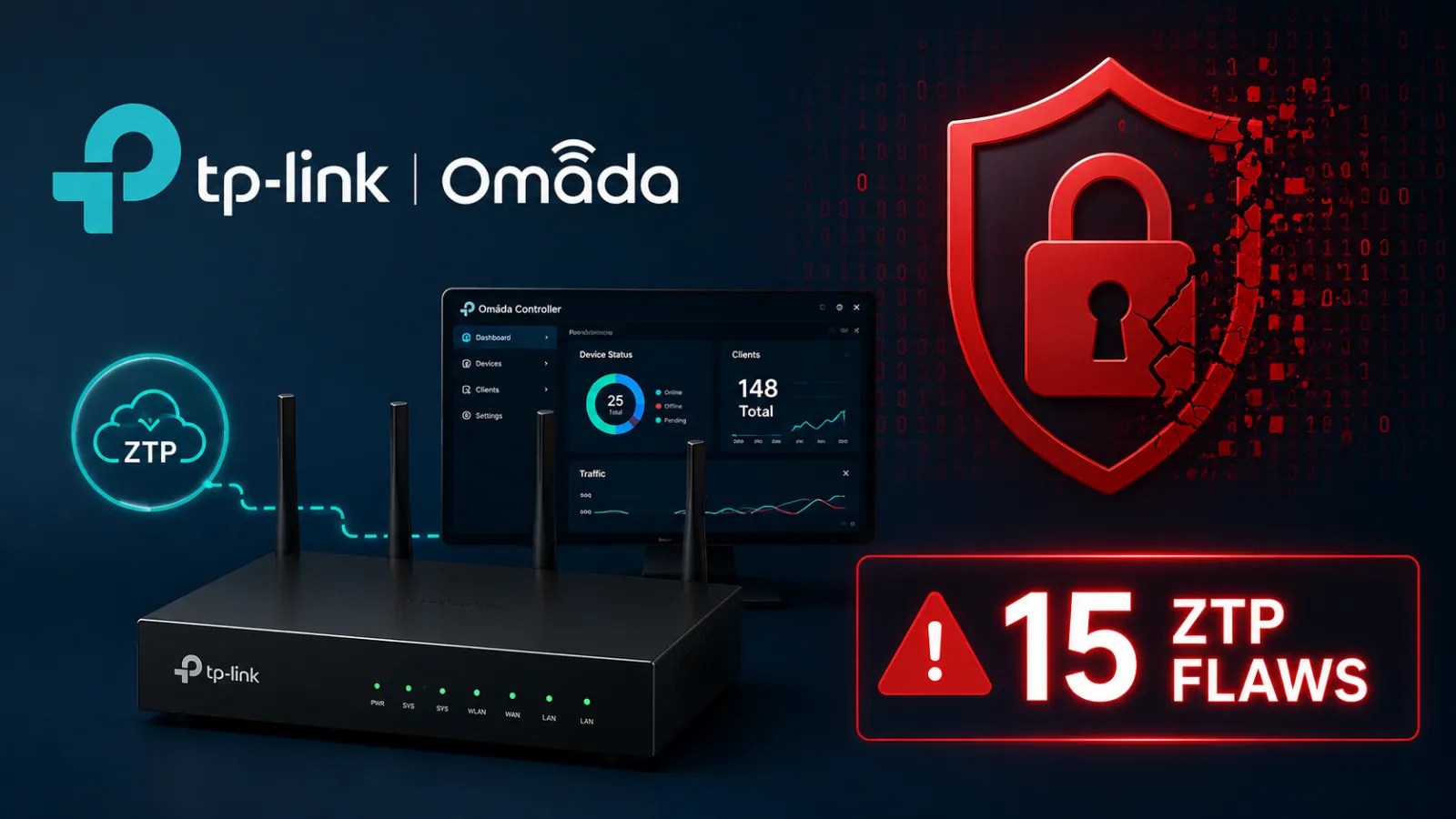
A recently discovered group of 15 vulnerabilities in TP-Link’s Omada Zero-Touch Provisioning (ZTP) poses significant threats to enterprise networks. These findings are slated for presentation at Black Hat USA 2026, highlighting potential risks in network security management.

Understanding TP-Link Omada and Its Role

TP-Link Omada is a centralized system used for managing routers, switches, gateways, and wireless access points. The ZTP feature allows for quick deployment of numerous devices by automatically connecting them to a controller and updating their configurations and firmware without manual intervention. This automation, while efficient, also presents a tempting target for cyber threats.

Compromising the relationship between the controller and its devices can allow attackers to control multiple devices, threatening entire network systems rather than isolated units.

Vulnerability Scope and Impact

The vulnerabilities affect cloud, software, and hardware controllers, as well as Omada and Festa VPN routers. They also may impact TP-Link’s IP cameras, smart-home products, and several Android applications like Tapo, Kasa, and Deco. Key issues include client-side code execution, information disclosure, device hijacking, and encrypted communication compromise.

Critical vulnerabilities such as CVE-2025-15628 involve hard-coded TLS certificates undermining trust between controllers and devices. CVE-2025-15627 affects protocol version 1, allowing attackers to mimic trusted systems or intercept communications.

Exploiting and Mitigating the Risks

Research by Forescout uncovered a cloud adoption race condition (CVE-2025-15630) enabling attackers to spoof MAC addresses and steal sensitive configuration data. Another issue, CVE-2025-9289, involves cross-channel scripting in the web interface, potentially leading to credential theft or controller data extraction.

When combined with previously identified vulnerabilities, these could enable a full-scale attack, including root code execution on affected devices. To mitigate these risks, organizations should implement TP-Link’s updates, enforce strong credential policies, and utilize multi-factor authentication.

Recommendations for Network Defense

Administrators are advised to avoid shared passwords and regularly change VPN credentials. It’s crucial to limit local man-in-the-middle attacks through protocols like 802.1X and network segmentation. Continuous intrusion detection and monitoring are also vital to distinguish between legitimate management activities and potential threats.

As cybersecurity threats evolve, maintaining robust security measures and staying informed about vulnerabilities are essential to safeguarding enterprise networks.

Cyber Security News Tags:Black Hat USA, cloud security, CVE, Cybersecurity, data protection, device hijacking, Encryption, enterprise networks, network management, network security, Omada, router security, TP-Link, Vulnerabilities, ZTP

Post navigation

Previous Post: Black Hat USA 2026: Latest Cybersecurity Announcements

Related Posts

Hackers Scanning Cisco ASA Devices to Exploit Vulnerabilities from 25,000 IPs Hackers Scanning Cisco ASA Devices to Exploit Vulnerabilities from 25,000 IPs Cyber Security News
APT35 Hacker Groups Internal Documents Leak Exposes their Targets and Attack Methods APT35 Hacker Groups Internal Documents Leak Exposes their Targets and Attack Methods Cyber Security News
Antv NPM Packages Compromised in Supply Chain Attack Antv NPM Packages Compromised in Supply Chain Attack Cyber Security News
CISA Warns of Android 0-Day Use-After-Free Vulnerability Exploited in Attacks CISA Warns of Android 0-Day Use-After-Free Vulnerability Exploited in Attacks Cyber Security News
Chinese Cyber Espionage Targets Singapore Telecom Industry Chinese Cyber Espionage Targets Singapore Telecom Industry Cyber Security News
15 Best Website Monitoring Tools in 2025 15 Best Website Monitoring Tools in 2025 Cyber Security News

Categories

  • Cyber Security News
  • How To?
  • Security Week News
  • The Hacker News

Recent Posts

  • 15 TP-Link Omada Flaws Risk Network Security
  • Black Hat USA 2026: Latest Cybersecurity Announcements
  • Critical Vulnerabilities Patched in Veeam, Terraform, and Django
  • Counterfeit Open VSX Extensions Compromise Developer Data
  • Malware Exploits Passkey Systems in New Attack Methods

Pages

  • About Us – Contact
  • Disclaimer
  • Privacy Policy
  • Terms and Rules

Archives

  • August 2026
  • July 2026
  • June 2026
  • May 2026
  • April 2026
  • March 2026
  • February 2026
  • January 2026
  • December 2025
  • November 2025
  • October 2025
  • September 2025
  • August 2025
  • July 2025
  • June 2025
  • May 2025

Recent Posts

  • 15 TP-Link Omada Flaws Risk Network Security
  • Black Hat USA 2026: Latest Cybersecurity Announcements
  • Critical Vulnerabilities Patched in Veeam, Terraform, and Django
  • Counterfeit Open VSX Extensions Compromise Developer Data
  • Malware Exploits Passkey Systems in New Attack Methods

Pages

  • About Us – Contact
  • Disclaimer
  • Privacy Policy
  • Terms and Rules

Categories

  • Cyber Security News
  • How To?
  • Security Week News
  • The Hacker News

Copyright © 2026 Cyber Web Spider Blog – News.

Powered by PressBook Masonry Dark