A recent disclosure has uncovered a critical vulnerability within Visual Studio Code’s Remote-SSH extension, revealing a severe post-compromise attack vector. This flaw allows attackers to transition from compromised developer machines into broader cloud and production environments, posing a substantial threat to organizations reliant on remote access to infrastructure.
Widespread Development Challenges
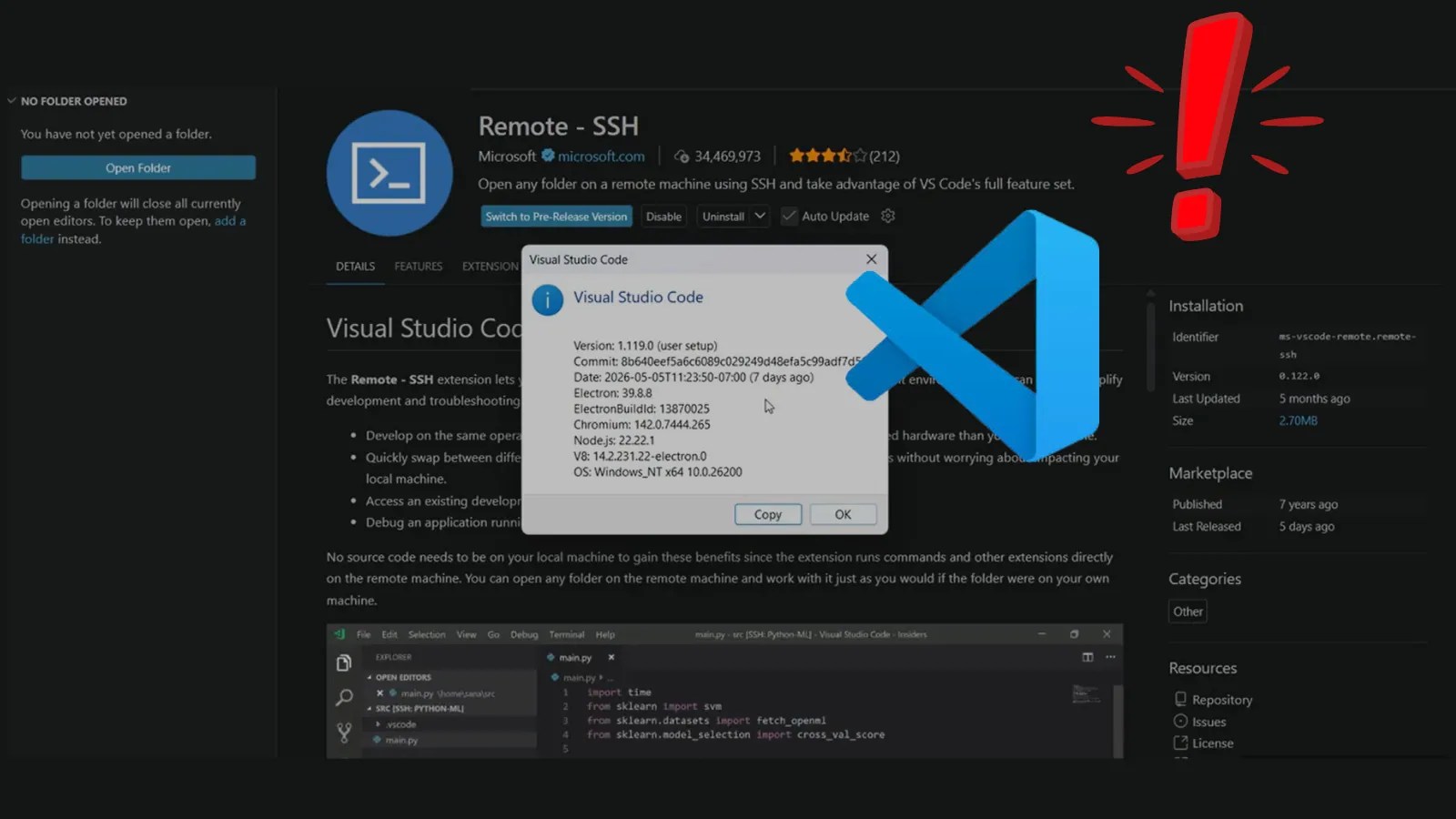
The Remote-SSH extension is integral to many modern development processes, facilitating seamless connections to AWS EC2 instances, Azure virtual machines, and on-premises servers. This capability effectively establishes a trusted connection between local development systems and sensitive remote environments. However, recent research indicates that this trust can be exploited to enable remote code execution on connected infrastructure.
The vulnerability originates from the way VS Code manages Remote-SSH session initiation. Specifically, the application generates a shell script locally, stored in a temporary directory writable by users. This script is then automatically transferred and executed on the target system. The process lacks critical integrity checks, such as file locking and signature verification, leading to a Time-of-Check to Time-of-Use (TOCTOU) race condition.
Exploitation and Potential Impact
An attacker with access to a compromised developer environment can monitor the temporary directory, intercept the generated script, and insert malicious payloads before execution. Even sessions secured with multi-factor authentication (MFA) are vulnerable, as the tampered script is executed post-login, granting attackers code execution on remote servers.
This breach of trust enables attackers to move laterally from developer workstations into cloud infrastructures like AWS and Azure without needing additional exploits. Proof-of-concept attacks have demonstrated successful breaches in various environments, including Azure VMs, AWS EC2, and local servers. Notably, the attack does not circumvent authentication but leverages it to execute post-authentication, rendering MFA ineffective.
Mitigation and Microsoft’s Response
With over 76 million installations affected, including extensions like Remote-SSH, Remote Explorer, and AWS Toolkit, the exposure is extensive. Microsoft has acknowledged the report but classified the behavior as consistent with the product’s design, leaving risk mitigation primarily to users and organizations.
Security experts emphasize this vulnerability as a post-compromise technique aligned with contemporary attack strategies, highlighting the risk of trusted developer workflows becoming conduits for cloud breaches. Organizations are advised to avoid using Remote-SSH on untrusted systems and to isolate developer environments to minimize cloud compromise risks. Monitoring temporary directories for unauthorized changes and detecting anomalous remote system activities can also aid in identifying exploitation attempts.
This revelation underscores a growing trend in cybersecurity: developer environments are increasingly targeted not for inherent weaknesses but due to their trusted status within cloud ecosystems. As the landscape evolves, vigilance in monitoring and securing development environments becomes paramount.