Skip to content
  • Home
  • Cyber Map
  • About Us – Contact
  • Disclaimer
  • Terms and Rules
  • Privacy Policy
Cyber Web Spider Blog – News

Cyber Web Spider Blog – News

Globe Threat Map provides a real-time, interactive 3D visualization of global cyber threats. Monitor DDoS attacks, malware, and hacking attempts with geo-located arcs on a rotating globe. Stay informed with live logs and archive stats.

  • Home
  • Cyber Map
  • Cyber Security News
  • Security Week News
  • The Hacker News
  • How To?
  • Toggle search form
New “Brash” Exploit Crashes Chromium Browsers Instantly with a Single Malicious URL

New “Brash” Exploit Crashes Chromium Browsers Instantly with a Single Malicious URL

Posted on October 30, 2025October 30, 2025 By CWS

Oct 30, 2025Ravie LakshmananBrowser Safety / Vulnerability
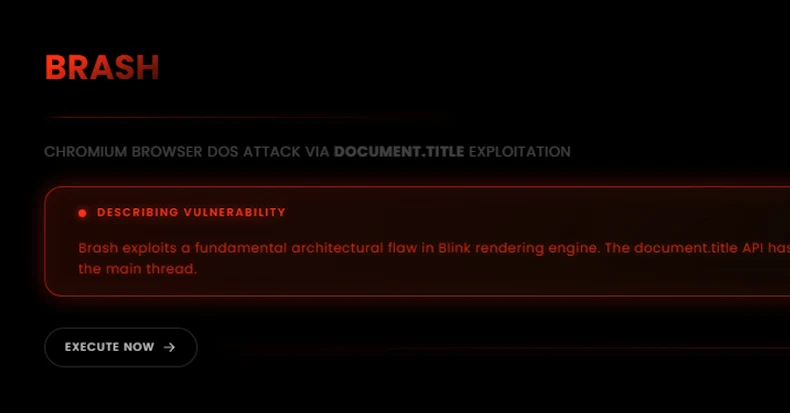
A extreme vulnerability disclosed in Chromium’s Blink rendering engine could be exploited to crash many Chromium-based browsers inside a couple of seconds.
Safety researcher Jose Pino, who disclosed particulars of the flaw, has codenamed it Brash.
“It permits any Chromium browser to break down in 15-60 seconds by exploiting an architectural flaw in how sure DOM operations are managed,” Pino mentioned in a technical breakdown of the shortcoming.
At its core, Brash stems from the shortage of charge limiting on “doc.title” API updates, which, in flip, permits for bombarding hundreds of thousands of [document object model] mutations per second, inflicting the online browser to crash, in addition to degrade system efficiency because of devoting CPU assets to this course of.

The assault performs out in three steps –

Hash era or preparation part, the place the attacker preloads into reminiscence 100 distinctive hexadecimal strings of 512 characters that act as a seed for the browser tab title modifications per interval in order to maximise the impression of the assault
Burst injection part, the place bursts of three consecutive doc.title updates are executed, injecting roughly 24 million updates per second in default configuration (burst: 8000, interval: 1ms)
UI thread saturation part, the place the continual stream of updates saturates the browser’s predominant thread, inflicting it to go unresponsive and requiring pressured termination

“A vital function that amplifies Brash’s hazard is its capacity to be programmed to execute at particular moments,” Pino mentioned. “An attacker can inject the code with a temporal set off, remaining dormant till a predetermined precise time.”
“This kinetic timing functionality transforms Brash from a disruption software right into a temporal precision weapon, the place the attacker controls not solely the ‘what’ and ‘the place,’ but additionally the ‘when’ with millisecond accuracy.”

This additionally signifies that the assault can act like a logic bomb that is configured to detonate at a selected time or after a sure period of time has elapsed, all whereas evading preliminary inspection or detection. In a hypothetical assault situation, all it could take is a click on of a specifically crafted URL to set off the conduct, resulting in unintended penalties.
The vulnerability works on Google Chrome and all internet browsers that run on Chromium, which incorporates Microsoft Edge, Courageous, Opera, Vivaldi, Arc Browser, Dia Browser, OpenAI ChatGPT Atlas, and Perplexity Comet. Mozilla Firefox and Apple Safari are proof against the assault, as are all third-party browsers on iOS, on condition that they’re all primarily based on WebKit.
The Hacker Information has reached out to Google for additional touch upon the findings and its plans for a repair, and we are going to replace the story if we hear again.


The Hacker News Tags:Brash, Browsers, Chromium, Crashes, Exploit, Instantly, Malicious, Single, URL

Post navigation

Previous Post: 12 Malicious Extension in VSCode Marketplace Steal Source Code and Exfiltrate Login Credentials
Next Post: New Malware Targeting WooCommerce Sites with Malicious Plugins Steals Credit Card Data

Related Posts

How AI-Enabled Workflow Automation Can Help SOCs Reduce Burnout How AI-Enabled Workflow Automation Can Help SOCs Reduce Burnout The Hacker News
Google Brings AirDrop Compatibility to Android’s Quick Share Using Rust-Hardened Security Google Brings AirDrop Compatibility to Android’s Quick Share Using Rust-Hardened Security The Hacker News
A New Approach to a Decade-Old Challenge A New Approach to a Decade-Old Challenge The Hacker News
Public Exploit for Chained SAP Flaws Exposes Unpatched Systems to Remote Code Execution Public Exploit for Chained SAP Flaws Exposes Unpatched Systems to Remote Code Execution The Hacker News
Your First and Last Line of Defense Your First and Last Line of Defense The Hacker News
Malicious Outlook Add-In Exploits Supply Chain Flaws Malicious Outlook Add-In Exploits Supply Chain Flaws The Hacker News

Categories

  • Cyber Security News
  • How To?
  • Security Week News
  • The Hacker News

Recent Posts

  • Muddled Libra Exploits VMware vSphere in Cyber Attack
  • Feiniu NAS Devices Targeted in Major Botnet Attack
  • Rapid SSH Worm Exploits Linux Systems with Credential Stuffing
  • Odido Telecom Hacked: 6.2 Million Accounts Compromised
  • Lazarus Group Targets npm and PyPI with Malicious Packages

Pages

  • About Us – Contact
  • Disclaimer
  • Privacy Policy
  • Terms and Rules

Archives

  • February 2026
  • January 2026
  • December 2025
  • November 2025
  • October 2025
  • September 2025
  • August 2025
  • July 2025
  • June 2025
  • May 2025

Recent Posts

  • Muddled Libra Exploits VMware vSphere in Cyber Attack
  • Feiniu NAS Devices Targeted in Major Botnet Attack
  • Rapid SSH Worm Exploits Linux Systems with Credential Stuffing
  • Odido Telecom Hacked: 6.2 Million Accounts Compromised
  • Lazarus Group Targets npm and PyPI with Malicious Packages

Pages

  • About Us – Contact
  • Disclaimer
  • Privacy Policy
  • Terms and Rules

Categories

  • Cyber Security News
  • How To?
  • Security Week News
  • The Hacker News