
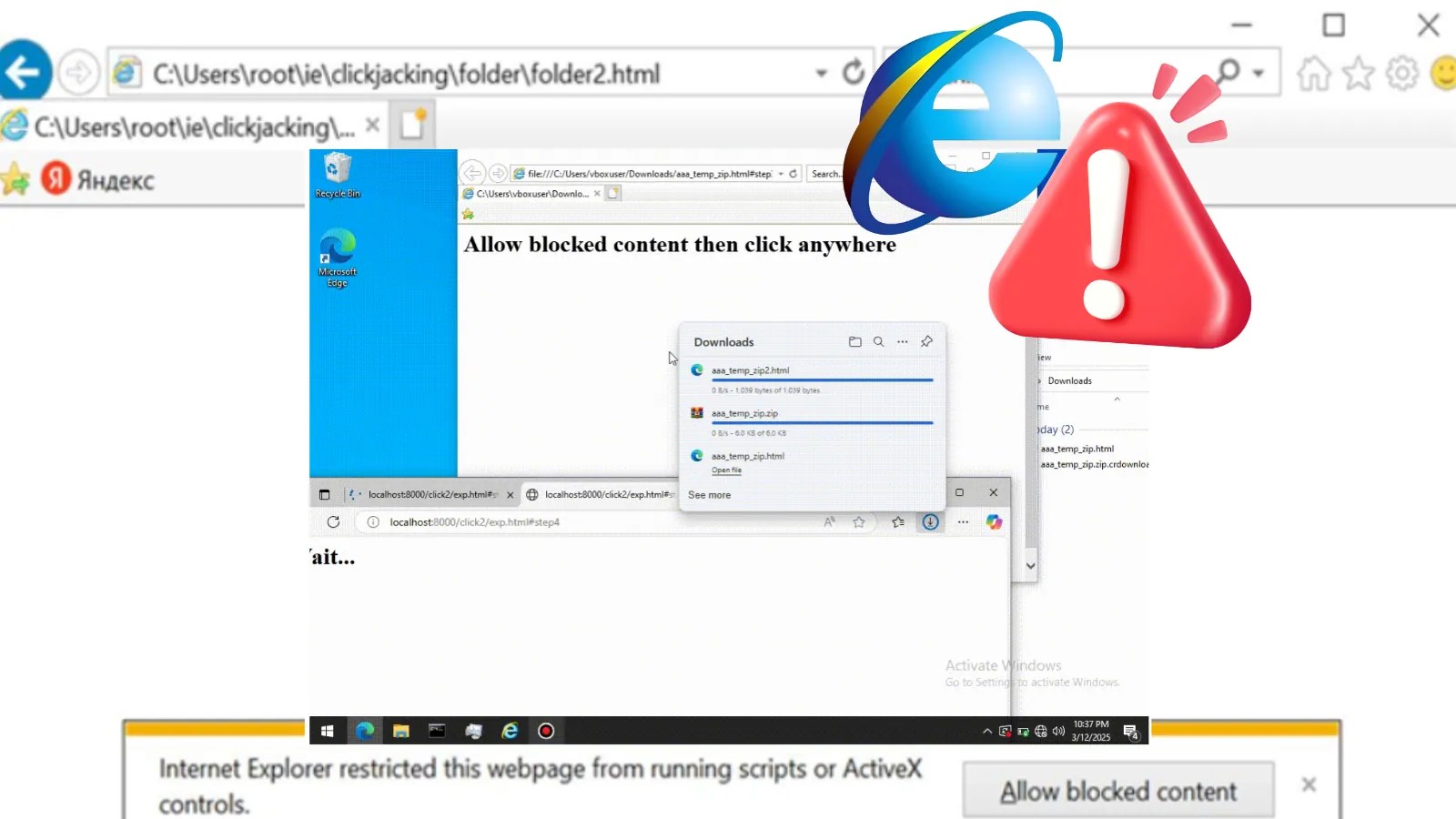
The legacy WebBrowser control within Internet Explorer remains a significant security risk, enabling attackers to achieve remote code execution (RCE) on Windows systems through a single user interaction. Despite Internet Explorer being officially retired, its embedded components in various applications continue to pose vulnerabilities.
Exploitation of Internet Explorer’s Legacy Components
Security researchers at PT Security have highlighted how attackers exploit Internet Explorer’s zone model, Mark of the Web (MOTW), and COM/ActiveX components to execute code remotely. The mshtml engine and WebBrowser control are integral to many desktop applications, particularly older VB, .NET, and C/C++ tools, which often lack adequate HTML and JavaScript sanitization, making them susceptible to cross-site scripting (XSS) attacks.
Mechanics of the RCE Attack Chain
Once attackers achieve script execution within a localhost context, they harness Internet Explorer’s handling of localhost and file zones to open local HTML files, effectively elevating the script’s privileges. A timing flaw in Internet Explorer’s window operations permits crafted JavaScript to open these files without security prompts, enabling the bypass of MOTW restrictions.
Microsoft has addressed the direct execution from localhost scripts, yet the attack chain persists. By leveraging both Internet Explorer and Microsoft Edge, attackers can bypass MOTW, turning remote payloads into local scripts without security warnings, thus facilitating higher-privilege execution.
Mitigation Strategies and Future Outlook
To mitigate these risks, experts recommend replacing Internet Explorer’s WebBrowser control with modern, sandboxed alternatives. Eliminating XSS vulnerabilities in localhost web interfaces and enforcing stringent ActiveX/COM policies are critical steps. Additionally, enhancing MOTW-based execution rules can significantly reduce exposure to these exploits.
The continued reliance on outdated components like Internet Explorer’s WebBrowser control underscores the importance of proactive cybersecurity measures. Organizations must prioritize updating legacy systems to prevent exploitation and safeguard against potential threats.
Stay informed about the latest cybersecurity developments by following us on Google News, LinkedIn, and X.



.webp?ssl=1 "Hackers Exploit Microsoft 365 Mailbox Rules for Email Interception")