Skip to content
  • Home
  • Cyber Map
  • About Us – Contact
  • Disclaimer
  • Terms and Rules
  • Privacy Policy
Cyber Web Spider Blog – News

Cyber Web Spider Blog – News

Globe Threat Map provides a real-time, interactive 3D visualization of global cyber threats. Monitor DDoS attacks, malware, and hacking attempts with geo-located arcs on a rotating globe. Stay informed with live logs and archive stats.

  • Home
  • Cyber Map
  • Cyber Security News
  • Security Week News
  • The Hacker News
  • How To?
  • Toggle search form
Critical Linux Kernel Exploit Grants Root Access

Critical Linux Kernel Exploit Grants Root Access

Posted on June 26, 2026 By CWS

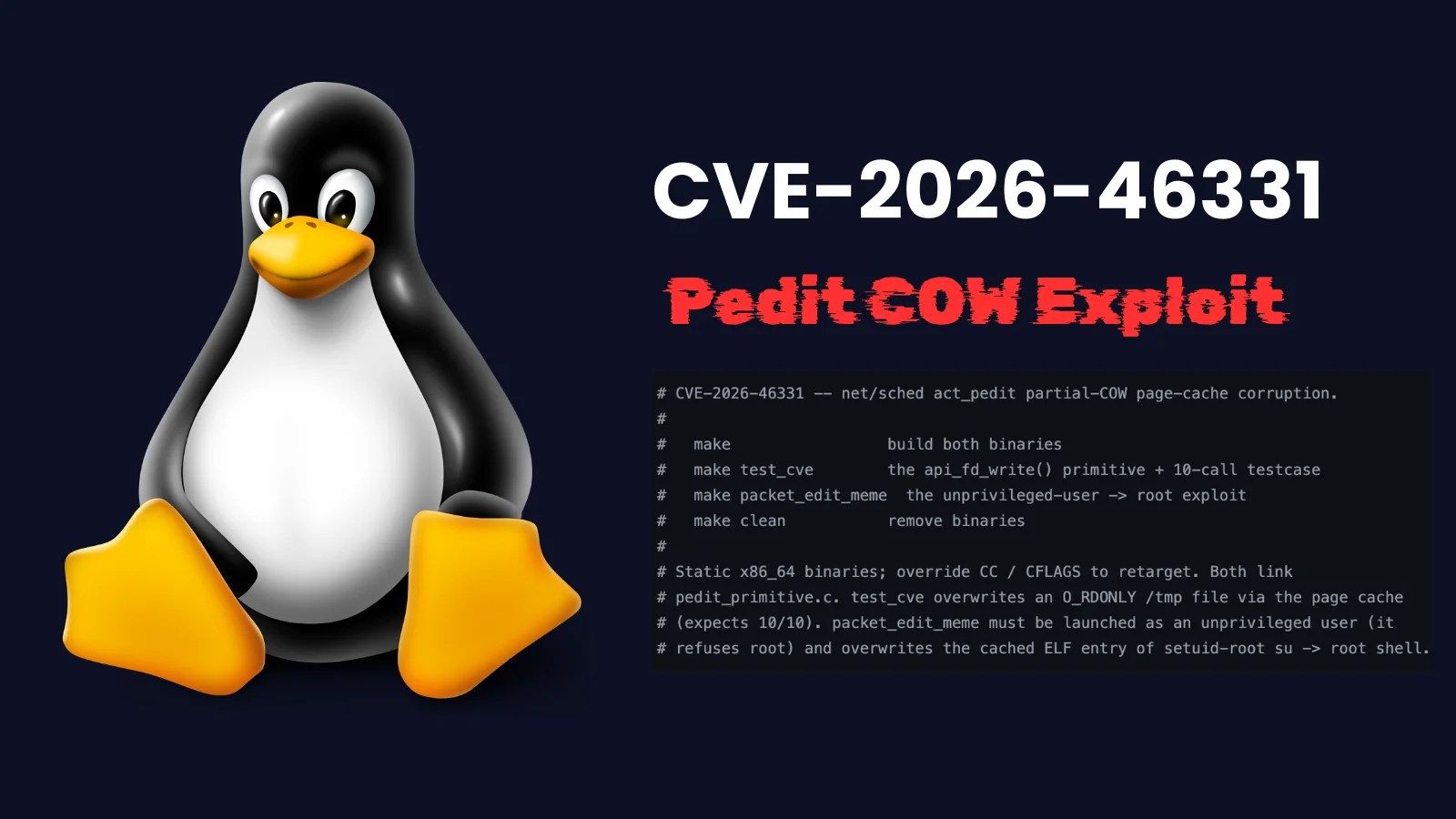
A significant security vulnerability has emerged in the Linux kernel, involving a Copy-on-Write (COW) page-cache corruption flaw combined with the act_pedit component in the net/sched subsystem. This exploit is enabling local attackers, without privileged access, to escalate their permissions to root access across multiple major Linux distributions.

Exploit Details and Impact

Named packet_edit_meme, this exploit was confirmed in June 2026 and affects both enterprise and consumer Linux kernels. The underlying issue is traced back to a partial-COW page-cache corruption bug introduced in kernel commit 899ee91156e5. This bug is present in kernel versions from v5.18 to v7.1-rc6 and was addressed in version v7.1-rc7. The vulnerability resides within the net/sched act_pedit subsystem, which is part of the Linux traffic control framework, allowing for traffic editing.

The exploit operates by initiating a user namespace child process endowed with CAP_NET_ADMIN capabilities. This is possible on systems where unprivileged user namespaces are enabled by default. Subsequently, the exploit uses the COW corruption to alter the page-cached ELF entry point of the setuid-root binary /bin/su, inserting shellcode that results in a root shell for the attacker.

Affected Systems and Distributions

This vulnerability marks the fourth recent privilege escalation issue reported within Linux systems. Verified tests indicate successful exploitation across various distributions, including RHEL 10.06, Debian 13, and specific Ubuntu versions. Notably, RHEL and Debian are highly susceptible due to their default settings that permit unprivileged user namespaces. In contrast, Ubuntu enforces restrictions through sysctls, limiting unprivileged user namespace creation, thereby reducing vulnerability.

However, the exploit can bypass these constraints on Ubuntu 24.04.4 using permissive profiles via aa-exec, though this route is blocked in Ubuntu 26.04 due to tightened security measures.

Mitigation Strategies

Red Hat has issued a security bulletin (RHSB-2026-008), urging administrators to promptly apply the necessary kernel patches. It is recommended to restrict the creation of unprivileged user namespaces where feasible, using sysctl, and to vigilantly monitor for any unusual aa-exec invocations or namespace activity.

Organizations running affected kernel versions between v5.18 and v7.1-rc6 should prioritize patching to protect against potential exploitation.

In conclusion, this exploit highlights the critical need for ongoing vigilance and timely updates to maintain system security in the face of evolving threats.

Cyber Security News Tags:COW exploit, Exploit, Kernel, Linux, Linux distributions, net/sched, root access, Security, system security, Vulnerability

Post navigation

Previous Post: Chinese APT Group Deploys TinyRCT in Southeast Asia
Next Post: New Linux Vulnerability ‘DirtyClone’ Grants Root Access

Related Posts

AI Uncovers Cryptographic Flaws Overlooked by Experts AI Uncovers Cryptographic Flaws Overlooked by Experts Cyber Security News
Windows BitLocker Vulnerability Poses Security Risks Windows BitLocker Vulnerability Poses Security Risks Cyber Security News
Red Hat npm Packages Breached by Credential-Stealing Malware Red Hat npm Packages Breached by Credential-Stealing Malware Cyber Security News
Palo Alto Networks Finalizes B CyberArk Acquisition Palo Alto Networks Finalizes $25B CyberArk Acquisition Cyber Security News
FortiWeb SQL Injection Vulnerability Allows Attacker to Execute Malicious SQL Code FortiWeb SQL Injection Vulnerability Allows Attacker to Execute Malicious SQL Code Cyber Security News
RubyGems Packages Exploit Developer Machines for Monero Mining RubyGems Packages Exploit Developer Machines for Monero Mining Cyber Security News

Categories

  • Cyber Security News
  • How To?
  • Security Week News
  • The Hacker News

Recent Posts

  • GitHub Enhances Malware Detection Across Multiple Ecosystems
  • Anthropic Enhances Security with Claude Code Auto Mode
  • Windows 11 Vulnerabilities Expose MFA Flaws
  • HP ThinPro Encryption Flaw Risks LUKS Key Exposure
  • Gunra Ransomware Exploits VPN Vulnerabilities for Data Theft

Pages

  • About Us – Contact
  • Disclaimer
  • Privacy Policy
  • Terms and Rules

Archives

  • August 2026
  • July 2026
  • June 2026
  • May 2026
  • April 2026
  • March 2026
  • February 2026
  • January 2026
  • December 2025
  • November 2025
  • October 2025
  • September 2025
  • August 2025
  • July 2025
  • June 2025
  • May 2025

Recent Posts

  • GitHub Enhances Malware Detection Across Multiple Ecosystems
  • Anthropic Enhances Security with Claude Code Auto Mode
  • Windows 11 Vulnerabilities Expose MFA Flaws
  • HP ThinPro Encryption Flaw Risks LUKS Key Exposure
  • Gunra Ransomware Exploits VPN Vulnerabilities for Data Theft

Pages

  • About Us – Contact
  • Disclaimer
  • Privacy Policy
  • Terms and Rules

Categories

  • Cyber Security News
  • How To?
  • Security Week News
  • The Hacker News

Copyright © 2026 Cyber Web Spider Blog – News.

Powered by PressBook Masonry Dark