Skip to content
  • Home
  • Cyber Map
  • About Us – Contact
  • Disclaimer
  • Terms and Rules
  • Privacy Policy
Cyber Web Spider Blog – News

Cyber Web Spider Blog – News

Globe Threat Map provides a real-time, interactive 3D visualization of global cyber threats. Monitor DDoS attacks, malware, and hacking attempts with geo-located arcs on a rotating globe. Stay informed with live logs and archive stats.

  • Home
  • Cyber Map
  • Cyber Security News
  • Security Week News
  • The Hacker News
  • How To?
  • Toggle search form
New Linux Vulnerability ‘DirtyClone’ Grants Root Access

New Linux Vulnerability ‘DirtyClone’ Grants Root Access

Posted on June 26, 2026 By CWS

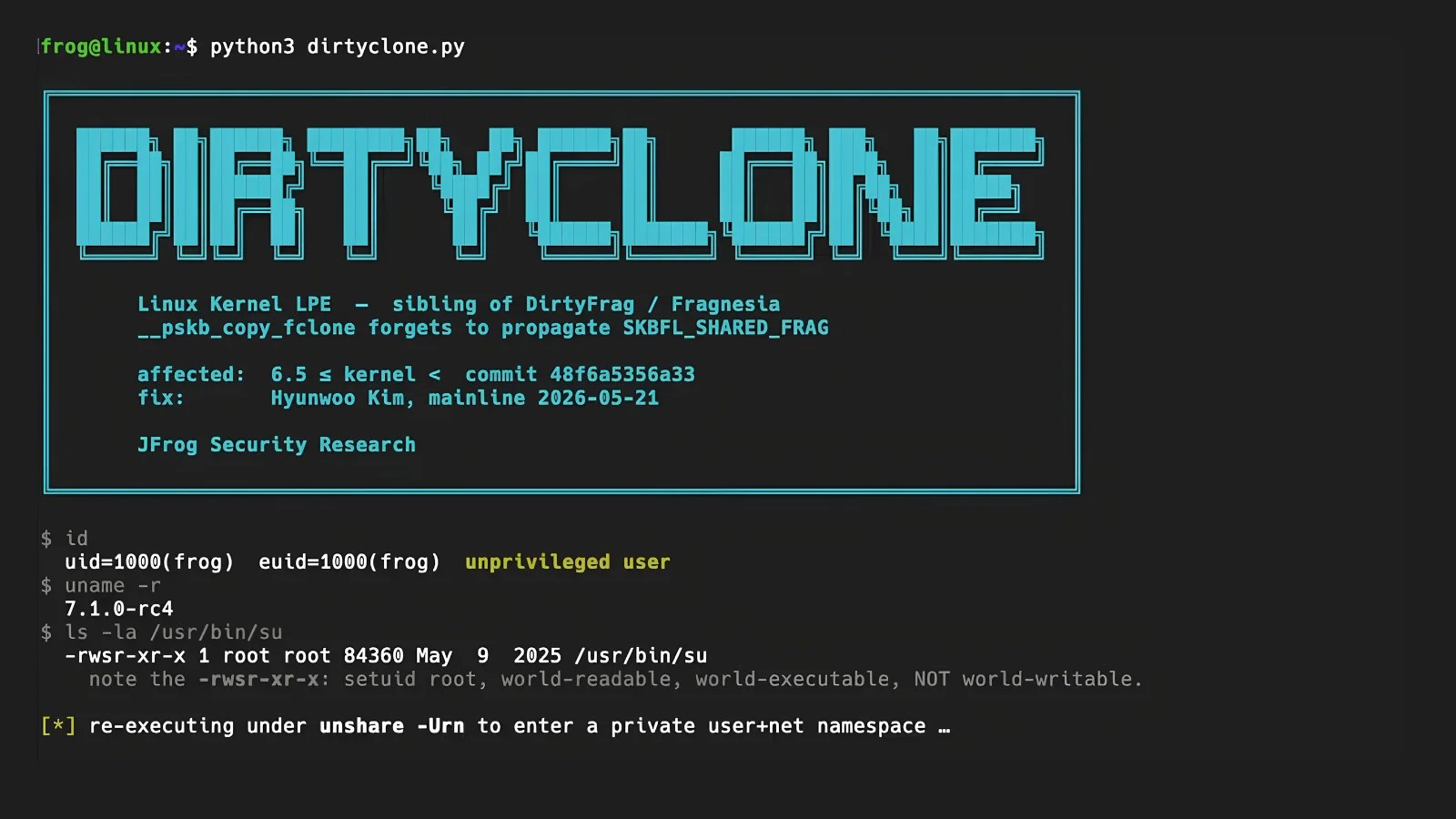
A newly identified security flaw in the Linux kernel, known as ‘DirtyClone’ (CVE-2026-43503), poses a significant threat by enabling local users without privileges to attain root access. This vulnerability is manipulated through cloned network packets within the XFRM/IPsec subsystem, and crucially, it operates without leaving any trace in kernel logs or audit records.

Understanding the DirtyClone Vulnerability

DirtyClone emerges as a severe issue in the DirtyFrag vulnerability series, which involves memory corruption bugs in the Linux kernel affecting how socket buffers reference shared page-cache memory. Discovered by JFrog Security Research, this vulnerability is rated with a CVSS score of 8.8. The vulnerability was identified during an audit of Linux kernel patches addressing previous DirtyFrag issues.

The central problem resides in the __pskb_copy_fclone() function, which inadvertently drops the SKBFL_SHARED_FRAG safety flag during packet cloning. This flag was initially introduced to protect memory in earlier DirtyFrag fixes. Unlike its predecessor, DirtyClone leverages a different packet cloning path, specifically via the Linux netfilter TEE target, to duplicate packets internally.

Technical Insights and Exploitation Method

The DirtyClone vulnerability was reported by JFrog on May 19, 2026, shortly after a broader report by original DirtyFrag researcher Hyunwoo Kim. The exploitation chain involves several steps, including mapping a privileged binary and manipulating the encryption key to execute a modified binary without authentication checks. This approach results in root access through a series of complex operations involving packet cloning and IPsec decryption.

The attack remains stealthy as it does not modify the disk file, thus evading file-integrity monitoring tools. Systems at risk include various Linux distributions and environments that enable unprivileged user namespaces, such as Debian, Fedora, and certain versions of Ubuntu. Cloud environments and containerized workloads are particularly vulnerable due to the nature of their configurations.

Mitigation and Future Outlook

The Linux kernel community has responded by merging a fix into the mainline on May 21, 2026, with the first patched version being Linux v7.1-rc5. To protect systems, users should update to this version or apply the backported patch from their distribution. Additional measures include restricting user namespaces and blacklisting certain kernel modules if IPsec is not utilized.

JFrog has withheld the release of a full exploit code until distribution patches are completed. The immediate recommendation is to update affected systems and ensure proper configuration to mitigate potential exploitation. This vulnerability highlights the ongoing need for vigilance in monitoring and securing Linux-based systems against emerging threats.


Cyber Security News Tags:CVE-2026-43503, DirtyClone, Exploit, JFrog, Kernel, Linux, Patch, root access, Security, Vulnerability

Post navigation

Previous Post: Critical Linux Kernel Exploit Grants Root Access
Next Post: New Malware SharkLoader Deploys Cobalt Strike

Related Posts

GhostBat RAT Android Malware With Fake RTO Apps Steals Targeting Indian Users to Steal Banking Data GhostBat RAT Android Malware With Fake RTO Apps Steals Targeting Indian Users to Steal Banking Data Cyber Security News
Pink Group Uses Vishing to Steal Cloud Passwords Pink Group Uses Vishing to Steal Cloud Passwords Cyber Security News
Critical NGINX Security Flaws Patched by F5 Critical NGINX Security Flaws Patched by F5 Cyber Security News
Hackers Allegedly Claim Leak of LG Source Code, SMTP, and Hardcoded Credentials Hackers Allegedly Claim Leak of LG Source Code, SMTP, and Hardcoded Credentials Cyber Security News
Cybercriminals Exploit Google Services in Facebook Phishing Cybercriminals Exploit Google Services in Facebook Phishing Cyber Security News
Magento Vulnerability Exploited for Remote Code Execution Magento Vulnerability Exploited for Remote Code Execution Cyber Security News

Categories

  • Cyber Security News
  • How To?
  • Security Week News
  • The Hacker News

Recent Posts

  • GitHub Enhances Malware Detection Across Multiple Ecosystems
  • Anthropic Enhances Security with Claude Code Auto Mode
  • Windows 11 Vulnerabilities Expose MFA Flaws
  • HP ThinPro Encryption Flaw Risks LUKS Key Exposure
  • Gunra Ransomware Exploits VPN Vulnerabilities for Data Theft

Pages

  • About Us – Contact
  • Disclaimer
  • Privacy Policy
  • Terms and Rules

Archives

  • August 2026
  • July 2026
  • June 2026
  • May 2026
  • April 2026
  • March 2026
  • February 2026
  • January 2026
  • December 2025
  • November 2025
  • October 2025
  • September 2025
  • August 2025
  • July 2025
  • June 2025
  • May 2025

Recent Posts

  • GitHub Enhances Malware Detection Across Multiple Ecosystems
  • Anthropic Enhances Security with Claude Code Auto Mode
  • Windows 11 Vulnerabilities Expose MFA Flaws
  • HP ThinPro Encryption Flaw Risks LUKS Key Exposure
  • Gunra Ransomware Exploits VPN Vulnerabilities for Data Theft

Pages

  • About Us – Contact
  • Disclaimer
  • Privacy Policy
  • Terms and Rules

Categories

  • Cyber Security News
  • How To?
  • Security Week News
  • The Hacker News

Copyright © 2026 Cyber Web Spider Blog – News.

Powered by PressBook Masonry Dark