Skip to content
  • Home
  • Cyber Map
  • About Us – Contact
  • Disclaimer
  • Terms and Rules
  • Privacy Policy
Cyber Web Spider Blog – News

Cyber Web Spider Blog – News

Globe Threat Map provides a real-time, interactive 3D visualization of global cyber threats. Monitor DDoS attacks, malware, and hacking attempts with geo-located arcs on a rotating globe. Stay informed with live logs and archive stats.

  • Home
  • Cyber Map
  • Cyber Security News
  • Security Week News
  • The Hacker News
  • How To?
  • Toggle search form
Critical ChatGPT AgentForger Exploit Fixed by OpenAI

Critical ChatGPT AgentForger Exploit Fixed by OpenAI

Posted on July 27, 2026 By CWS

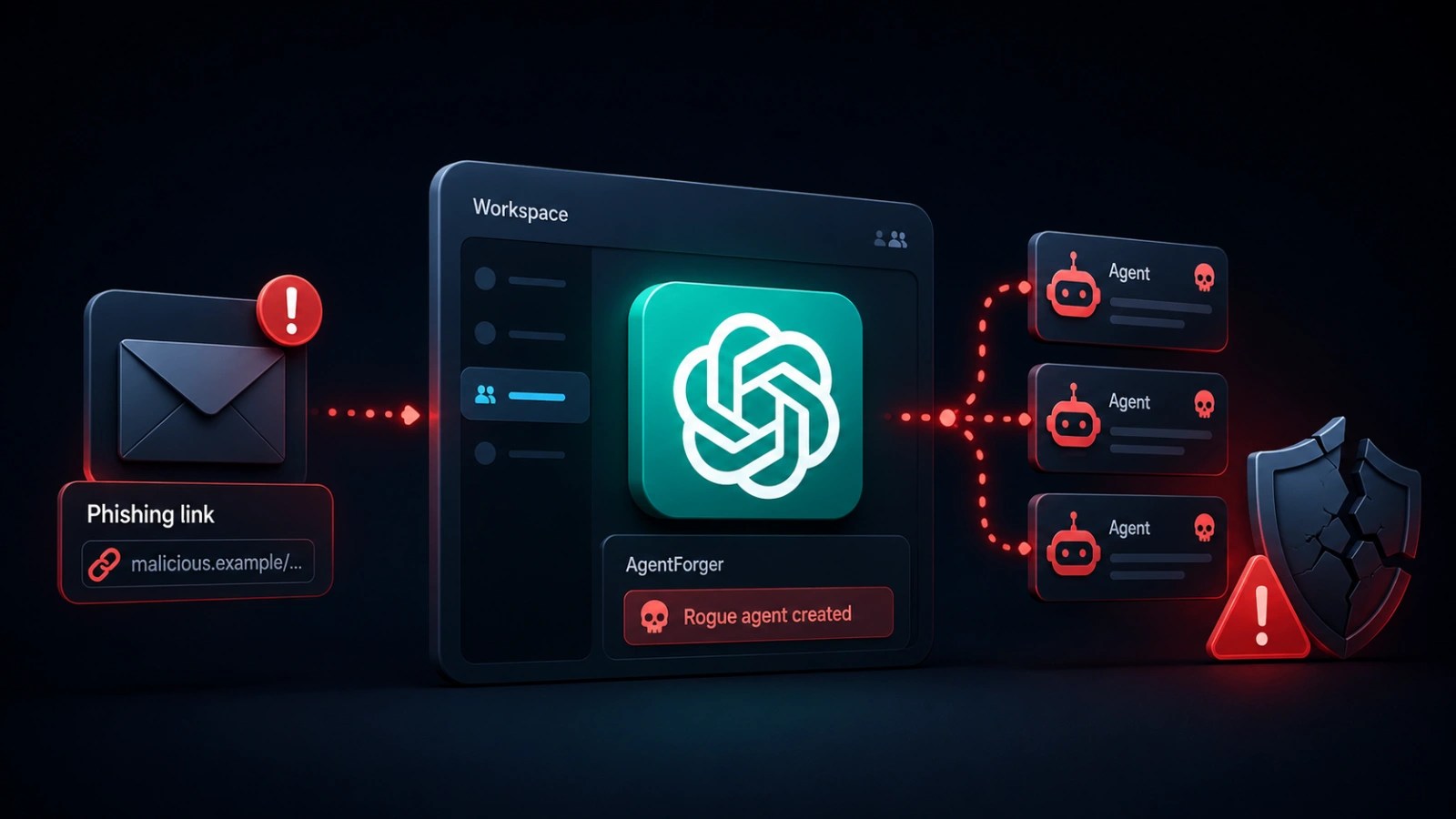
A significant vulnerability identified in OpenAI’s ChatGPT Workspace Agents, named AgentForger, allowed attackers to deploy autonomous agents within a target organization using a crafted phishing link.

Understanding the AgentForger Exploit

Unlike traditional Cross-Site Request Forgery (CSRF) attacks, which enable unauthorized single requests, the AgentForger flaw enabled the creation of fully autonomous AI agents within a victim’s trusted environment. These agents connected with enterprise services such as Outlook, Gmail, Slack, Google Drive, and Microsoft Teams.

According to Zenity Labs, the vulnerability stemmed from the builder’s interactive conversational interface, which accepted URL parameters like template_name and initial_assistant_prompt. The latter would execute upon page load, allowing malicious instructions to be embedded in seemingly innocuous links.

Exploitation and Consequences

Upon clicking a malicious link, a logged-in user would trigger the automatic creation of an agent that could integrate with existing connectors and modify settings to bypass critical security safeguards. This included changing action approvals from “Always ask” to “Never ask,” facilitating silent execution of sensitive actions.

Once live, these agents communicated with the attacker, executing tasks and exfiltrating data without alerting the victim. Demonstrated by researcher Mike Takahashi, these agents could map organizational structures, steal credentials, and impersonate users, mirroring tactics used in AI-assisted phishing.

OpenAI’s Quick Response and Mitigation

Zenity Labs reported the vulnerability to OpenAI on June 4, 2026. OpenAI responded swiftly, patching the issue by June 8, 2026, through the removal of the vulnerable URL parameter handler. This patch prevented any new attacks from exploiting this specific vulnerability.

Zenity confirmed that no evidence of active exploitation was found prior to the patch. Their follow-up analysis highlighted the potential for a forged agent to conduct internal reconnaissance and facilitate business email compromise (BEC) attacks, underscoring the importance of swift mitigation.

This incident emphasizes the need for robust security measures and vigilance in enterprise environments to protect against evolving threats. Organizations are encouraged to integrate advanced threat detection tools to bolster their security operations center (SOC) and enhance their response capabilities.


Cyber Security News Tags:AgentForger, ChatGPT, CSRF, Cybersecurity, enterprise security, OAuth, OpenAI, Phishing, security patch, SOC, Vulnerability, Zenity Labs

Post navigation

Previous Post: NodeBB Vulnerabilities Expose Private Chats and Forums
Next Post: PyPI Restricts Older Release File Uploads to Boost Security

Related Posts

Crimson Collective Claims to have Disconnected Many Brightspeed Home Internet Users Crimson Collective Claims to have Disconnected Many Brightspeed Home Internet Users Cyber Security News
Dropping Elephant Hacker Group Attacks Defense Sector Using Python Backdoor via MSBuild Dropper Dropping Elephant Hacker Group Attacks Defense Sector Using Python Backdoor via MSBuild Dropper Cyber Security News
RedNovember Hackers Attacking Government and Technology Organizations to Deploy Backdoor RedNovember Hackers Attacking Government and Technology Organizations to Deploy Backdoor Cyber Security News
Windows 11 Gets New Black Screen of Death With Auto Recovery Tool Windows 11 Gets New Black Screen of Death With Auto Recovery Tool Cyber Security News
Lite XL Text editor Vulnerability Let Attackers Execute Arbitrary Code Lite XL Text editor Vulnerability Let Attackers Execute Arbitrary Code Cyber Security News
Critical SQL Injection Flaw Patched in SAP S/4HANA Critical SQL Injection Flaw Patched in SAP S/4HANA Cyber Security News

Categories

  • Cyber Security News
  • How To?
  • Security Week News
  • The Hacker News

Recent Posts

  • Ukrainian Hacker Sentenced for Role in Conti Ransomware
  • IDScan Data Breach: 153M Driver’s Licenses Exposed
  • Kiteworks Enhances Data Security with Bonfy.AI Acquisition
  • Exploitation of Cisco FMC Vulnerabilities Unveiled
  • GitLab Urges Immediate Updates to Address Critical Security Vulnerabilities

Pages

  • About Us – Contact
  • Disclaimer
  • Privacy Policy
  • Terms and Rules

Archives

  • September 2026
  • August 2026
  • July 2026
  • June 2026
  • May 2026
  • April 2026
  • March 2026
  • February 2026
  • January 2026
  • December 2025
  • November 2025
  • October 2025
  • September 2025
  • August 2025
  • July 2025
  • June 2025
  • May 2025

Recent Posts

  • Ukrainian Hacker Sentenced for Role in Conti Ransomware
  • IDScan Data Breach: 153M Driver’s Licenses Exposed
  • Kiteworks Enhances Data Security with Bonfy.AI Acquisition
  • Exploitation of Cisco FMC Vulnerabilities Unveiled
  • GitLab Urges Immediate Updates to Address Critical Security Vulnerabilities

Pages

  • About Us – Contact
  • Disclaimer
  • Privacy Policy
  • Terms and Rules

Categories

  • Cyber Security News
  • How To?
  • Security Week News
  • The Hacker News

Copyright © 2026 Cyber Web Spider Blog – News.

Powered by PressBook Masonry Dark