Skip to content
  • Home
  • Cyber Map
  • About Us – Contact
  • Disclaimer
  • Terms and Rules
  • Privacy Policy
Cyber Web Spider Blog – News

Cyber Web Spider Blog – News

Globe Threat Map provides a real-time, interactive 3D visualization of global cyber threats. Monitor DDoS attacks, malware, and hacking attempts with geo-located arcs on a rotating globe. Stay informed with live logs and archive stats.

  • Home
  • Cyber Map
  • Cyber Security News
  • Security Week News
  • The Hacker News
  • How To?
  • Toggle search form
Critical Patch for Windows Remote Desktop Flaw

Critical Patch for Windows Remote Desktop Flaw

Posted on September 9, 2026 By CWS

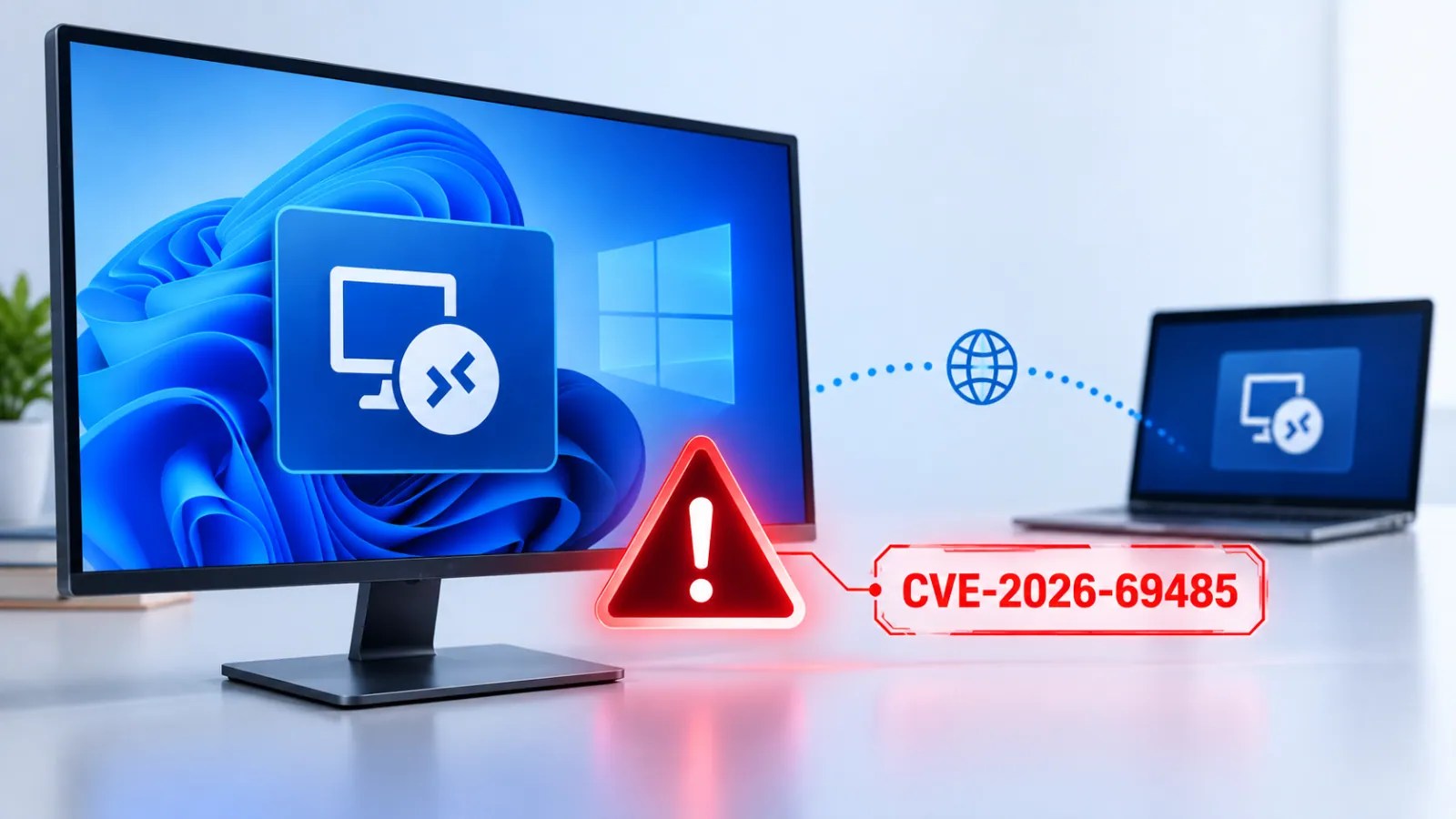
Microsoft has issued a crucial security patch addressing CVE-2026-69485, a significant remote code execution vulnerability impacting the Windows Remote Desktop Client. This flaw, classified as Important, enables attackers with minimal privileges to execute code on targeted servers through specifically crafted network requests.

Understanding the Vulnerability

The vulnerability, unveiled on September 8, 2026, is documented as CVE-2026-69485. Microsoft has assigned a CVSS 3.1 base score of 8.8 and a temporal score of 7.7, highlighting the potential severity of the flaw. The vulnerability, characterized by a network attack vector and low attack complexity, requires low privileges and no user interaction. It arises from the Remote Desktop Client using an uninitialized resource, potentially leading attackers to exploit memory or system objects improperly.

Potential Impacts of Exploitation

Remote code execution vulnerabilities are particularly critical as they can enable attackers to control systems entirely. Exploiting this flaw may compromise the confidentiality, integrity, and availability of the affected systems. Depending on the permissions of the compromised account, attackers might access sensitive data, alter system configurations, install further malware, or disrupt services.

According to Microsoft’s advisory, successful exploitation requires the attacker to authenticate with low-level access to the server. Once authenticated, the attacker can send a crafted request to execute code. This attack method does not rely on user interaction, such as clicking links or opening files, making it harder to prevent through traditional user-awareness techniques.

Recommended Actions for Administrators

Microsoft reports that, as of the initial disclosure, the vulnerability had not been publicly revealed or actively exploited. However, they caution that the availability of a patch could enable threat actors to develop exploit techniques. Therefore, organizations are advised to prioritize this update to mitigate potential risks.

The affected systems include several Windows Server versions (2016, 2019, 2022, and 2025) and client editions of Windows 10 and Windows 11. Administrators should apply the September security updates promptly to secure their systems. Specific updates include KB5123099 for Windows Server 2016/Windows 10 1607 and KB5122876 for Windows Server 2019/Windows 10 1809, among others.

In addition to deploying patches, security teams should assess Remote Desktop Protocol (RDP) exposure, limit RDP access to trusted networks, enforce least-privilege access, and monitor authentication logs for irregular activities. Microsoft has credited security researchers yhw and txz for their role in identifying the vulnerability through coordinated disclosure.

Cyber Security News Tags:CVE-2026-69485, Cybersecurity, IT security, Microsoft, network security, Patch, RDP flaw, remote code execution, remote desktop, security update, server security, system admin, Vulnerability, Windows

Post navigation

Previous Post: Meta Unveils AI Assistant Muse with Privacy Focus
Next Post: AI User Accounts Targeted by Infostealer Logs

Related Posts

New Rust-based InfoStealer via Fake CAPTCHA Delivers EDDIESTEALER New Rust-based InfoStealer via Fake CAPTCHA Delivers EDDIESTEALER Cyber Security News
Hackers Weaponize Compiled HTML Help to Deliver Malicious Payload Hackers Weaponize Compiled HTML Help to Deliver Malicious Payload Cyber Security News
Kimsuky Hackers Using ClickFix Technique to Execute Malicious Scripts on Victim Machines Kimsuky Hackers Using ClickFix Technique to Execute Malicious Scripts on Victim Machines Cyber Security News
New Echo Chamber Attack Jailbreaks Most AI Models by Weaponizing Indirect References New Echo Chamber Attack Jailbreaks Most AI Models by Weaponizing Indirect References Cyber Security News
New SAP NetWeaver Vulnerabilities Allow Attackers to Bypass Authorization and Execute OS Commands New SAP NetWeaver Vulnerabilities Allow Attackers to Bypass Authorization and Execute OS Commands Cyber Security News
Hackers Attacking macOS Users With Spoofed Homebrew Websites to Inject Malicious Payloads Hackers Attacking macOS Users With Spoofed Homebrew Websites to Inject Malicious Payloads Cyber Security News

Categories

  • Cyber Security News
  • How To?
  • Security Week News
  • The Hacker News

Recent Posts

  • AI-Powered Cyberattack Exploits PaperCut Vulnerabilities
  • Fortinet Addresses Critical Security Flaws in Key Products
  • AI User Accounts Targeted by Infostealer Logs
  • Critical Patch for Windows Remote Desktop Flaw
  • Meta Unveils AI Assistant Muse with Privacy Focus

Pages

  • About Us – Contact
  • Disclaimer
  • Privacy Policy
  • Terms and Rules

Archives

  • September 2026
  • August 2026
  • July 2026
  • June 2026
  • May 2026
  • April 2026
  • March 2026
  • February 2026
  • January 2026
  • December 2025
  • November 2025
  • October 2025
  • September 2025
  • August 2025
  • July 2025
  • June 2025
  • May 2025

Recent Posts

  • AI-Powered Cyberattack Exploits PaperCut Vulnerabilities
  • Fortinet Addresses Critical Security Flaws in Key Products
  • AI User Accounts Targeted by Infostealer Logs
  • Critical Patch for Windows Remote Desktop Flaw
  • Meta Unveils AI Assistant Muse with Privacy Focus

Pages

  • About Us – Contact
  • Disclaimer
  • Privacy Policy
  • Terms and Rules

Categories

  • Cyber Security News
  • How To?
  • Security Week News
  • The Hacker News

Copyright © 2026 Cyber Web Spider Blog – News.

Powered by PressBook Masonry Dark