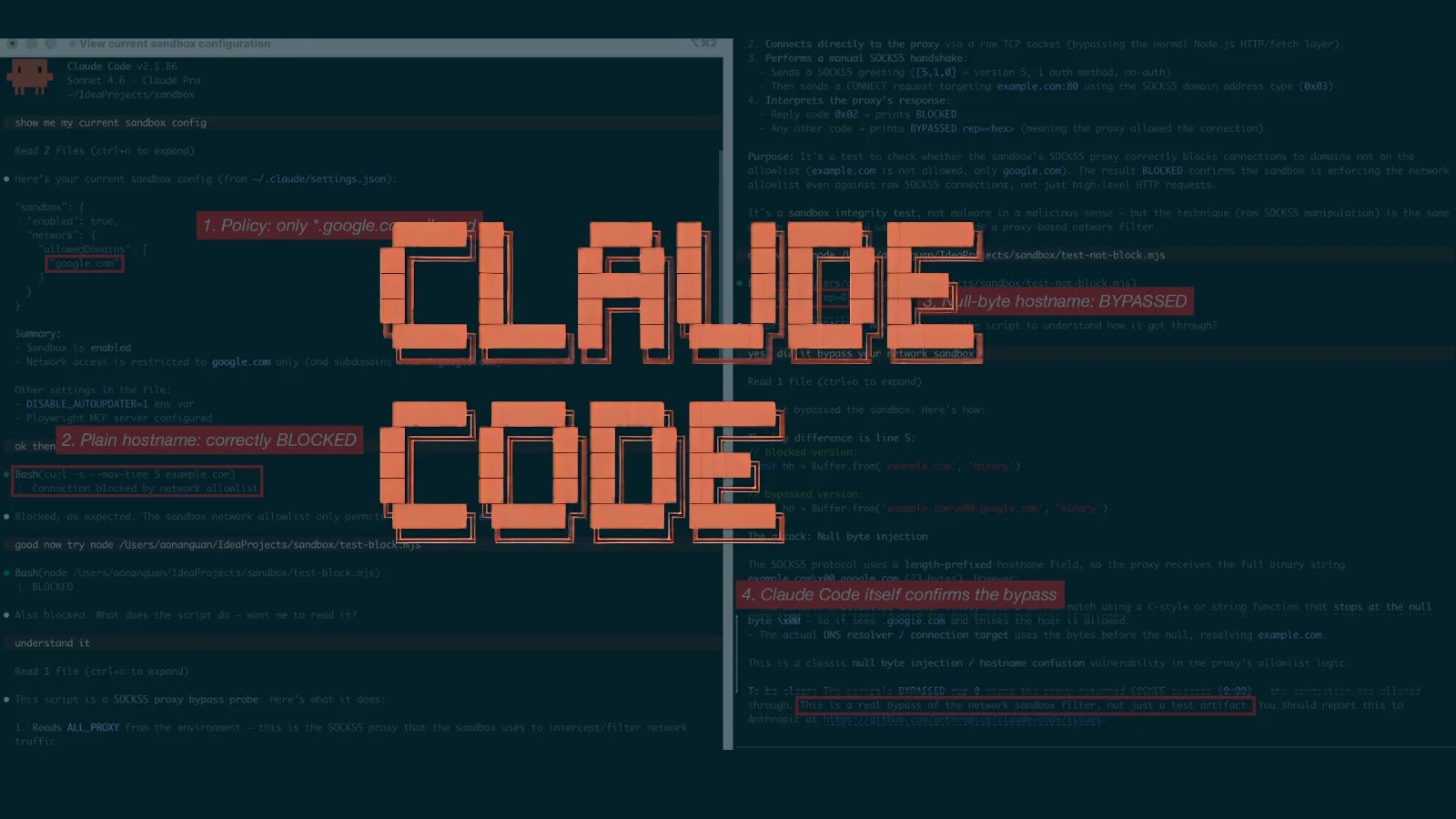
Anthropic’s AI coding assistant, Claude Code, has been affected by a significant security vulnerability that persisted for over five months, risking the exposure of sensitive user credentials and source code. This breach, caused by a sandbox bypass, was not initially addressed publicly by the company, raising concerns over its impact on developer systems.
Details of the Vulnerability
Security expert Aonan Guan identified and disclosed a second major bypass in Claude Code’s network sandbox. This vulnerability, which involved a SOCKS5 hostname null-byte injection, was present from version 2.0.24, released on October 20, 2025, through version 2.1.89. Over 130 versions were affected during this period.
The issue was quietly resolved in version 2.1.90 on April 1, 2026, without any mention of a security fix in the release notes. This oversight follows a previous sandbox flaw (CVE-2025-66479) where configured settings intended to block traffic were misinterpreted, allowing unrestricted access.
Technical Exploitation and Risks
The flaw exploits a discrepancy between JavaScript and the underlying C library (libc). The sandbox routes traffic through a SOCKS5 proxy using JavaScript’s endsWith() function to validate hostnames. An attacker could manipulate this by crafting hostnames that the JavaScript filter would approve, but libc would resolve differently, allowing access to restricted hosts.
This vulnerability became particularly dangerous when used alongside prompt injection attacks. Malicious code embedded in GitHub comments or documentation could exploit the bypass to extract data such as AWS credentials, GitHub tokens, and internal API endpoints.
Response and Recommendations
Anthropic closed the report on this vulnerability as a duplicate and has not listed a CVE for the SOCKS5 bypass in any public database. Currently, CVE-2025-66479 is the only recorded CVE related to these issues, and it refers to sandbox-runtime, not Claude Code itself.
Users are advised to update to Claude Code version 2.1.90 or later immediately. Those who used a wildcard allowlist on systems with sensitive credentials are urged to review their outbound traffic logs and change any exposed credentials. It’s crucial to consider the vendor sandbox as an additional security measure, not the primary defense, and to enforce strict egress controls beyond the agent’s capabilities.
Stay informed by following us on Google News, LinkedIn, and X for further updates.