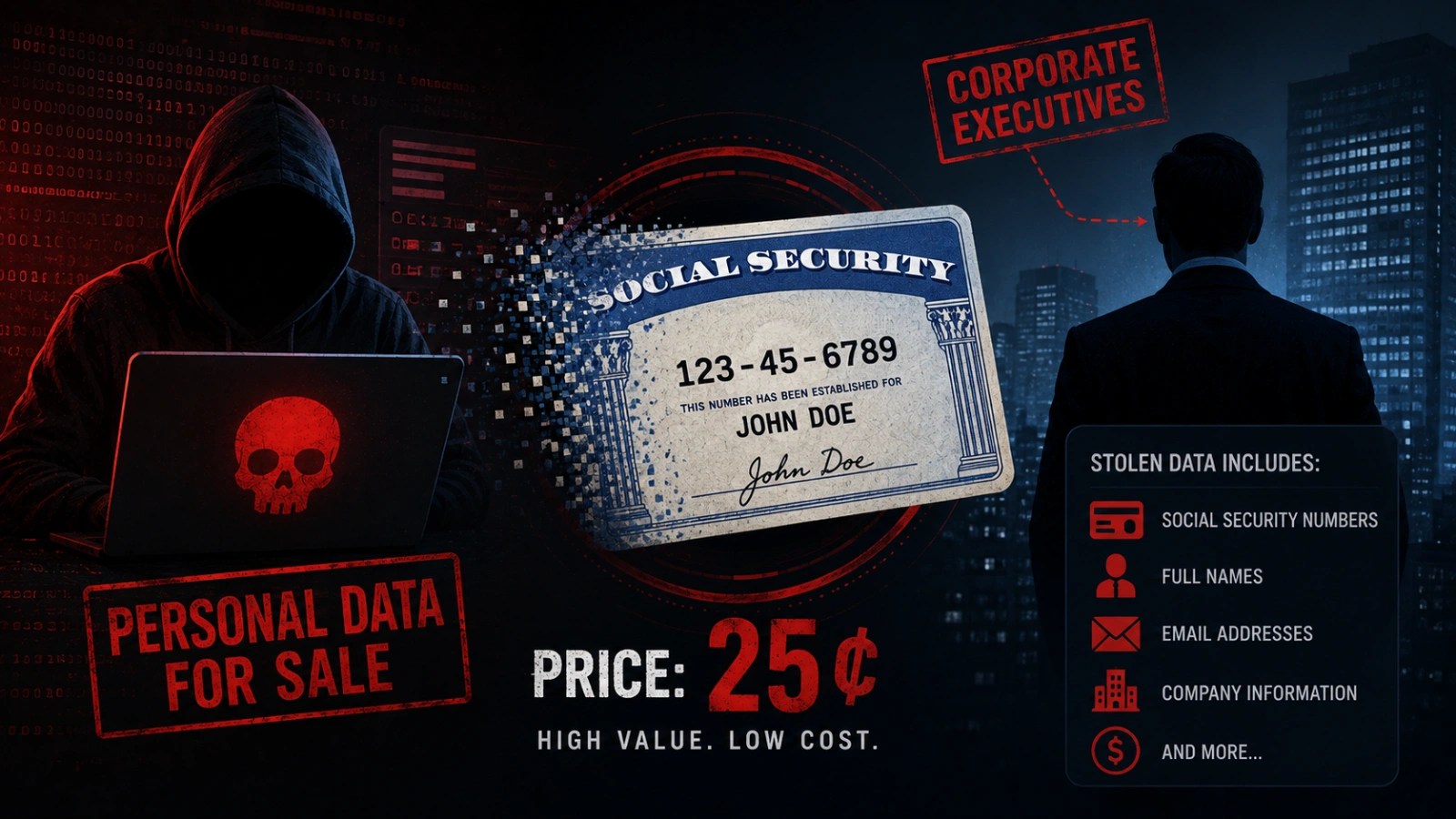
Corporate leaders are facing an increasing threat as their Social Security numbers are being sold on dark web platforms for just 25 cents. This alarming trend was exposed by recent intelligence from cybersecurity firm Rapid7, highlighting a growing underground economy targeting executive identities.
Security Risks from Permanent SSN Compromise
Unlike credit cards, which can be quickly deactivated, Social Security numbers are permanent identifiers. This makes them particularly valuable to cybercriminals who exploit their durability to facilitate identity theft and fraud. Since the start of 2026, Rapid7 has documented 476 instances of compromised SSN records linked to corporate staff, predominantly affecting senior executives.
Statistics reveal that 44.6% of the compromised profiles belong to C-suite executives, while company presidents account for another 28.6%. This demonstrates a concentrated attack on high-ranking individuals within organizations, elevating the risk of sophisticated fraud schemes.
Marketplaces for Stolen Executive Data
The dark web hosts various platforms where stolen SSNs are traded. Three platforms—Xilo, Bankomat, and PeopleFinder—are responsible for 81.5% of the executive SSN leaks. Xilo offers these records for just 25 cents, while Bankomat, which also deals in stolen credit card data, charges $4 per record. PeopleFinder, a successor to the SSNDOB Marketplace, prices each lookup at $1.50.
These platforms do not generate data themselves but serve as intermediaries, sourcing information from significant breaches at data aggregators, healthcare systems, and financial institutions. Additionally, infostealer malware and phishing campaigns contribute fresher data, further endangering high-profile individuals.
Strategic Responses to Mitigate Risks
Rapid7 advises organizations to treat the exposure of executive identities as an ongoing threat. Proactive measures such as continuous dark web monitoring and reducing executives’ digital footprints are recommended. Organizations should also consider purchasing leaked records to prevent them from falling into the wrong hands.
Training for executives and their assistants on impersonation tactics, coupled with stringent verification processes for sensitive requests, forms a robust defense strategy. As underground markets become more efficient, the urgency for swift detection and response is paramount.
In conclusion, the sale of executives’ Social Security numbers online underscores the critical need for enhanced cybersecurity measures. Organizations must adopt a proactive approach to safeguard their leaders against these persistent threats.