A complicated approach that permits attackers to execute malicious code immediately in reminiscence is gaining traction, posing a big problem to fashionable Endpoint Detection and Response (EDR) options.
This technique, which includes an in-memory Moveable Executable (PE) loader, allows a risk actor to run an executable inside an already trusted course of, successfully bypassing safety checks that primarily monitor recordsdata written to disk.
Loading PE in Memeory
In response to a consumer with the alias G3tSyst3m, the approach highlights a crucial blind spot in some safety postures, permitting secondary payloads to be deployed stealthily after preliminary entry is gained.
This “fileless” assault vector is especially harmful as a result of it operates underneath the radar. An EDR answer might validate and approve an preliminary software, deeming it protected to run.
Nevertheless, as soon as that trusted course of is lively, it may be manipulated to obtain and execute one other PE file, reminiscent of a distant entry trojan or info-stealer, totally inside its personal reminiscence area.
As a result of the malicious executable by no means touches the file system, conventional antivirus and EDR instruments that depend on file scanning and disk-based heuristics might fail to detect the risk.
In-Reminiscence PE Loader Leveraged
The assault begins by leveraging the official course of to obtain a PE file from a distant supply, reminiscent of a GitHub repository, G3tSyst3m added.
Utilizing normal Home windows APIs like InternetOpenUrlA and InternetReadFile, the code fetches the executable and shops it in a reminiscence buffer.
This preliminary step is usually mistaken for delicate community exercise, permitting the payload to be smuggled onto the goal system with out elevating alarms. As soon as the PE file resides in reminiscence as a byte array, the loader meticulously reconstructs it for execution.
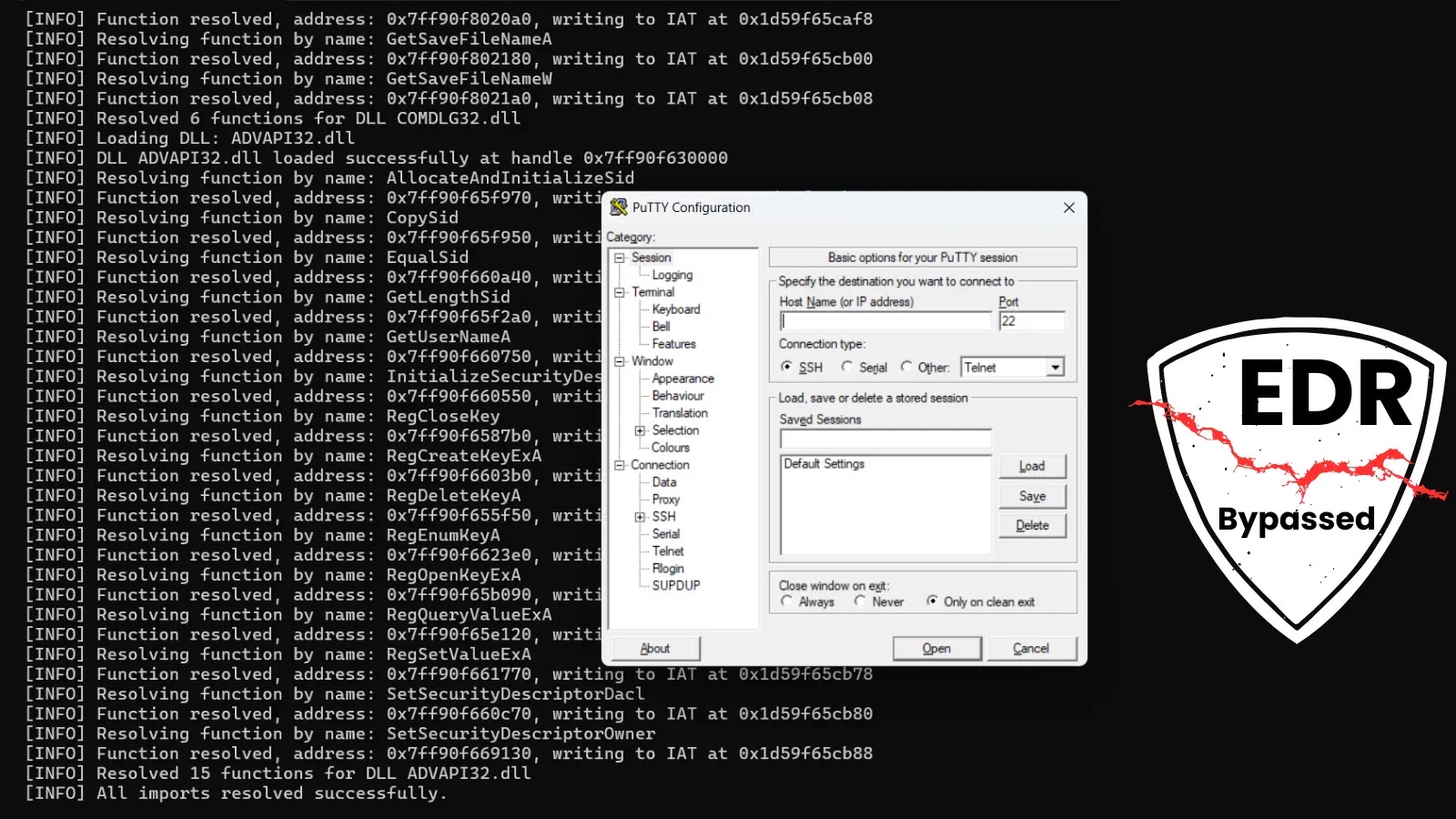
Putty downloaded utilizing PE
This reconstruction course of manually emulates the features of the Home windows working system’s personal loader. At a excessive degree, the loader performs a number of crucial steps:
Parses PE Headers: It reads the DOS and NT headers of the downloaded file to grasp its construction, together with its sections and dependencies.
Allocates Reminiscence: It makes use of VirtualAlloc to order a brand new block of reminiscence inside the host course of to map the executable picture.
Maps Sections: The loader copies the PE headers and sections (like .textual content for code and .information for variables) from the buffer into the newly allotted reminiscence area in accordance with their digital addresses.
Resolves Imports: It hundreds any required Dynamic-Hyperlink Libraries (DLLs) and resolves the addresses of exterior features the PE must run. That is achieved by utilizing LoadLibraryA and GetProcAddress.
Applies Relocations: It adjusts any hardcoded addresses within the code to make sure they level to the proper places in reminiscence.
After efficiently mapping the PE file and resolving its dependencies, the ultimate steps contain adjusting reminiscence permissions and triggering execution, G3tSyst3m stated.
The loader makes use of VirtualProtect to set the suitable permissions for every part, for example, marking the code part as executable and the info part as readable/writable.
This mirrors the conduct of a legitimately loaded program and is essential for the code to run with out crashing the method. With the reminiscence accurately ready, the loader merely calls the PE file’s entry level, launching the malicious code.
This technique has confirmed efficient in crimson workforce engagements and has been noticed bypassing outstanding EDR options like Microsoft Defender for Endpoint (XDR) and Sophos XDR.
Whereas not totally foolproof, particularly in opposition to superior AI and machine learning-based detection that may flag anomalous course of conduct over time, custom-built PE loaders stay a potent software for evading detection.
The approach underscores the necessity for safety options that may carry out deep reminiscence inspection and behavioral evaluation, shifting past a reliance on file-based risk intelligence.
Comply with us on Google Information, LinkedIn, and X for day by day cybersecurity updates. Contact us to characteristic your tales.