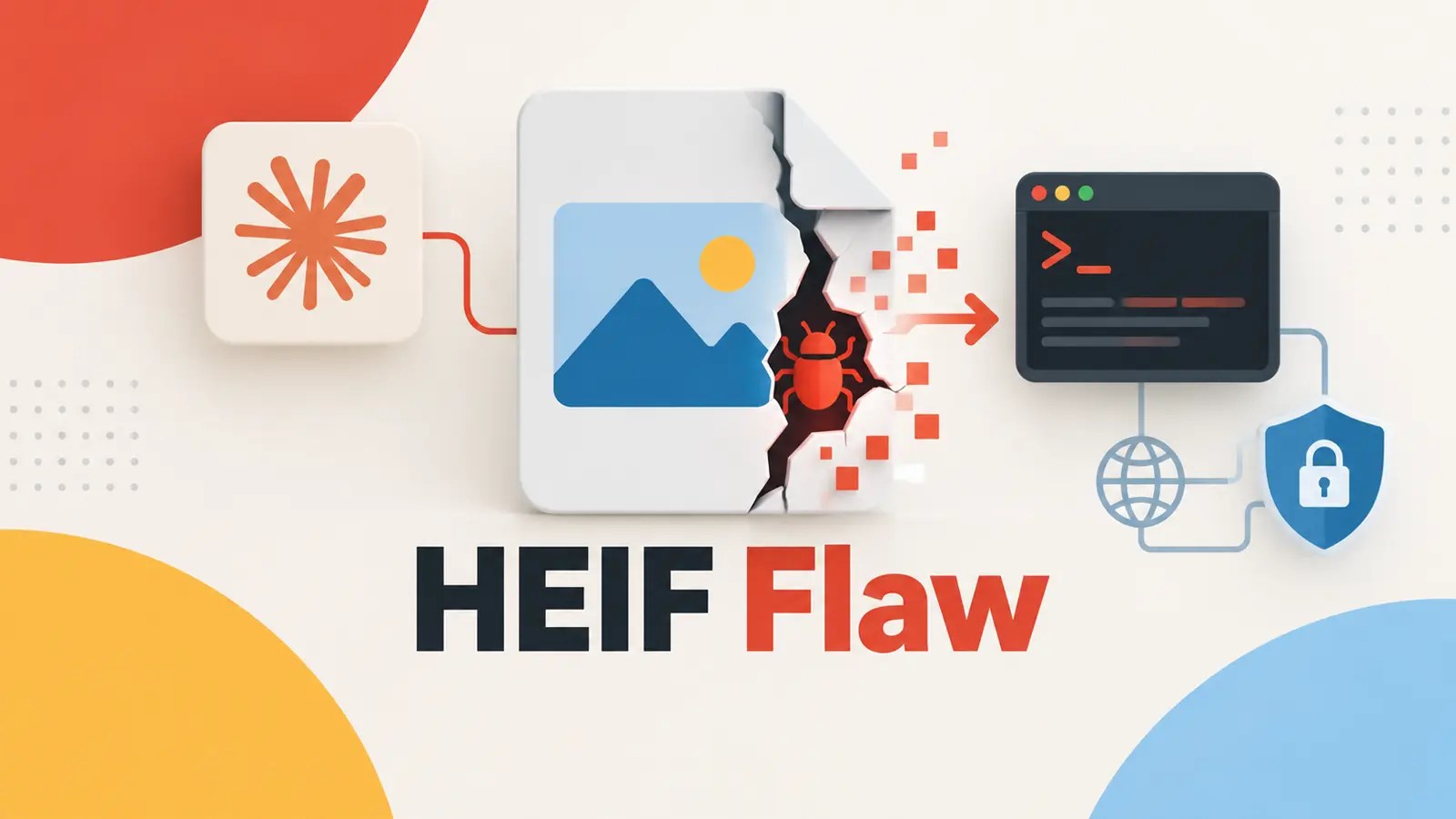
Researchers have identified a critical vulnerability in image-decoding software that could allow attackers to execute code remotely. This flaw, dubbed ‘HEIF Heist,’ poses a significant threat to systems that process HEIF, HEIC, or AVIF images, potentially turning routine image uploads into server takeover opportunities.
Understanding the HEIF Heist Vulnerability
The vulnerability affects applications handling HEIF, HEIC, or AVIF images, where attackers can embed malicious code within an image file. Unlike traditional malware, this technique bypasses standard defenses, exploiting trusted conversion tools to execute harmful actions.
Hacktron researchers, using AI-assisted methods, were able to uncover this flaw, highlighting the risk as image files often traverse trusted tools that could inadvertently process malicious content. Although no active exploitation campaigns have been reported, the potential impact is severe, exposing sensitive data like user files, access tokens, and critical system information.
The Role of AI and Claude Opus 5
The investigation revealed that the core issue lies in how libheif and libde265 decode image data. Malformed HEIC images can exploit a heap-buffer overflow, enabling unauthorized memory access or modification. AI systems, including Claude Opus 5, were instrumental in transforming this vulnerability into a viable remote code execution method.
Testing demonstrated the vulnerability’s reach, with one proof of concept targeting a Discourse-based forum, where researchers used the flaw to compromise employee accounts and access internal code repositories. The vulnerability was identified on July 25 and quickly patched, resulting in a $6,500 bug bounty.
Preventive Measures and Security Recommendations
Organizations need to scrutinize all services accepting HEIF, HEIC, or AVIF uploads, ensuring that libheif and libde265 packages are up-to-date with the latest security patches. Simply updating the front-end application is insufficient; vulnerabilities may reside within containers or system packages.
Security teams should review software inventories, disable unnecessary decoders, and conduct conversions in isolated environments with minimal permissions. These steps, along with enforcing file-type checks, size limits, and monitoring upload processes, can mitigate risks.
By treating image uploads as high-risk operations, similar to the recent Next.js and WordPress image processing vulnerabilities, organizations can safeguard against potential breaches. Adopting robust monitoring and logging practices will further enhance security postures.
For real-time threat intelligence and reduced alert investigation times, integrating tools like TI Lookup into your SOC can offer immediate context and response capabilities.