Skip to content
  • Home
  • Cyber Map
  • About Us – Contact
  • Disclaimer
  • Terms and Rules
  • Privacy Policy
Cyber Web Spider Blog – News

Cyber Web Spider Blog – News

Globe Threat Map provides a real-time, interactive 3D visualization of global cyber threats. Monitor DDoS attacks, malware, and hacking attempts with geo-located arcs on a rotating globe. Stay informed with live logs and archive stats.

  • Home
  • Cyber Map
  • Cyber Security News
  • Security Week News
  • The Hacker News
  • How To?
  • Toggle search form
New Udados Botnet Launches Massive HTTP Flood DDoS Attacks Targeting Tech Sector

New Udados Botnet Launches Massive HTTP Flood DDoS Attacks Targeting Tech Sector

Posted on December 18, 2025December 18, 2025 By CWS

A newly recognized botnet malware household, dubbed “Udados,” has emerged as a big risk to the Expertise and Telecommunications sectors, orchestrating high-volume HTTP flood Distributed Denial-of-Service (DDoS) assaults.

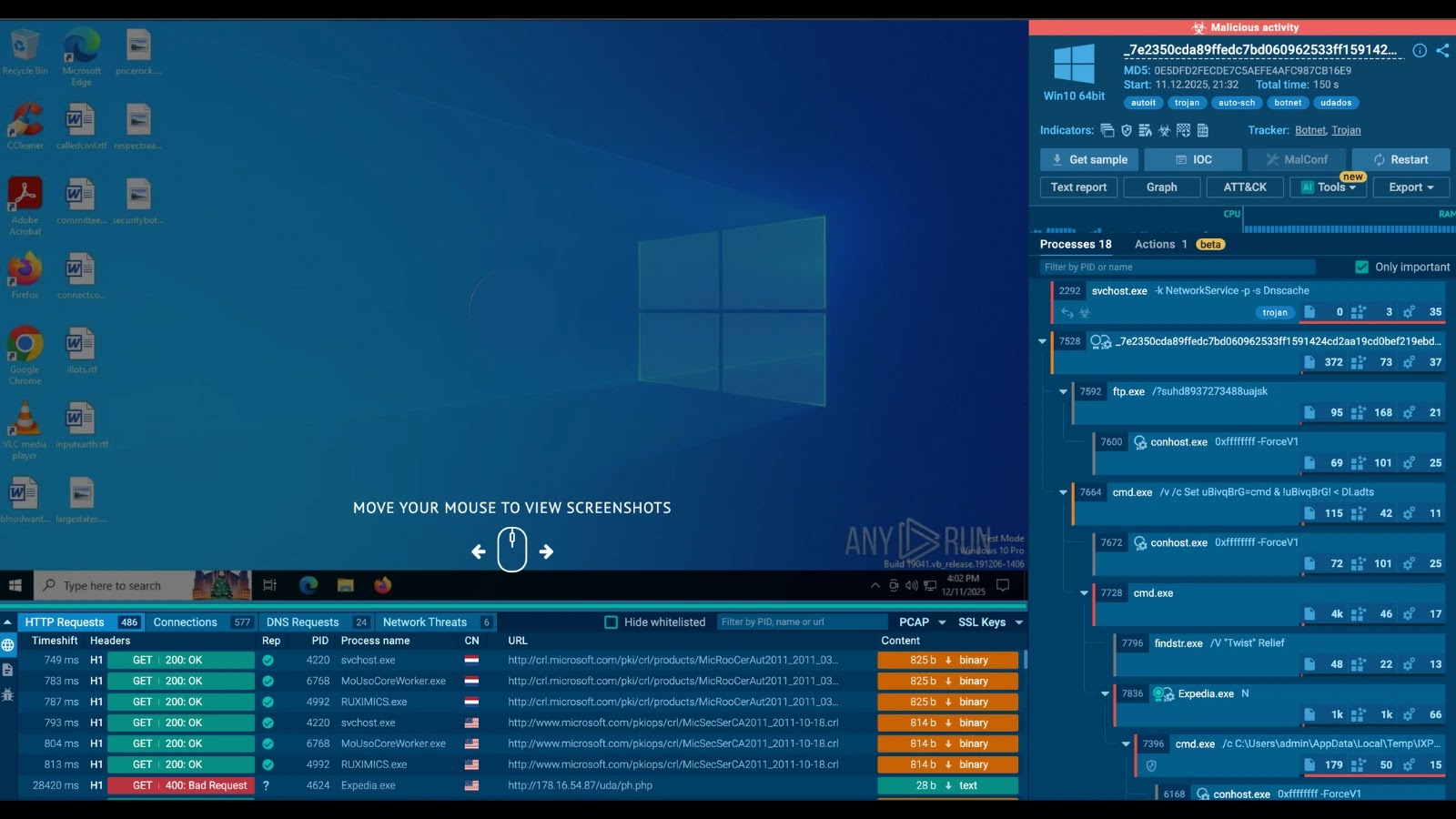
In accordance with ANY.RUN sandbox evaluation, the botnet leverages contaminated hosts to execute sustained denial-of-service campaigns designed to disrupt enterprise continuity by overwhelming goal servers with legitimate-looking visitors.​

The Udados malware operates by establishing communication with a Command and Management (C2) server to obtain assault directions.

Contaminated hosts ship structured JSON knowledge to the C2, together with detailed system metadata: person ID (Uid), process execution standing (St), bot model (Bv), and privilege degree (Priv). This telemetry permits the operator to handle the botnet’s assets successfully.​

Upon check-in, the C2 server responds with particular assault instructions. The first directive noticed is !httppost, which triggers the DDoS module. This command contains parameters for the assault length (e.g., 888 seconds), the variety of concurrent threads (e.g., 88), and a Base64-encoded payload containing random knowledge.

Udados Botnet

Using HTTP POST requests permits the assault visitors to mix seamlessly with professional internet visitors, making detection and mitigation considerably tougher for community defenders.​

Infrastructure and Community Indicators

The botnet’s infrastructure is hosted inside Autonomous System AS214943, also called RAILNET. This community has not too long ago gained a status as a haven for malicious exercise; latest intelligence studies point out that RAILNET has hosted infrastructure for over 30 distinct malware households in late 2025, together with main threats like Remcos and Amadey.

The precise C2 server recognized on this marketing campaign is positioned at IP handle 178.16.54[.]87.​

The malware communicates by way of the URI /uda/ph.php, which serves as a important indicator for community monitoring. Defenders can detect potential infections by inspecting outbound HTTP visitors for this particular path and the attribute JSON parameters (uid, st, msg, tid) within the request physique.

Organizations are suggested to behave quick and block visitors to the recognized C2 infrastructure and monitor for the next indicators:

TypeValueSHA2567e2350cda89ffedc7bd060962533ff1591424cd2aa19cd0bef219ebd576566bb​SHA256770d78f34395c72191c8b865c08b08908dff6ac572ade06396d175530b0403b8 ​IPv4178.16.54[.]87 (Hosted on RAILNET)​Domainryxuz[.]com ​URI Path/uda/ph.php

Community directors also needs to examine short-term spikes in outbound HTTP visitors from particular person hosts, as this habits typically precedes the high-volume flood orchestrated by the C2.​

Establish cyber threats early to behave quick With Interactive Sandbox => Strive Now

Cyber Security News Tags:Attacks, Botnet, DDoS, Flood, HTTP, Launches, Massive, Sector, Targeting, Tech, Udados

Post navigation

Previous Post: UEFI Vulnerability in Major Motherboards Enables Early-Boot Attacks
Next Post: China-Aligned Threat Group Uses Windows Group Policy to Deploy Espionage Malware

Related Posts

Fake CAPTCHA Attacks Fuel LummaStealer Malware Surge Fake CAPTCHA Attacks Fuel LummaStealer Malware Surge Cyber Security News
Threat Actors Leveraging RMM Tools to Attack Users via Weaponized PDF Files Threat Actors Leveraging RMM Tools to Attack Users via Weaponized PDF Files Cyber Security News
1-Click Clawdbot Vulnerability Enable Malicious Remote Code Execution Attacks 1-Click Clawdbot Vulnerability Enable Malicious Remote Code Execution Attacks Cyber Security News
Weaponized Chrome Extension Affects 1.7 Million Users Despite Google’s Verified Badges Weaponized Chrome Extension Affects 1.7 Million Users Despite Google’s Verified Badges Cyber Security News
New Phishing Attack Impersonates as DWP Attacking Users to Steal Credit Card Data New Phishing Attack Impersonates as DWP Attacking Users to Steal Credit Card Data Cyber Security News
CodeSign Secure v3.02: Future of Code Signing with PQC CodeSign Secure v3.02: Future of Code Signing with PQC Cyber Security News

Categories

  • Cyber Security News
  • How To?
  • Security Week News
  • The Hacker News

Recent Posts

  • VMware Fusion Vulnerability Receives Critical Update
  • Critical Vulnerability in MongoDB Risks Data Exposure
  • Windows Zero-Day Exploits: YellowKey and GreenPlasma Revealed
  • Fragnesia Linux Kernel Vulnerability Allows Root Access
  • NGINX Vulnerability Allows Remote Code Execution

Pages

  • About Us – Contact
  • Disclaimer
  • Privacy Policy
  • Terms and Rules

Archives

  • May 2026
  • April 2026
  • March 2026
  • February 2026
  • January 2026
  • December 2025
  • November 2025
  • October 2025
  • September 2025
  • August 2025
  • July 2025
  • June 2025
  • May 2025

Recent Posts

  • VMware Fusion Vulnerability Receives Critical Update
  • Critical Vulnerability in MongoDB Risks Data Exposure
  • Windows Zero-Day Exploits: YellowKey and GreenPlasma Revealed
  • Fragnesia Linux Kernel Vulnerability Allows Root Access
  • NGINX Vulnerability Allows Remote Code Execution

Pages

  • About Us – Contact
  • Disclaimer
  • Privacy Policy
  • Terms and Rules

Categories

  • Cyber Security News
  • How To?
  • Security Week News
  • The Hacker News

Copyright © 2026 Cyber Web Spider Blog – News.

Powered by PressBook Masonry Dark