Skip to content
  • Home
  • Cyber Map
  • About Us – Contact
  • Disclaimer
  • Terms and Rules
  • Privacy Policy
Cyber Web Spider Blog – News

Cyber Web Spider Blog – News

Globe Threat Map provides a real-time, interactive 3D visualization of global cyber threats. Monitor DDoS attacks, malware, and hacking attempts with geo-located arcs on a rotating globe. Stay informed with live logs and archive stats.

  • Home
  • Cyber Map
  • Cyber Security News
  • Security Week News
  • The Hacker News
  • How To?
  • Toggle search form
Node.js Exploit Exposes Remote Code Execution Risk

Node.js Exploit Exposes Remote Code Execution Risk

Posted on October 23, 2026 By CWS

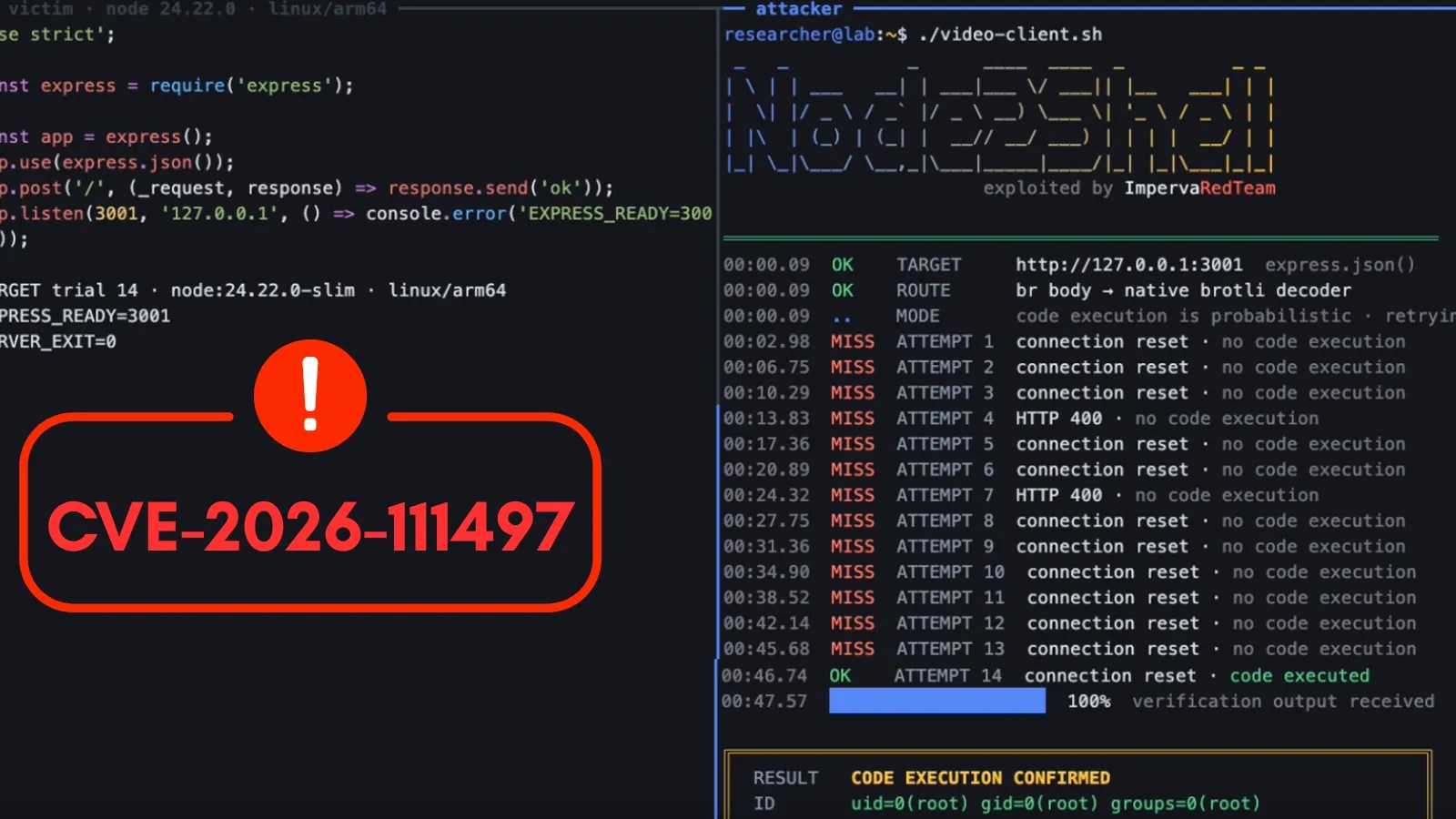
Cybersecurity researchers have unveiled a critical exploit named Node2Shell, which enables attackers to execute malicious code in Node.js applications via carefully crafted Brotli-compressed data. This vulnerability is linked to CVE-2026-111497, a significant memory flaw in the Brotli decoder that comes with Node.js.

Details of the Node.js Vulnerability

The Node.js security advisory, issued on October 21, 2026, highlights the potential for remote code execution due to this flaw, impacting Node.js versions 22.x, 24.x, and 26.x. Security patches have been released to address these issues across all affected versions.

Imperva’s research demonstrated a proof-of-concept exploit on the Node.js 24.22.0 Linux arm64 image. The exploit does not require a debugger or modified binary, and it was able to create a marker file in a test application, indicating successful execution of the malicious code.

Technical Insight into the Exploit

The vulnerability arises when the Brotli decoder improperly handles an invalid transition between block types in a Brotli stream. Instead of discarding the broken stream, the decoder misinterprets it as needing more input, continuing processing with an erroneous internal state.

Imperva’s memory-sanitizer tests revealed that this behavior can lead to out-of-bounds memory writes, which are the foundation of the demonstrated exploit. The patched version of the decoder correctly returns a format error for these transitions.

Mitigation and Security Recommendations

To mitigate the risk, Node.js has released updates that fix this security flaw. The Node.js 24.22.1 release notes confirm the integration of the Brotli patch, effectively preventing the exploit.

Administrators are advised to update to Node.js versions 22.23.4, 24.22.1, or 26.12.1, or later. These updates are crucial to protect against potential attacks exploiting this vulnerability.

Organizations should also review their Node.js deployments to ensure that vulnerable binaries are replaced with secured versions and that services decoding untrusted Brotli-compressed requests or responses are scrutinized. Imperva has also introduced WAF rules to provide temporary safeguards against this exploit, though updating the runtime is essential for long-term security.

Staying ahead of potential threats by integrating threat intelligence feeds and updating defenses promptly is crucial for safeguarding systems against emerging malware.


Cyber Security News Tags:Brotli, code execution, CVE-2026-111497, Cybersecurity, Exploit, Imperva, memory flaw, Node.js, Patch, RCE, remote code execution, Security, software update, Vulnerability

Post navigation

Previous Post: AI-Driven Ransomware Operations Unveiled by Researchers

Related Posts

Fortinet Confirms Critical FortiCloud SSO Vulnerability(CVE-2026-24858) Actively Exploited in the Wild Fortinet Confirms Critical FortiCloud SSO Vulnerability(CVE-2026-24858) Actively Exploited in the Wild Cyber Security News
Hackers Weaponizing SVG Files With Malicious Embedded JavaScript to Execute Malware on Windows Systems Hackers Weaponizing SVG Files With Malicious Embedded JavaScript to Execute Malware on Windows Systems Cyber Security News
Yurei Ransomware File Encryption, Operation Model and Data Transfer Methods Uncovered Yurei Ransomware File Encryption, Operation Model and Data Transfer Methods Uncovered Cyber Security News
Check Point Harmony SASE Windows Client Vulnerability Enables Privilege Escalation Check Point Harmony SASE Windows Client Vulnerability Enables Privilege Escalation Cyber Security News
New Android Malware ‘Fantasy Hub’ Intercepts SMS Messages, Contacts and Call Logs New Android Malware ‘Fantasy Hub’ Intercepts SMS Messages, Contacts and Call Logs Cyber Security News
Phishing Campaign Exploits OAuth Tokens in Microsoft 365 Phishing Campaign Exploits OAuth Tokens in Microsoft 365 Cyber Security News

Categories

  • Cyber Security News
  • How To?
  • Security Week News
  • The Hacker News

Recent Posts

  • Node.js Exploit Exposes Remote Code Execution Risk
  • AI-Driven Ransomware Operations Unveiled by Researchers
  • Critical Flaw in Okta Gateway Allows Admin Command Execution
  • BlackX UEFI Bootkit Compromises Secure Boot in Central Asia
  • WhatsApp Usage May Require Active SIM Under New Rules

Pages

  • About Us – Contact
  • Disclaimer
  • Privacy Policy
  • Terms and Rules

Archives

  • October 2026
  • September 2026
  • August 2026
  • July 2026
  • June 2026
  • May 2026
  • April 2026
  • March 2026
  • February 2026
  • January 2026
  • December 2025
  • November 2025
  • October 2025
  • September 2025
  • August 2025
  • July 2025
  • June 2025
  • May 2025

Recent Posts

  • Node.js Exploit Exposes Remote Code Execution Risk
  • AI-Driven Ransomware Operations Unveiled by Researchers
  • Critical Flaw in Okta Gateway Allows Admin Command Execution
  • BlackX UEFI Bootkit Compromises Secure Boot in Central Asia
  • WhatsApp Usage May Require Active SIM Under New Rules

Pages

  • About Us – Contact
  • Disclaimer
  • Privacy Policy
  • Terms and Rules

Categories

  • Cyber Security News
  • How To?
  • Security Week News
  • The Hacker News

Copyright © 2026 Cyber Web Spider Blog – News.

Powered by PressBook Masonry Dark