Introduction to OperTraitor
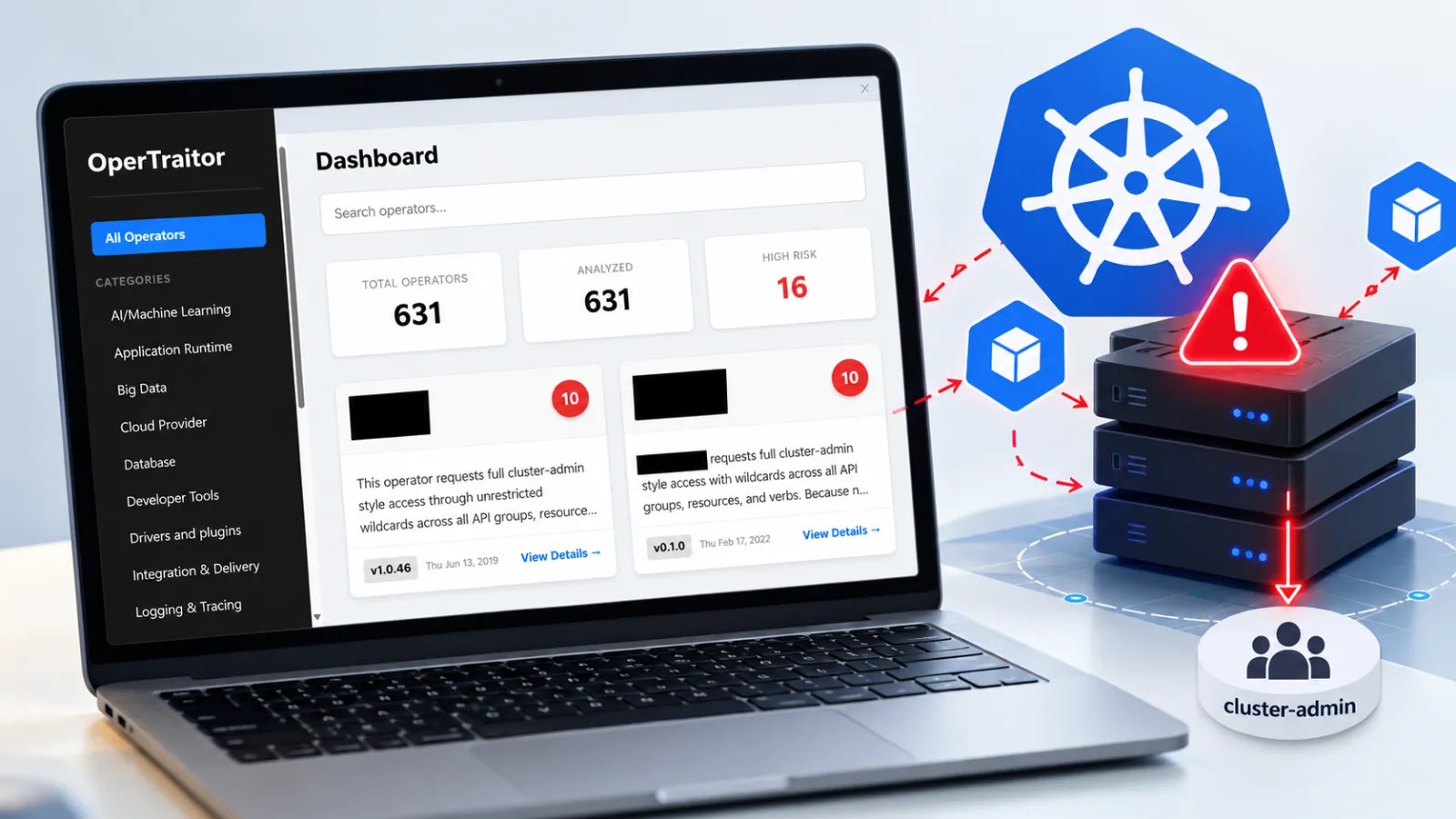
OperTraitor, a new open-source security tool, has been developed to identify potential security vulnerabilities in Kubernetes operators. Released by Palo Alto Networks, the tool focuses on exposing the risks associated with excessive permissions granted to operators, which can lead to privilege escalation within clusters.
This tool scrutinizes the manifests of operators, comparing the documented roles with the actual permissions assigned to service accounts. This process is crucial for understanding the security posture of Kubernetes environments, especially as operators automate complex administrative tasks.
Role of Kubernetes Operators
Kubernetes operators play a vital role in managing infrastructure resources, deploying applications, and monitoring workloads. They achieve this by using custom resource definitions and controllers to ensure a cluster’s desired state aligns with its real state. However, these operators often require service accounts with role-based access control (RBAC) permissions to function effectively.
Unfortunately, for convenience, operators are frequently granted broad permissions, sometimes using wildcard permissions or cluster-wide roles. This over-permissioning can pose serious security threats if an attacker gains access through vulnerabilities such as compromised container images or dependency flaws.
OperTraitor’s Analysis and Findings
OperTraitor evaluates RBAC YAML manifests from both locally installed Kubernetes operators and the OperatorHub catalog. Utilizing an advanced LLM-powered analysis engine, the tool identifies discrepancies between an operator’s intended functions and its actual permissions. Operators are then assigned a risk score on a scale of 1 to 10.
Research conducted using OperTraitor revealed that over 5% of analyzed operators sought excessive permissions, potentially enabling access to cluster administrator roles. This risk is particularly pertinent for outdated or abandoned operators available through platforms like OperatorHub.
Case Studies and Implications
One notable case involved IBM’s Prometurbo operator, linked to IBM Turbonomic. OperTraitor detected that it had permissions to access cluster-wide Kubernetes Secrets, raising concerns about the potential exposure of sensitive information. Following responsible disclosure, IBM addressed the issue, reducing the operator’s permissions and assigning a CVSS rating of 8.8.
Similarly, the Datadog operator was flagged for unrestricted access to Secrets and RBAC resources. Datadog acknowledged the necessity of certain permissions due to dynamic secret names and provided documentation for users to assess and mitigate risks.
Conclusion and Recommendations
The findings underscore the growing security challenges as Kubernetes environments evolve, incorporating LLM-enhanced operators capable of autonomous decision-making and external service interactions. Organizations are advised to regularly review operator service accounts, avoid using outdated packages, and prefer namespace-scoped roles over cluster-wide ones.
Monitoring Kubernetes audit logs is also recommended to detect unusual activities, such as unauthorized access attempts. OperTraitor offers a valuable tool for security teams to identify and mitigate risks associated with non-human identities, thus preventing potential cluster compromises.