Skip to content
  • Home
  • Cyber Map
  • About Us – Contact
  • Disclaimer
  • Terms and Rules
  • Privacy Policy
Cyber Web Spider Blog – News

Cyber Web Spider Blog – News

Globe Threat Map provides a real-time, interactive 3D visualization of global cyber threats. Monitor DDoS attacks, malware, and hacking attempts with geo-located arcs on a rotating globe. Stay informed with live logs and archive stats.

  • Home
  • Cyber Map
  • Cyber Security News
  • Security Week News
  • The Hacker News
  • How To?
  • Toggle search form
Ransomware Exploits Active Directory for Disruption

Ransomware Exploits Active Directory for Disruption

Posted on September 21, 2026 By CWS

An advanced ransomware attack has leveraged Active Directory Group Policy Objects (GPO) to disrupt a Windows domain without utilizing file encryption, affecting a manufacturing firm in the Middle East.

This incident, occurring in April 2026, showcased how attackers can manipulate domain-level controls, utilize stolen credentials, and deploy malicious GPOs to issue ransom demands, disable security defenses, and restrict administrator access.

Attack Methodology and Access

The perpetrators reportedly infiltrated the organization using a compromised domain account via the FortiGate SSL VPN. The exact method of credential compromise remains uncertain, although phishing, password spraying, credential stuffing, or acquisition from an initial access broker are suspected.

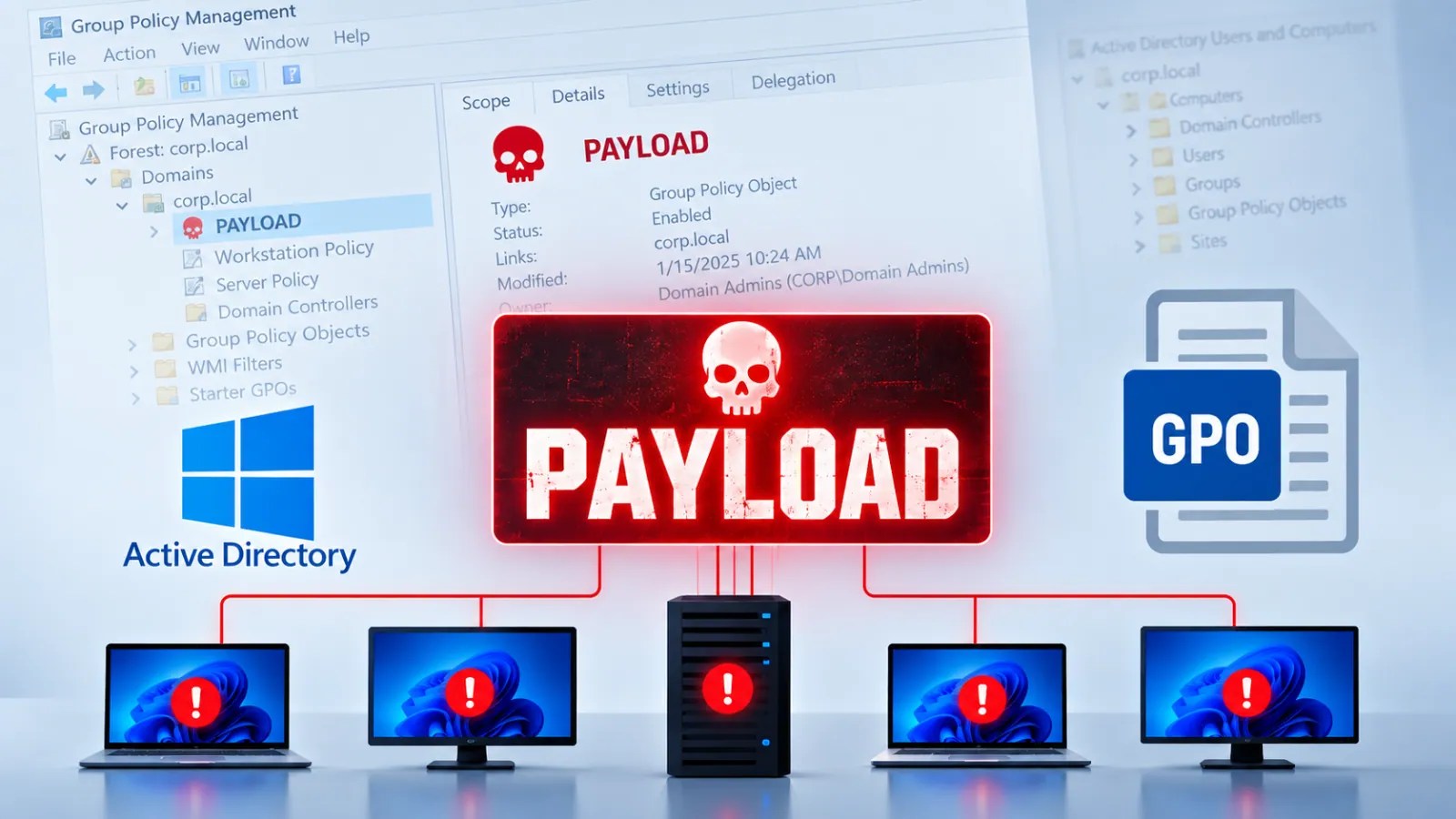
Once sufficient privileges were attained, the attackers engineered a malicious GPO, named PAYLOAD, and linked it to the root of the Active Directory domain, thereby impacting nearly all domain-connected devices.

Technical Execution and Impact

Instead of deploying traditional ransomware executables, the PAYLOAD GPO utilized Windows policy mechanisms to propagate ransom notes, modify desktop backgrounds and lock screens, display ransom messages, and deactivate local Administrator accounts.

A secondary GPO, named “win Firewall Off,” was also created to disable Windows Firewall across various profiles, enhancing the attack’s effectiveness by weakening network defenses.

The attack was particularly insidious as it operated largely within the Active Directory framework. Kaspersky’s analysis revealed no encrypted files or malicious binaries on affected systems, with the attack relying on policy changes and pre-existing system tools.

Data Exfiltration and Organizational Response

Before the visible disruption, data was exfiltrated from file servers, which was later published on a dark-web leak site, indicating a strategy of encryptionless extortion through data theft and operational disruption.

This incident underscores the necessity for organizations to broaden their cybersecurity focus beyond conventional ransomware defenses. Monitoring Active Directory changes, especially specific Event IDs, and alerting on unauthorized GPO alterations are critical measures.

Organizations are advised to promptly eradicate malicious GPOs, update compromised credentials, and restore secure policy settings. Implementing phishing-resistant multi-factor authentication for VPN access is also recommended to enhance security posture.

By maintaining SYSVOL integrity and separating GPO creation and linking rights, enterprises can mitigate the risk of widespread policy manipulation.

Cyber Security News Tags:Active Directory, cyber attack, Cybersecurity, data breach, data exfiltration, endpoint protection, GPO, IT infrastructure, IT security, Malware, MFA, network security, policy management, Ransomware, VPN security

Post navigation

Previous Post: Google Fined $463 Million for EU Privacy Violations
Next Post: Fake LastPass Installer Uses Signed Driver to Bypass Security

Related Posts

Hackers Exploit YouTube Channels for Malware Deployment Hackers Exploit YouTube Channels for Malware Deployment Cyber Security News
Critical Updates for SolarWinds Serv-U Fix Major Security Flaws Critical Updates for SolarWinds Serv-U Fix Major Security Flaws Cyber Security News
APT28 With Weaponized Office Documents Delivers BeardShell and Covenant Modules APT28 With Weaponized Office Documents Delivers BeardShell and Covenant Modules Cyber Security News
US Indicts Two Companies for Cybercrime Support US Indicts Two Companies for Cybercrime Support Cyber Security News
UEFI Shell Vulnerabilities Could Allow Hackers to Bypass Secure Boot on 200,000+ Laptops UEFI Shell Vulnerabilities Could Allow Hackers to Bypass Secure Boot on 200,000+ Laptops Cyber Security News
Critical Cybersecurity Developments: Chrome Zero-Day, AI Threats Critical Cybersecurity Developments: Chrome Zero-Day, AI Threats Cyber Security News

Categories

  • Cyber Security News
  • How To?
  • Security Week News
  • The Hacker News

Recent Posts

  • Google Faces €403 Million Fine for GDPR Breach on Location Data
  • Fake LastPass Installer Uses Signed Driver to Bypass Security
  • Ransomware Exploits Active Directory for Disruption
  • Google Fined $463 Million for EU Privacy Violations
  • Microsoft Probes Teams Calling Disruption Affecting Users

Pages

  • About Us – Contact
  • Disclaimer
  • Privacy Policy
  • Terms and Rules

Archives

  • September 2026
  • August 2026
  • July 2026
  • June 2026
  • May 2026
  • April 2026
  • March 2026
  • February 2026
  • January 2026
  • December 2025
  • November 2025
  • October 2025
  • September 2025
  • August 2025
  • July 2025
  • June 2025
  • May 2025

Recent Posts

  • Google Faces €403 Million Fine for GDPR Breach on Location Data
  • Fake LastPass Installer Uses Signed Driver to Bypass Security
  • Ransomware Exploits Active Directory for Disruption
  • Google Fined $463 Million for EU Privacy Violations
  • Microsoft Probes Teams Calling Disruption Affecting Users

Pages

  • About Us – Contact
  • Disclaimer
  • Privacy Policy
  • Terms and Rules

Categories

  • Cyber Security News
  • How To?
  • Security Week News
  • The Hacker News

Copyright © 2026 Cyber Web Spider Blog – News.

Powered by PressBook Masonry Dark