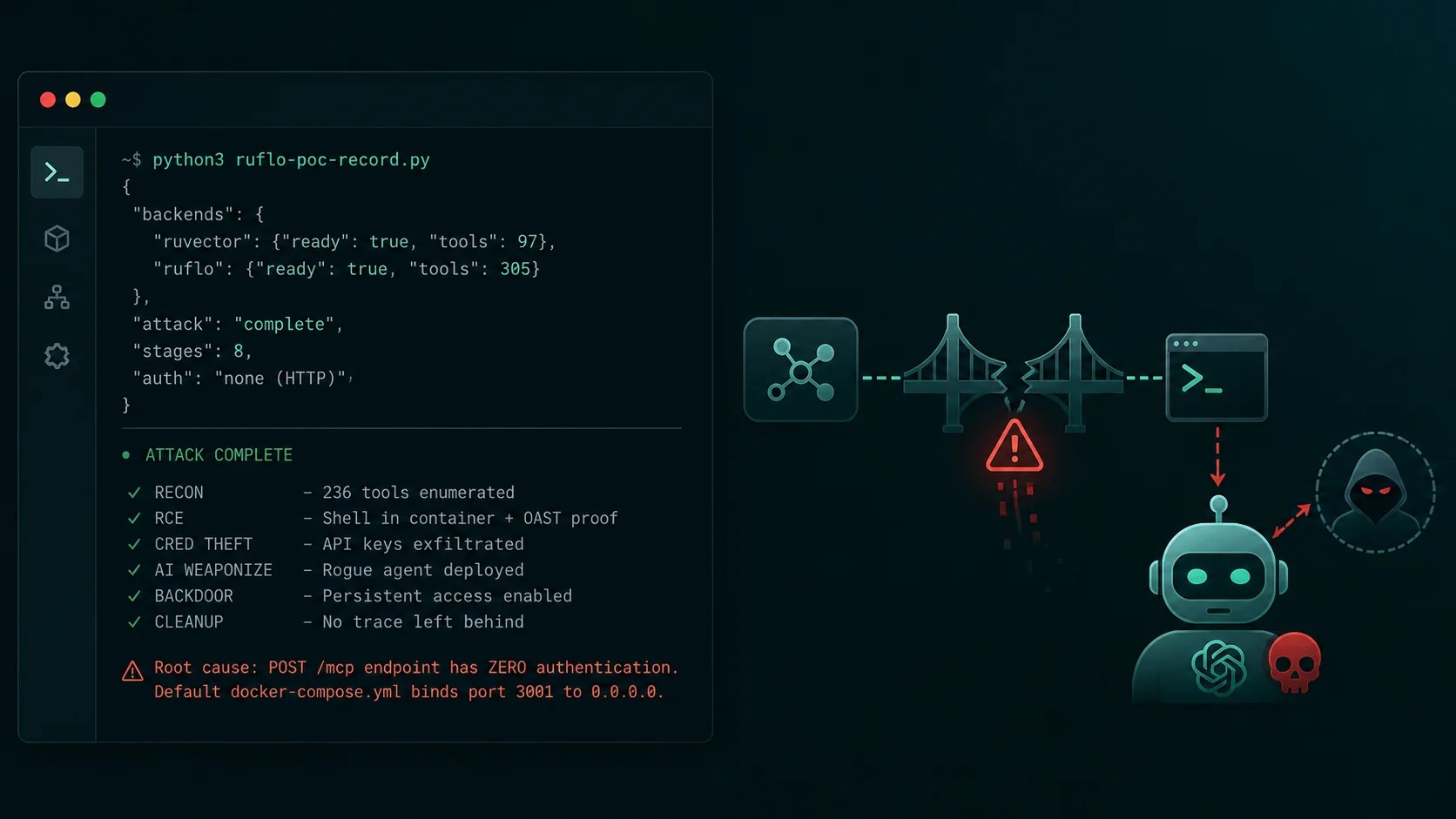
A significant security vulnerability has been identified in Ruflo’s open-source AI orchestration platform, potentially allowing unauthorized users to perform arbitrary command executions and compromise AI agent environments. This flaw has been assigned a maximum CVSS base score of 10.0 and has been tracked as CVE-2026-59726 by the Noma Labs research team.
Understanding the Ruflo MCP Bridge Vulnerability
Ruflo, a rapidly expanding AI orchestration platform with over 67,000 stars on GitHub and approximately 1 million active users, is affected by this vulnerability. The issue resides in Ruflo’s Model Context Protocol (MCP) Bridge, a crucial component that manages tool execution across AI workflows. The bridge, implemented as an Express.js server, exposes over 233 tools via HTTP, including functionalities for shell execution and database interaction, but lacks default authentication controls.
The flaw arises from the MCP Bridge being publicly accessible on port 3001, often configured to bind to all network interfaces (0.0.0.0) in standard Docker deployments. This configuration enables attackers to execute arbitrary commands through a crafted HTTP POST request to the /mcp endpoint, bypassing the need for API keys, tokens, or session validation.
Exploitation Risks and Consequences
Exploiting this vulnerability allows attackers to perform a range of malicious activities, leveraging the trust boundary of the MCP Bridge. Attackers can exfiltrate sensitive credentials from environment variables, use them to hijack AI swarms, and inject harmful patterns into Ruflo’s persistent memory, AgentDB, affecting future AI outputs.
The vulnerability also leaves Ruflo’s internal MongoDB instances vulnerable, allowing attackers to query and extract conversation histories, system prompts, and metadata without authentication. These actions mirror risks seen in other API connection vulnerabilities where unauthenticated endpoints compromise system integrity.
Mitigation and Security Measures
In response to the vulnerability’s disclosure on June 30, 2026, Ruflo’s development team swiftly released a security patch (GHSA-c4hm-4h84-2cf3). The patch includes several critical measures: enforced token-based authentication for all MCP endpoints, default restriction of MCP Bridge exposure to localhost, disabling of terminal execution unless enabled by an administrator, and mandatory authentication for MongoDB instances.
Security professionals are advised to review and update their deployment models to enhance API security, limit access to the affected ports, rotate all provider API keys, and audit AI memory stores for unauthorized changes.
This incident highlights the risks associated with rapid AI deployment without adequate security oversight, especially in environments where high-privilege orchestration platforms are used. Organizations deploying Ruflo should ensure robust security practices are in place to protect against such vulnerabilities.