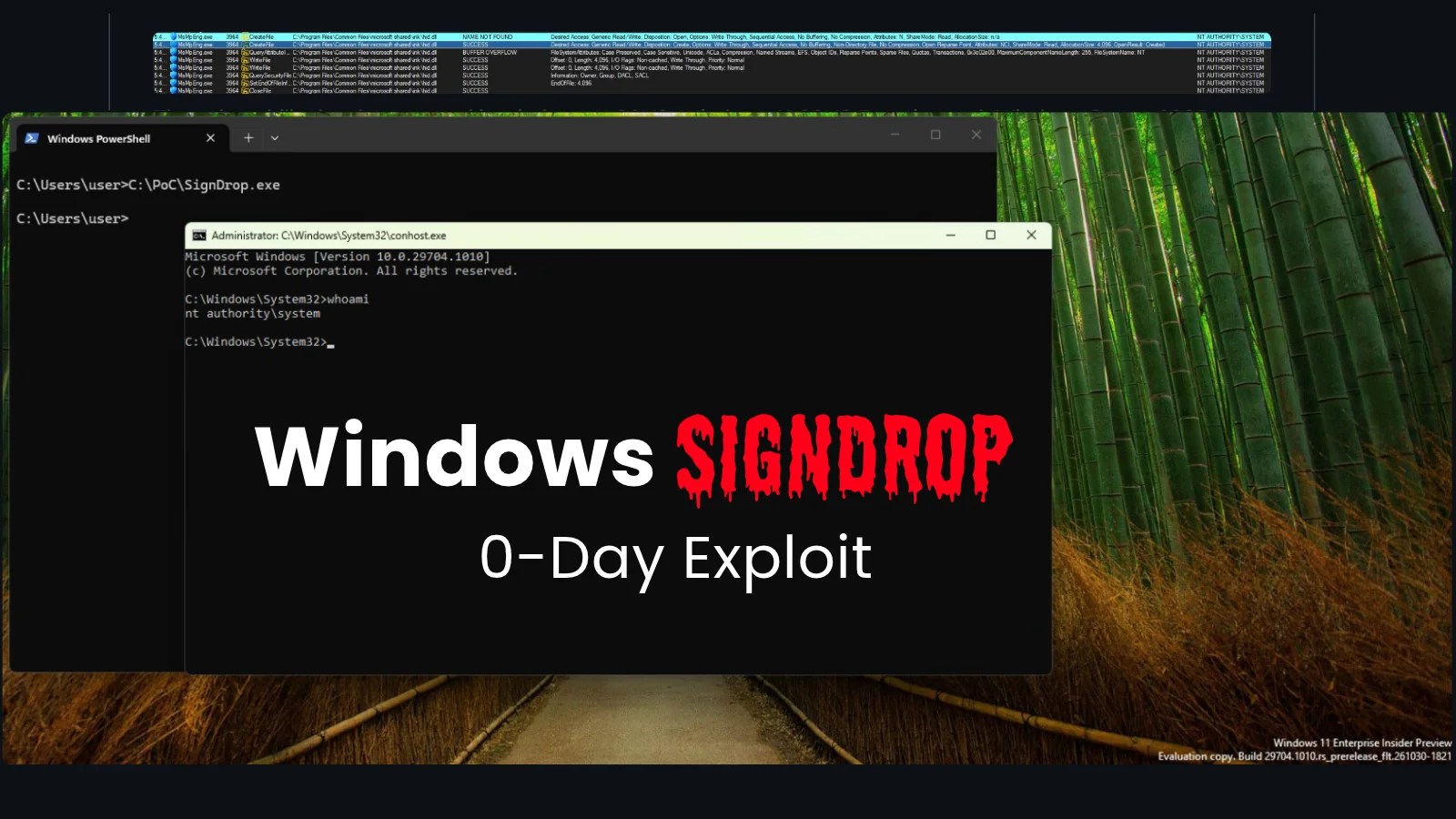
An alarming exploit, known as SignDrop, has emerged, targeting a security feature in Windows designed to protect the Common Log File System (CLFS). This exploit reportedly allows an attacker to elevate a standard user account to a SYSTEM account, which holds the highest level of control on Windows systems.
Unpatched Zero-Day Exploit Raises Concerns
As of November 11, 2026, the vulnerability remains without a CVE number or a patch. Microsoft has yet to confirm the existence of this exploit, which adds to the urgency of the situation.
The exploit was publicly disclosed by a researcher identified as MSNightmare, also known as Nightmare Eclipse, who shared a proof-of-concept on GitHub on November 10, 2026. The researcher is known for releasing Windows exploits, and was previously banned from GitHub, with GitLab suspending their account earlier this year.
Technical Details of the Exploit
The exploit is found in the clfs.sys kernel driver, responsible for CLFS operations. It manipulates the way a “.cnpf” authentication file is created when a new log file is generated via the exposed CLFS device. The attack leverages symbolic links and file timing to manipulate a high-privilege Windows Defender process into creating files in restricted areas.
CLFS has historically been a target because it manages complex log files within the kernel. Errors in this process can cause memory corruption, leading to privilege escalation. Microsoft has attempted to mitigate risks by implementing a hash-based message authentication code (HMAC) in CLFS, requiring a match for file access.
Potential Impact and Mitigation Strategies
MSNightmare claims that the vulnerability affects systems in both learning and enforcement modes of CLFS, potentially impacting systems older than 90 days. Estimates suggest that approximately 80% of Windows installations could be vulnerable, though this figure lacks precise measurement.
It’s important to note that SignDrop is a local privilege escalation vulnerability, necessitating prior code execution on the target machine. It cannot independently breach a system from the internet. Tests conducted on Windows 11 26H2 and Windows Server 2025 indicated that disabling CLFS authentication negates the exploit, though doing so is not advised.
Security experts recommend maintaining CLFS authentication enabled and limiting code execution capabilities on critical systems. Monitoring for unusual file creation activities by Defender or other privileged processes is also advisable. Administrators should be vigilant for unexpected CLFS error codes such as ERROR_LOG_METADATA_CORRUPT.
While SignDrop presents a serious threat, it remains unconfirmed. Microsoft is expected to investigate, and any potential fix would likely be included in a future Patch Tuesday update. In the meantime, keeping Windows systems updated and maintaining strict account controls are crucial steps in mitigating this risk.