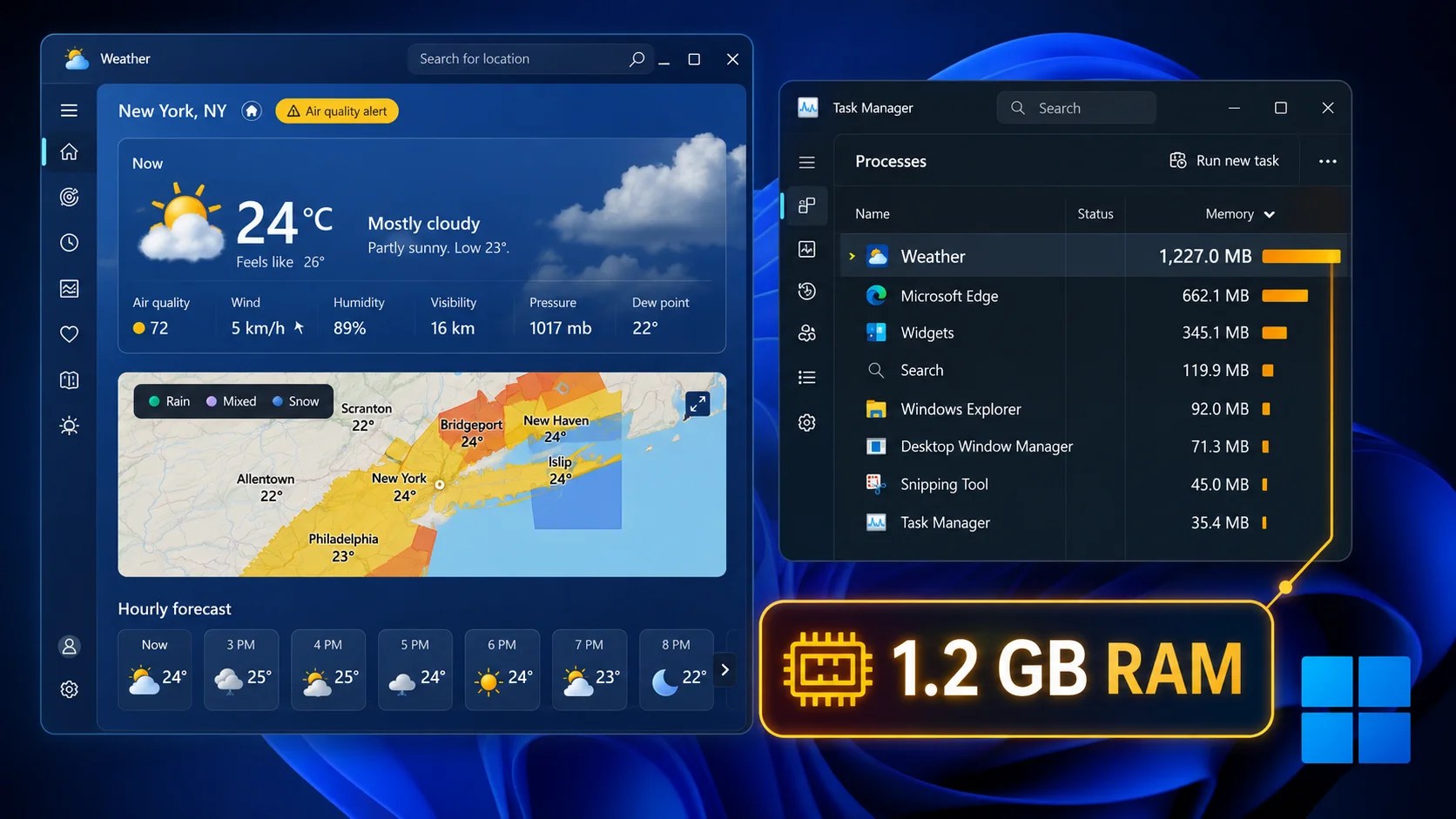
The built-in Weather app on Windows 11, regularly accessed via the taskbar, has come under scrutiny due to its excessive memory usage. Recent reports indicate that the app can consume over 1.2GB of RAM merely to display weather forecasts and maps.
Understanding the App’s High Memory Consumption
Initial reports from Windows Latest, supported by Wccftech and Notebookcheck, highlight a significant contradiction. Despite Microsoft’s assurances of enhanced memory efficiency with Windows 11, especially for 8GB systems, the Weather app appears to undermine these promises. The app is, in essence, MSN Weather repackaged within Microsoft’s WebView2 framework, which utilizes the Chromium engine, similar to Microsoft Edge.
When users examine the app’s process tree in Task Manager, they discover nine distinct Chromium-based sub-processes running concurrently. This extensive use of resources transforms a simple operation like checking the weather into a full-fledged browser session in the background.
Comparisons and Implications for Users
Windows Latest documented the app’s resource consumption as exceeding 1.2GB shortly after launching, even without intensive user interaction. Further testing showed memory usage stabilizing between 500-600MB when idle, spiking to 1.5GB when navigating maps or forecasts. Such resource demands are particularly concerning on 8GB systems, where the app can significantly hinder multitasking, especially on budget laptops prevalent in markets like India.
Comparisons with Apple’s macOS Weather app exacerbate the issue. Apple’s native application reportedly uses only 246.7MB of memory, roughly one-fifth of what Windows requires. Unlike the Windows app, Apple’s version is a fully native macOS application and is ad-free, contrasting with the ad-supported, resource-intensive Windows equivalent.
Microsoft’s Response and User Alternatives
Microsoft’s current situation is challenging, as the company has pledged to optimize Windows 11 for improved performance on devices with 8GB and 16GB of RAM through future updates. Reports suggest that Microsoft plans to transition the Weather app to a more native architecture, potentially by 2026, in a bid to enhance efficiency.
In the interim, users with limited hardware resources are advised to either disable the Weather widget within Windows 11 settings or uninstall it entirely. Many users have already switched to more lightweight weather apps available on the Microsoft Store to avoid the high memory overhead.
Until Microsoft provides a native solution, the Weather app serves as a reminder of how legacy web-wrapper designs can detract from an operating system’s performance objectives.