A longstanding security flaw in the Linux Kernel-based Virtual Machine (KVM), identified as CVE-2026-53359 and named “Januscape,” has been revealed. This vulnerability enables a malicious virtual guest to compromise the host’s kernel memory, threatening the core isolation principles of virtualization.
The Nature of the Vulnerability
The flaw, undetected for close to 16 years, affects the shadow memory management of KVM’s x86 architecture, impacting both Intel and AMD systems. The issue is located within KVM’s shadow Memory Management Unit (MMU), especially in its handling of nested virtualization scenarios.
In typical setups, hardware-assisted paging like Intel EPT or AMD NPT is utilized; however, KVM reverts to shadow paging when a guest hypervisor (L1) runs an additional nested guest (L2). In such cases, the host (L0) must emulate second-level address translation in software, exposing vulnerabilities in the process.
Technical Details and Implications
The crux of Januscape lies in a logic error within the function that retrieves shadow page structures. The implementation erroneously reuses a shadow page based on a matching guest frame number (GFN) without properly verifying the page’s role. Shadow pages in KVM can signify various translation contexts, such as direct mappings or page table shadows. Incorrect reuse can lead to memory tracking inconsistencies, undermining KVM’s reverse mapping (rmap) system.
Over time, this inconsistency may cause a use-after-free condition, where a freed shadow page remains referenced. If the kernel later accesses this page, it could write to memory already allocated for another purpose, leading to kernel memory corruption.
Exploitation and Mitigation
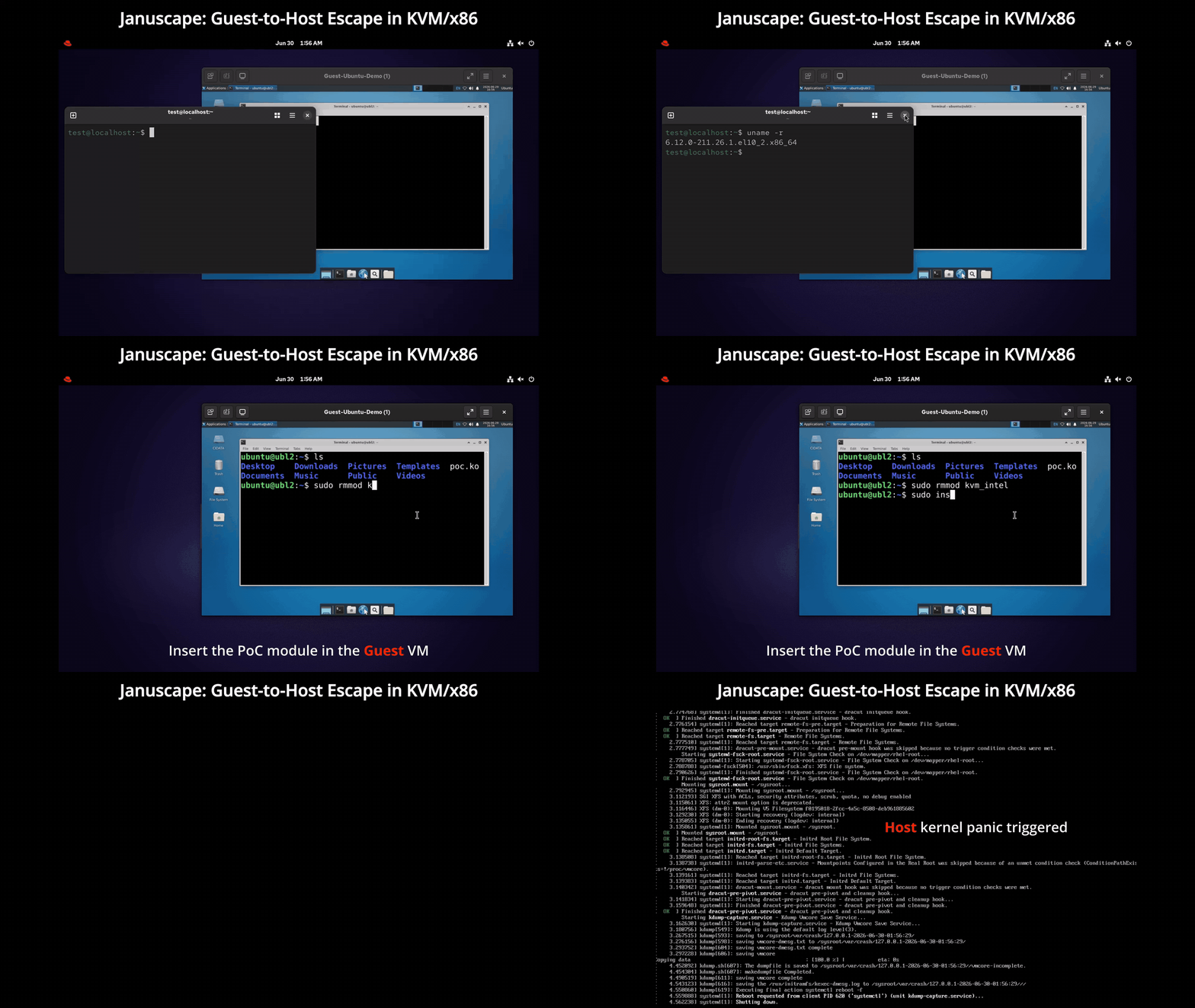
A proof-of-concept has demonstrated a denial-of-service (DoS) attack through orchestrated nested page table operations within a guest. This triggers memory corruption detected by KVM’s integrity checks, resulting in a host kernel panic and system crash. Systems with strict corruption checks, like those using CONFIG_BUG_ON_DATA_CORRUPTION, experience immediate crashes.
More alarmingly, researchers verified that the flaw could enable a full guest-to-host escape, potentially granting attackers root-level code execution on the host. This poses a significant risk in cloud environments like AWS or Google Cloud, where untrusted guests might utilize nested virtualization.
The vulnerability’s shared x86 KVM code makes it cross-architecture, affecting both Intel (VMX) and AMD (SVM) platforms. A GitHub proof-of-concept demonstrates the exploit’s reliability across these architectures. The vulnerability was actively exploited as a zero-day in Google’s kvmCTF before its public disclosure.
Response and Recommendations
Following responsible disclosure in June 2026, a patch was promptly developed and integrated into the Linux kernel. This update ensures shadow pages are reused only when both the guest frame number and page role match, resolving the root cause of the vulnerability.
Organizations using KVM-based virtualization are urged to apply this patch immediately. Systems allowing nested virtualization to guest users are particularly vulnerable. Until patched, disabling nested virtualization can reduce exposure.
Januscape highlights the hidden dangers within legacy code paths of trusted infrastructures and underscores how subtle memory-management flaws can compromise even well-established isolation mechanisms.


.webp?ssl=1 "Malware Targets Windows via Deceptive npm Package")