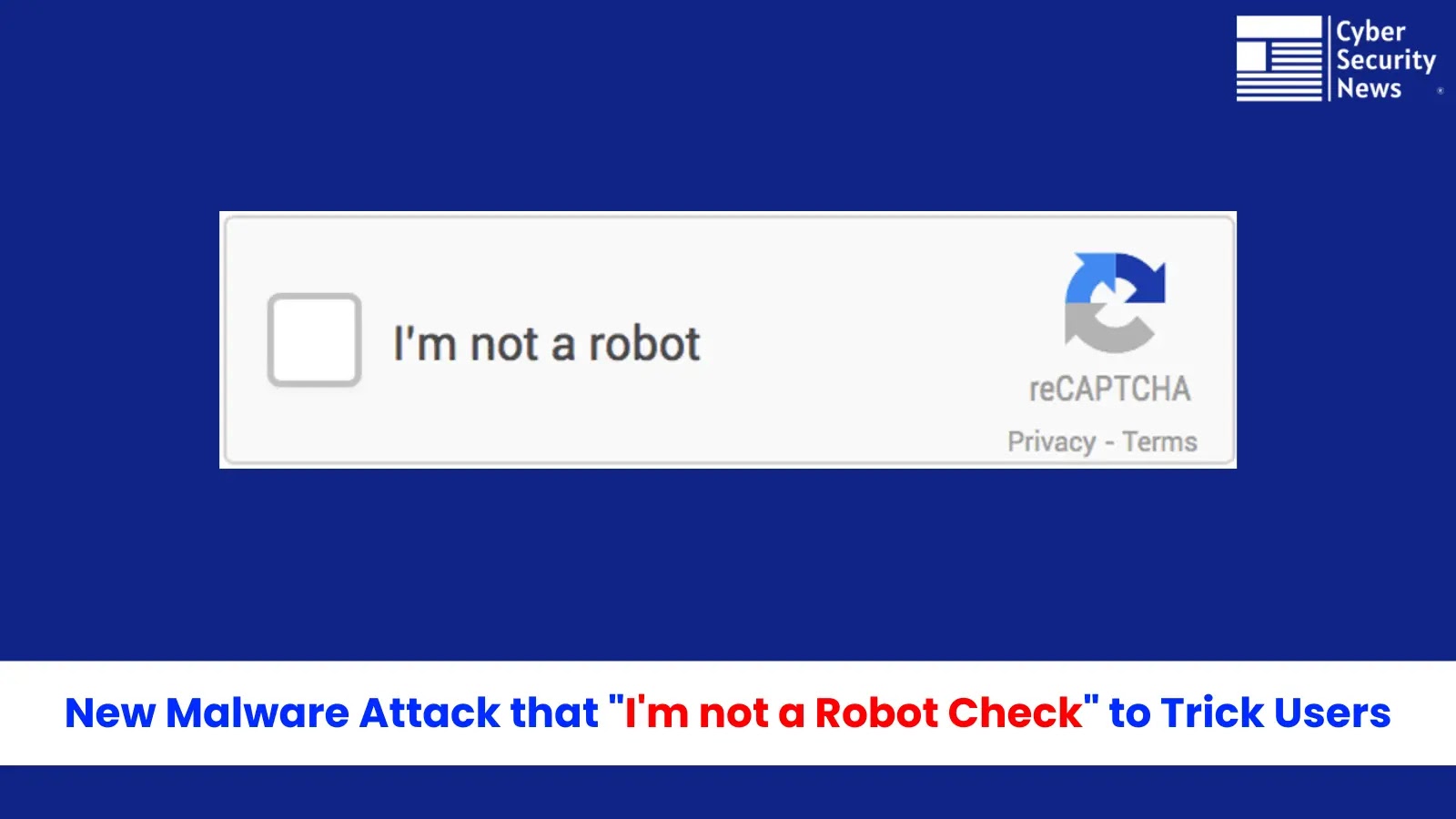
A classy new malware assault vector that manipulates customers via faux browser verification prompts designed to imitate reliable CAPTCHA methods.
This assault leverages social engineering strategies mixed with clipboard manipulation and obfuscated PowerShell instructions to trick victims into voluntarily executing malicious code on their methods.
The marketing campaign represents a big evolution in malware distribution strategies, because it exploits consumer belief in acquainted safety interfaces whereas bypassing conventional antivirus detection mechanisms via its reliance on reliable system instruments and consumer interplay.
How the Misleading Browser Verification Works
Based on Alexander Zammit, the assault begins when customers encounter what seems to be a regular browser safety examine, full with the acquainted “I’m not a robotic” interface that resembles Google’s reCAPTCHA system.
Nonetheless, as an alternative of clicking checkboxes or figuring out pictures, the faux verification immediate instructs customers to carry out a sequence of keyboard shortcuts to “full the browser examine.”
The malicious interface shows three seemingly innocuous steps: urgent Home windows key + R to open the Run dialog, urgent Ctrl + V to stick the clipboard content material, and urgent Enter to execute the command.
This social engineering strategy is especially efficient as a result of it mimics reliable safety processes that customers encounter commonly on-line.
The attackers have rigorously designed the interface to look genuine, utilizing related visible parts and language present in real browser safety checks.
The directions are introduced as obligatory steps to “guarantee optimum expertise,” making the method appear routine somewhat than suspicious.
This psychological manipulation exploits customers’ conditioned responses to safety prompts and their common willingness to adjust to perceived safety necessities.
Technical evaluation reveals that the core of this assault lies in its refined use of clipboard manipulation and PowerShell obfuscation strategies.
When customers go to the malicious website, JavaScript code robotically copies a closely obfuscated PowerShell command to their clipboard with out their information.
The PowerShell payload employs a number of obfuscation layers, together with base64 encoding, string concatenation, and variable substitution to evade static evaluation instruments and antivirus signatures.
The obfuscated command usually incorporates directions to obtain and execute extra malware payloads from distant servers.
Safety analysts have noticed variations that embrace fileless assault strategies, the place the malware operates fully in reminiscence with out writing information to disk, making detection considerably tougher.
The PowerShell execution additionally leverages reliable Home windows processes and providers, permitting the malware to mix seamlessly with regular system operations whereas sustaining persistence mechanisms via registry modifications or scheduled duties.
Safety Methods
Organizations and particular person customers can implement a number of defensive measures towards this assault vector.
Browser safety settings ought to be configured to forestall automated clipboard entry, and customers ought to be educated concerning the reliable look of precise CAPTCHA methods versus these misleading prompts.
Safety consciousness coaching ought to emphasize that reliable browser verification by no means requires customers to execute instructions via the Home windows Run dialog or command immediate.
Endpoint detection and response (EDR) options ought to be configured to watch uncommon PowerShell execution patterns, notably these involving community connections or system modifications.
Community safety home equipment might be programmed to detect the attribute visitors patterns related to these assaults, together with the preliminary payload supply and subsequent command-and-control communications.
Moreover, implementing utility whitelisting and PowerShell execution insurance policies can considerably cut back the assault floor by stopping unauthorized script execution.
Dwell Credential Theft Assault Unmask & On the spot Protection – Free Webinar
.webp?ssl=1 "Turla’s Advanced Espionage Operations in Ukraine Uncovered")